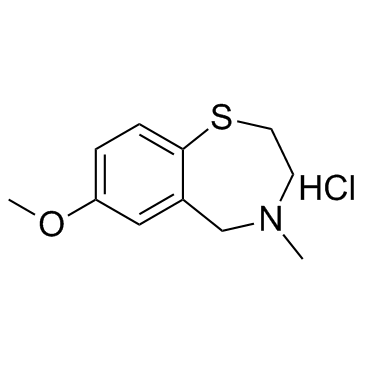
S107 hydrochloride is a novel, potent, and RyR-selective 1,4-benzothiazepine analogue that stabilizes RyR2 channels by increasing the binding affinity of calstabin2 to mutant and/or PKA-phosphorylated channels.
Physicochemical Properties
| Molecular Formula | C11H16CLNOS |
| Molecular Weight | 245.768840789795 |
| Exact Mass | 245.064 |
| CAS # | 1357476-46-0 |
| Related CAS # | 1357476-46-0 |
| PubChem CID | 53311704 |
| Appearance | Solid |
| Hydrogen Bond Donor Count | 1 |
| Hydrogen Bond Acceptor Count | 3 |
| Rotatable Bond Count | 1 |
| Heavy Atom Count | 15 |
| Complexity | 188 |
| Defined Atom Stereocenter Count | 0 |
| InChi Key | PKLKSAHANRLKJK-UHFFFAOYSA-N |
| InChi Code | InChI=1S/C11H15NOS.ClH/c1-12-5-6-14-11-4-3-10(13-2)7-9(11)8-12;/h3-4,7H,5-6,8H2,1-2H3;1H |
| Chemical Name | 7-methoxy-4-methyl-3,5-dihydro-2H-1,4-benzothiazepine;hydrochloride |
| Synonyms | S107; S-107; S 107 |
| HS Tariff Code | 2934.99.9001 |
| Storage |
Powder-20°C 3 years 4°C 2 years In solvent -80°C 6 months -20°C 1 month |
| Shipping Condition | Room temperature (This product is stable at ambient temperature for a few days during ordinary shipping and time spent in Customs) |
Biological Activity
| Targets |
RyR2/FKBP12.6 complex Ryanodine receptor 2 (RyR2) – stabilizes the channel by enhancing calstabin2 (FKBP12.6) binding to mutant or PKA-phosphorylated RyR2, thereby inhibiting Ca²⁺ leak. [1] |
| ln Vitro |
S107, a novel RyR2-specific compound, inhibits channel leak, stops cardiac arrhythmias, and raises the threshold for seizures while improving the binding of calstabin2 to the mutant Ryr2-R2474S channel.[1] S107 enhances calstabin2 binding to RyR2 at low nanomolar concentrations and does not interact with over 400 receptors, enzymes, and ion channels at concentrations up to 10 μM. It has no effect on voltage-gated Na⁺, K⁺, and Ca²⁺ channels at up to 10 μM, and does not alter normal Ca²⁺ signaling in cells. [1] |
| ln Vivo |
S107 treatment (5 mg/kg/h via subcutaneous osmotic pump for 1 week) prevents stress-induced ventricular arrhythmias and sudden cardiac death in Ryr2-R2474S heterozygous mice. It also raises seizure threshold and reduces seizure severity in the same mouse model. [1] |
| Cell Assay |
Cardiomyocytes from Ryr2-R2474S mice treated with isoproterenol show increased transient inward current (I_Ti) density, which is reduced by pretreatment with S107. Confocal Ca²⁺ imaging shows that S107 reduces abnormal intracellular Ca²⁺ release events and Ca²⁺ spark frequency in cardiomyocytes. [1] |
| Animal Protocol |
S107 was administered via subcutaneous osmotic pump at 5 mg/kg/h for 7 days prior to seizure or arrhythmia induction. For seizure studies, mice were pretreated for 1 week before 4-AP and caffeine challenge. For arrhythmia studies, mice were treated for 1 week before exercise stress testing followed by epinephrine injection. [1] |
| References |
[1]. J Clin Invest. 2008 Jun 2; 118(6): 2230–2245. |
| Additional Infomation |
S107 is a novel, orally available 1,4-benzothiazepine derivative with high RyR2 specificity and no significant off-target effects. It stabilizes leaky RyR2 channels by enhancing calstabin2 binding, preventing Ca²⁺ leak in both heart and brain, thereby inhibiting seizures and cardiac arrhythmias in a mouse model of CPVT. [1] |
Solubility Data
| Solubility (In Vitro) |
Water: ~49 mg/mL (~199.4 mM) Ethanol: ~10 mg/mL (~40.7 mM) DMSO: ~24 mg/mL (~97.7 mM) |
| Solubility (In Vivo) |
Note: Listed below are some common formulations that may be used to formulate products with low water solubility (e.g. < 1 mg/mL), you may test these formulations using a minute amount of products to avoid loss of samples. Injection Formulations (e.g. IP/IV/IM/SC) Injection Formulation 1: DMSO : Tween 80: Saline = 10 : 5 : 85 (i.e. 100 μL DMSO stock solution → 50 μL Tween 80 → 850 μL Saline) *Preparation of saline: Dissolve 0.9 g of sodium chloride in 100 mL ddH ₂ O to obtain a clear solution. Injection Formulation 2: DMSO : PEG300 :Tween 80 : Saline = 10 : 40 : 5 : 45 (i.e. 100 μL DMSO → 400 μLPEG300 → 50 μL Tween 80 → 450 μL Saline) Injection Formulation 3: DMSO : Corn oil = 10 : 90 (i.e. 100 μL DMSO → 900 μL Corn oil) Example: Take the Injection Formulation 3 (DMSO : Corn oil = 10 : 90) as an example, if 1 mL of 2.5 mg/mL working solution is to be prepared, you can take 100 μL 25 mg/mL DMSO stock solution and add to 900 μL corn oil, mix well to obtain a clear or suspension solution (2.5 mg/mL, ready for use in animals). Injection Formulation 4: DMSO : 20% SBE-β-CD in saline = 10 : 90 [i.e. 100 μL DMSO → 900 μL (20% SBE-β-CD in saline)] *Preparation of 20% SBE-β-CD in Saline (4°C,1 week): Dissolve 2 g SBE-β-CD in 10 mL saline to obtain a clear solution. Injection Formulation 5: 2-Hydroxypropyl-β-cyclodextrin : Saline = 50 : 50 (i.e. 500 μL 2-Hydroxypropyl-β-cyclodextrin → 500 μL Saline) Injection Formulation 6: DMSO : PEG300 : castor oil : Saline = 5 : 10 : 20 : 65 (i.e. 50 μL DMSO → 100 μLPEG300 → 200 μL castor oil → 650 μL Saline) Injection Formulation 7: Ethanol : Cremophor : Saline = 10: 10 : 80 (i.e. 100 μL Ethanol → 100 μL Cremophor → 800 μL Saline) Injection Formulation 8: Dissolve in Cremophor/Ethanol (50 : 50), then diluted by Saline Injection Formulation 9: EtOH : Corn oil = 10 : 90 (i.e. 100 μL EtOH → 900 μL Corn oil) Injection Formulation 10: EtOH : PEG300:Tween 80 : Saline = 10 : 40 : 5 : 45 (i.e. 100 μL EtOH → 400 μLPEG300 → 50 μL Tween 80 → 450 μL Saline) Oral Formulations Oral Formulation 1: Suspend in 0.5% CMC Na (carboxymethylcellulose sodium) Oral Formulation 2: Suspend in 0.5% Carboxymethyl cellulose Example: Take the Oral Formulation 1 (Suspend in 0.5% CMC Na) as an example, if 100 mL of 2.5 mg/mL working solution is to be prepared, you can first prepare 0.5% CMC Na solution by measuring 0.5 g CMC Na and dissolve it in 100 mL ddH2O to obtain a clear solution; then add 250 mg of the product to 100 mL 0.5% CMC Na solution, to make the suspension solution (2.5 mg/mL, ready for use in animals). Oral Formulation 3: Dissolved in PEG400 Oral Formulation 4: Suspend in 0.2% Carboxymethyl cellulose Oral Formulation 5: Dissolve in 0.25% Tween 80 and 0.5% Carboxymethyl cellulose Oral Formulation 6: Mixing with food powders Note: Please be aware that the above formulations are for reference only. InvivoChem strongly recommends customers to read literature methods/protocols carefully before determining which formulation you should use for in vivo studies, as different compounds have different solubility properties and have to be formulated differently. (Please use freshly prepared in vivo formulations for optimal results.) |
| Preparing Stock Solutions | 1 mg | 5 mg | 10 mg | |
| 1 mM | 4.0688 mL | 20.3442 mL | 40.6884 mL | |
| 5 mM | 0.8138 mL | 4.0688 mL | 8.1377 mL | |
| 10 mM | 0.4069 mL | 2.0344 mL | 4.0688 mL |