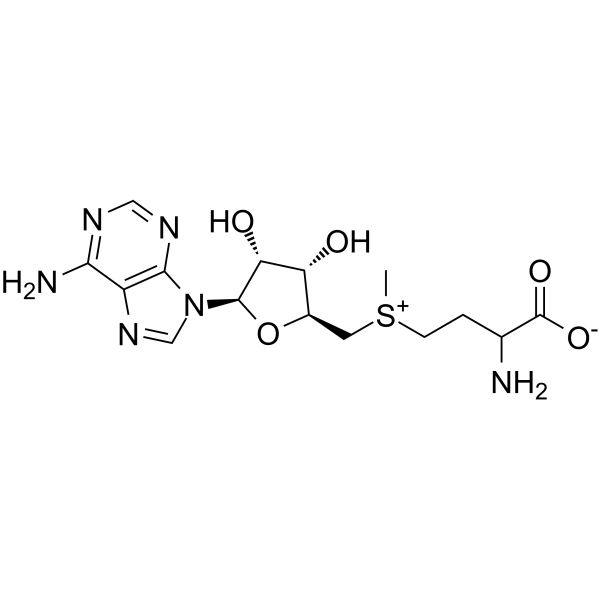
Physicochemical Properties
| Molecular Formula | C₁₅H₂₂N₆O₅S |
| Molecular Weight | 398.44 |
| Exact Mass | 570.156 |
| CAS # | 17176-17-9 |
| Related CAS # | S-Adenosyl-L-methionine tosylate;52248-03-0 |
| PubChem CID | 9865603 |
| Appearance | Off-white to light yellow solid powder |
| LogP | 1.339 |
| Hydrogen Bond Donor Count | 4 |
| Hydrogen Bond Acceptor Count | 10 |
| Rotatable Bond Count | 6 |
| Heavy Atom Count | 27 |
| Complexity | 527 |
| Defined Atom Stereocenter Count | 4 |
| SMILES | C[S+](CCC(C(=O)[O-])N)C[C@@H]1[C@H]([C@H]([C@@H](O1)N2C=NC3=C(N=CN=C32)N)O)O |
| InChi Key | MEFKEPWMEQBLKI-YDBXVIPQSA-N |
| InChi Code | InChI=1S/C15H22N6O5S/c1-27(3-2-7(16)15(24)25)4-8-10(22)11(23)14(26-8)21-6-20-9-12(17)18-5-19-13(9)21/h5-8,10-11,14,22-23H,2-4,16H2,1H3,(H2-,17,18,19,24,25)/t7?,8-,10-,11-,14-,27?/m1/s1 |
| Chemical Name | 2-amino-4-[[(2S,3S,4R,5R)-5-(6-aminopurin-9-yl)-3,4-dihydroxyoxolan-2-yl]methyl-methylsulfonio]butanoate |
| Synonyms | SAdenosylDLmethionine; S-Adenosyl-DL-methionine; 17176-17-9; DTXSID40169160; 2-amino-4-[[(2S,3S,4R,5R)-5-(6-aminopurin-9-yl)-3,4-dihydroxyoxolan-2-yl]methyl-methylsulfonio]butanoate; Ademetionine (INN); Ademetionine [INN]; Adenosine,5'-[(3-amino-3-carboxypropyl)methylsulfonio]-5'-deoxy-, inner salt (9CI); 2-Amino-4-((((2S,3S,4R,5R)-5-(6-amino-9H-purin-9-yl)-3,4-dihydroxytetrahydrofuran-2-yl)methyl)(methyl)sulfonio)butanoate; S Adenosyl DL methionine |
| HS Tariff Code | 2934.99.9001 |
| Storage |
Powder-20°C 3 years 4°C 2 years In solvent -80°C 6 months -20°C 1 month |
| Shipping Condition | Room temperature (This product is stable at ambient temperature for a few days during ordinary shipping and time spent in Customs) |
Biological Activity
| ln Vitro |
1. Metabolic Engineering Strategies: - The literature employed metabolic engineering to modify Saccharomyces cerevisiae, constructing a strain capable of efficiently producing S-adenosyl-L-methionine (SAMe) from DL-methionine. Key modifications included: - Overexpression of the SAM2 gene (encoding a feedback inhibition-insensitive SAM synthase) to enhance SAMe synthesis capacity; - Knockout of ADH1 and ADH4 genes (alcohol dehydrogenases) to reduce carbon source diversion; - Optimization of the DL-methionine transport system to improve precursor utilization. The final engineered strain achieved a SAMe yield of 3.2 g/L in shake-flask culture, a 2.8-fold increase compared to the wild-type strain [1]. 2. Fermentation Condition Optimization: - Using a fed-batch fermentation strategy in a 5 L fermenter with the addition of DL-methionine (50 mM) and an ATP regeneration system (glucose concentration maintained at 20 g/L), the SAMe yield was further increased to 4.7 g/L, with a space-time yield of 0.12 g/(L·h). The purity of SAMe in the fermentation broth was determined by HPLC to be 98.6% [1]. 3. Product Separation and Purification: - Ion exchange chromatography (strongly acidic resin) combined with gel filtration chromatography was used to purify SAMe from the fermentation broth, achieving an overall recovery rate of 78%. The final product met pharmaceutical-grade standards (purity > 99.5%) [1]. |
| References |
[1]. Efficient production of S-adenosyl-L-methionine from DL-methionine in metabolic engineered Saccharomyces cerevisiae. Biotechnology and Bioengineering. 2019. 177, 170-175. |
| Additional Infomation | See also: Ademetionine (annotation moved to). |
Solubility Data
| Solubility (In Vitro) | H2O : ~250 mg/mL (~627.45 mM) |
| Solubility (In Vivo) |
Solubility in Formulation 1: ≥ 2.08 mg/mL (5.22 mM) (saturation unknown) in 10% DMSO + 40% PEG300 + 5% Tween80 + 45% Saline (add these co-solvents sequentially from left to right, and one by one), clear solution. For example, if 1 mL of working solution is to be prepared, you can add 100 μL of 20.8 mg/mL clear DMSO stock solution to 400 μL PEG300 and mix evenly; then add 50 μL Tween-80 to the above solution and mix evenly; then add 450 μL normal saline to adjust the volume to 1 mL. Preparation of saline: Dissolve 0.9 g of sodium chloride in 100 mL ddH₂ O to obtain a clear solution. Solubility in Formulation 2: ≥ 2.08 mg/mL (5.22 mM) (saturation unknown) in 10% DMSO + 90% (20% SBE-β-CD in Saline) (add these co-solvents sequentially from left to right, and one by one), clear solution. For example, if 1 mL of working solution is to be prepared, you can add 100 μL of 20.8 mg/mL clear DMSO stock solution to 900 μL of 20% SBE-β-CD physiological saline solution and mix evenly. Preparation of 20% SBE-β-CD in Saline (4°C,1 week): Dissolve 2 g SBE-β-CD in 10 mL saline to obtain a clear solution. Solubility in Formulation 3: ≥ 2.08 mg/mL (5.22 mM) (saturation unknown) in 10% DMSO + 90% Corn Oil (add these co-solvents sequentially from left to right, and one by one), clear solution. For example, if 1 mL of working solution is to be prepared, you can add 100 μL of 20.8 mg/mL clear DMSO stock solution to 900 μL of corn oil and mix evenly. (Please use freshly prepared in vivo formulations for optimal results.) |
| Preparing Stock Solutions | 1 mg | 5 mg | 10 mg | |
| 1 mM | 2.5098 mL | 12.5489 mL | 25.0979 mL | |
| 5 mM | 0.5020 mL | 2.5098 mL | 5.0196 mL | |
| 10 mM | 0.2510 mL | 1.2549 mL | 2.5098 mL |