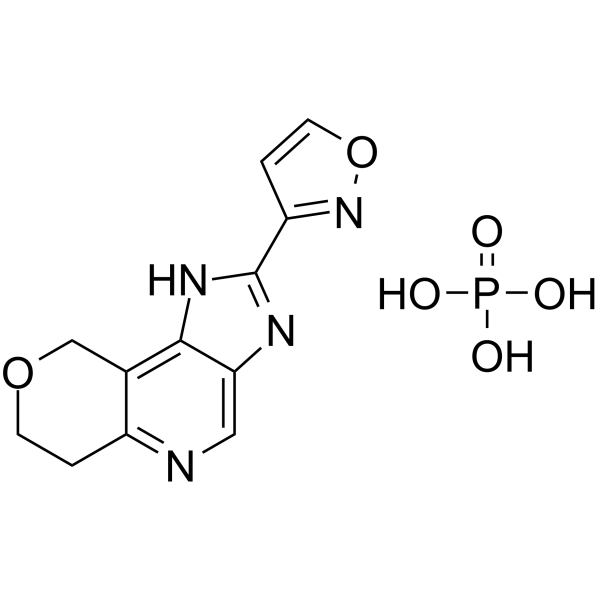
Physicochemical Properties
| Molecular Formula | C12H10N4O2.H3O4P |
| Molecular Weight | 340.22862 |
| Exact Mass | 340.057 |
| CAS # | 151466-23-8 |
| Related CAS # | 151224-83-8;151466-23-8 (phosphate); |
| PubChem CID | 135484551 |
| Appearance | Typically exists as solid at room temperature |
| Boiling Point | 393.4ºC at 760 mmHg |
| Flash Point | 191.7ºC |
| Vapour Pressure | 2.14E-06mmHg at 25°C |
| Hydrogen Bond Donor Count | 4 |
| Hydrogen Bond Acceptor Count | 9 |
| Rotatable Bond Count | 1 |
| Heavy Atom Count | 23 |
| Complexity | 366 |
| Defined Atom Stereocenter Count | 0 |
| SMILES | O=P(O)(O)O.C12=NC=C3C(NC(C4=NOC=C4)=N3)=C1COCC2 |
| InChi Key | SMMFBCMFJOBTLP-UHFFFAOYSA-N |
| InChi Code | InChI=1S/C12H10N4O2.H3O4P/c1-3-17-6-7-8(1)13-5-10-11(7)15-12(14-10)9-2-4-18-16-9;1-5(2,3)4/h2,4-5H,1,3,6H2,(H,14,15);(H3,1,2,3,4) |
| Chemical Name | 4-(1,2-oxazol-3-yl)-12-oxa-3,5,8-triazatricyclo[7.4.0.02,6]trideca-1,3,6,8-tetraene;phosphoric acid |
| HS Tariff Code | 2934.99.9001 |
| Storage |
Powder-20°C 3 years 4°C 2 years In solvent -80°C 6 months -20°C 1 month |
| Shipping Condition | Room temperature (This product is stable at ambient temperature for a few days during ordinary shipping and time spent in Customs) |
Biological Activity
| ln Vitro | S-8510 has strong affinity for BDZ receptors. The ratio of the Ki value of each ligand with and without GABA is defined as the GABA ratio, which is regarded a biological indication of BDZ receptor ligands. The GABA ratio of S-8510 or CGS8216 is close to the value of flumazenil, which is considered an antagonist or a very weak agonist. S-8510 (10-7 M) improves LTP, and this enhancement is antagonized by the BDZ receptor antagonist flumazenil. Flumazenil alone does not impair LTP or elicit a reaction prior to tetanus challenge. S-8510 has no effect on field-evoked potentials up to 10-5 M. However, S-8510 increased the amplitude of population spikes at a dose of 10-4 M, and this action was entirely antagonized by concurrent application of flumazenil (10-4 M) [1]. |
| ln Vivo | Convulsions that are lethal only when S-8510 or CGS8216 are taken in excess of 90 mg/kg of PTZ. S-8510's proconvulsant action seems to be specific to subconvulsive states brought on by PTZ. Scopolamine may have amnestic effects since it decreased the amount of time spent in the vicinity of the platform. S-8510 and CGS8216 counteract amnesia brought on by scopolamine. S-8510 also improves memory impairment caused by diazepam in passive avoidance and water maze paradigms. ACh levels were raised by S-8510 in a dose-dependent manner to 100 mg/kg. Hippocampal extracellular NA levels were raised in a dose-dependent manner by both PTZ and S-8510. The water-licking conflict paradigm was used to investigate the anxiolytic effects of S-8510, CGS8216, and FG7142 in Wistar rats. Even at doses of up to 30 mg/kg, S-8510 and CGS8216 were unable to alter this behavioral trend. S-8510 dramatically shortened the duration of immobility in the forced swim test in ddY mice, with dosages ranging from 40 to 80 mg/kg. At doses more than 10 mg/kg, S-8510 dramatically decreased the degree of tetrabenazine-induced ptosis in the tetrabenazine-induced ptosis mouse. Similarly, imipramine was more successful (reducing ptosis by almost 80% at 20 mg/kg) than S-8510, which only decreased it by 39% even at the maximal dose [1]. |
| References |
[1]. A novel benzodiazepine inverse agonist, S-8510, as a cognitive enhancer. Prog Neuropsychopharmacol Biol Psychiatry. 1996 Nov;20(8):1413-25. |
| Additional Infomation |
S-8510 / SB-737552 is a BZD inverse agonist investigated for the treatment of Alzheimer’s disease and mild to moderate senile dementia. It was being codeveloped by Shionogi and GlaxoSmithKline. Drug Indication Investigated for use/treatment in alzheimer's disease and dementia. Mechanism of Action S-8510 is a BZD partial inverse agonist to the BZD site on the GABA-A receptors in the central nervous system. As an inverse agonist (which as a group elicit CNS effects such as insomnia, agitation, and proconvulsant behaviors), S-8510 functions as a negative modulator of the GABA-A receptor. S-8510, however, is a partial inverse agonist, which means it has a lower affinity for the BZD binding site than do full agonists, and studies in animals have shown that the drug does not induce convulsions or anxiety. |
Solubility Data
| Solubility (In Vitro) | May dissolve in DMSO (in most cases), if not, try other solvents such as H2O, Ethanol, or DMF with a minute amount of products to avoid loss of samples |
| Solubility (In Vivo) |
Note: Listed below are some common formulations that may be used to formulate products with low water solubility (e.g. < 1 mg/mL), you may test these formulations using a minute amount of products to avoid loss of samples. Injection Formulations (e.g. IP/IV/IM/SC) Injection Formulation 1: DMSO : Tween 80: Saline = 10 : 5 : 85 (i.e. 100 μL DMSO stock solution → 50 μL Tween 80 → 850 μL Saline) *Preparation of saline: Dissolve 0.9 g of sodium chloride in 100 mL ddH ₂ O to obtain a clear solution. Injection Formulation 2: DMSO : PEG300 :Tween 80 : Saline = 10 : 40 : 5 : 45 (i.e. 100 μL DMSO → 400 μLPEG300 → 50 μL Tween 80 → 450 μL Saline) Injection Formulation 3: DMSO : Corn oil = 10 : 90 (i.e. 100 μL DMSO → 900 μL Corn oil) Example: Take the Injection Formulation 3 (DMSO : Corn oil = 10 : 90) as an example, if 1 mL of 2.5 mg/mL working solution is to be prepared, you can take 100 μL 25 mg/mL DMSO stock solution and add to 900 μL corn oil, mix well to obtain a clear or suspension solution (2.5 mg/mL, ready for use in animals). Injection Formulation 4: DMSO : 20% SBE-β-CD in saline = 10 : 90 [i.e. 100 μL DMSO → 900 μL (20% SBE-β-CD in saline)] *Preparation of 20% SBE-β-CD in Saline (4°C,1 week): Dissolve 2 g SBE-β-CD in 10 mL saline to obtain a clear solution. Injection Formulation 5: 2-Hydroxypropyl-β-cyclodextrin : Saline = 50 : 50 (i.e. 500 μL 2-Hydroxypropyl-β-cyclodextrin → 500 μL Saline) Injection Formulation 6: DMSO : PEG300 : castor oil : Saline = 5 : 10 : 20 : 65 (i.e. 50 μL DMSO → 100 μLPEG300 → 200 μL castor oil → 650 μL Saline) Injection Formulation 7: Ethanol : Cremophor : Saline = 10: 10 : 80 (i.e. 100 μL Ethanol → 100 μL Cremophor → 800 μL Saline) Injection Formulation 8: Dissolve in Cremophor/Ethanol (50 : 50), then diluted by Saline Injection Formulation 9: EtOH : Corn oil = 10 : 90 (i.e. 100 μL EtOH → 900 μL Corn oil) Injection Formulation 10: EtOH : PEG300:Tween 80 : Saline = 10 : 40 : 5 : 45 (i.e. 100 μL EtOH → 400 μLPEG300 → 50 μL Tween 80 → 450 μL Saline) Oral Formulations Oral Formulation 1: Suspend in 0.5% CMC Na (carboxymethylcellulose sodium) Oral Formulation 2: Suspend in 0.5% Carboxymethyl cellulose Example: Take the Oral Formulation 1 (Suspend in 0.5% CMC Na) as an example, if 100 mL of 2.5 mg/mL working solution is to be prepared, you can first prepare 0.5% CMC Na solution by measuring 0.5 g CMC Na and dissolve it in 100 mL ddH2O to obtain a clear solution; then add 250 mg of the product to 100 mL 0.5% CMC Na solution, to make the suspension solution (2.5 mg/mL, ready for use in animals). Oral Formulation 3: Dissolved in PEG400 Oral Formulation 4: Suspend in 0.2% Carboxymethyl cellulose Oral Formulation 5: Dissolve in 0.25% Tween 80 and 0.5% Carboxymethyl cellulose Oral Formulation 6: Mixing with food powders Note: Please be aware that the above formulations are for reference only. InvivoChem strongly recommends customers to read literature methods/protocols carefully before determining which formulation you should use for in vivo studies, as different compounds have different solubility properties and have to be formulated differently. (Please use freshly prepared in vivo formulations for optimal results.) |
| Preparing Stock Solutions | 1 mg | 5 mg | 10 mg | |
| 1 mM | 2.9392 mL | 14.6959 mL | 29.3919 mL | |
| 5 mM | 0.5878 mL | 2.9392 mL | 5.8784 mL | |
| 10 mM | 0.2939 mL | 1.4696 mL | 2.9392 mL |