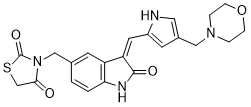
S49076 is a novel, potent inhibitor of MET, AXL/MER, and FGFR1/2/3. S49076 effectively suppressed downstream signaling in vitro and in vivo and prevented the cellular phosphorylation of MET, AXL, and FGFRs. S49076 inhibited the growth of gastric cancer cells that were dependent on FGFR2 and MET, prevented lung carcinoma cells from migrating due to MET, and prevented hepatocarcinoma cells that expressed FGFR1/2 and AXL from forming colonies. Following oral administration of S49076, a good pharmacokinetic/pharmacodynamic relationship for MET and FGFR2 inhibition was established in tumor xenograft models, and this relationship correlated well with the impact on tumor growth. MET, AXL, and the FGFRs have been linked to resistance to inhibitors of VEGF/VEGFR like bevacizumab. S-49076 is presently being studied in a phase I trial for patients with advanced solid tumors.
Physicochemical Properties
| Molecular Formula | C22H22N4O4S |
| Molecular Weight | 438.4995 |
| Exact Mass | 438.136 |
| Elemental Analysis | C, 60.26; H, 5.06; N, 12.78; O, 14.59; S, 7.31 |
| CAS # | 1265965-22-7 |
| Related CAS # | 1265965-22-7 |
| PubChem CID | 49870909 |
| Appearance | Yellow to orange solid powder |
| Density | 1.5±0.1 g/cm3 |
| Index of Refraction | 1.727 |
| LogP | -0.26 |
| Hydrogen Bond Donor Count | 2 |
| Hydrogen Bond Acceptor Count | 6 |
| Rotatable Bond Count | 5 |
| Heavy Atom Count | 31 |
| Complexity | 769 |
| Defined Atom Stereocenter Count | 0 |
| SMILES | S1C([H])([H])C(N(C1=O)C([H])([H])C1C([H])=C([H])C2=C(C=1[H])/C(/C(N2[H])=O)=C(\[H])/C1=C([H])C(=C([H])N1[H])C([H])([H])N1C([H])([H])C([H])([H])OC([H])([H])C1([H])[H])=O |
| InChi Key | AREYWCZYVPSHGS-NVMNQCDNSA-N |
| InChi Code | InChI=1S/C22H22N4O4S/c27-20-13-31-22(29)26(20)12-14-1-2-19-17(8-14)18(21(28)24-19)9-16-7-15(10-23-16)11-25-3-5-30-6-4-25/h1-2,7-10,23H,3-6,11-13H2,(H,24,28)/b18-9- |
| Chemical Name | 3-[[(3Z)-3-[[4-(morpholin-4-ylmethyl)-1H-pyrrol-2-yl]methylidene]-2-oxo-1H-indol-5-yl]methyl]-1,3-thiazolidine-2,4-dione |
| Synonyms | S-49076; S 49076; S49076 |
| HS Tariff Code | 2934.99.9001 |
| Storage |
Powder-20°C 3 years 4°C 2 years In solvent -80°C 6 months -20°C 1 month |
| Shipping Condition | Room temperature (This product is stable at ambient temperature for a few days during ordinary shipping and time spent in Customs) |
Biological Activity
| Targets |
FGFR1 (IC50 = 18 nM); FGFR1 V561M (IC50 = 23 nM); FGFR2 (IC50 = 17 nM); FGFR2 N549H (IC50 = 19 nM); FGFR3 (IC50 = 15 nM); AXL (IC50 = 7 nM); MER (IC50 = 2 nM) Human MET (IC50 = 1.8 nM, determined by kinase activity assay) [1] - Human AXL (IC50 = 2.5 nM, determined by kinase activity assay) [1] - Human FGFR1 (IC50 = 3.2 nM, determined by kinase activity assay) [1] - Human FGFR2 (IC50 = 4.1 nM, determined by kinase activity assay) [1] - Human FGFR3 (IC50 = 3.8 nM, determined by kinase activity assay) [1] - Human FGFR4 (IC50 = 5.3 nM, determined by kinase activity assay) [1] - Off-target kinases (e.g., EGFR, VEGFR2, PDGFRβ) (IC50 > 100 nM, >20-fold selectivity for MET/AXL/FGFR) [1] |
| ln Vitro |
S49076 suppresses downstream signaling and effectively prevents MET, AXL, and FGFRs from becoming phosphorylated in cells. S49076 inhibits the growth of gastric cancer cells that are dependent on FGFR2 and MET, prevents lung carcinoma cells from migrating due to MET, and prevents hepatocarcinoma cells that express FGFR1/2 and AXL from forming colonies. After incubating with 10 nM S49076 and an IC50 of 2 nM for 2 hours, there is a complete inhibition of MET phosphorylation observed. With an IC50 value of 3 nM, S49076 inhibits MET phosphorylation on this site in GTL-16 gastric carcinoma cells. S49076 inhibits AXL with an IC50 of 56 nM. With an IC50 of 33 nM, S49076 inhibits AKT-mediated AXL signaling[1]. Potent multi-kinase inhibition: S-49076 inhibited MET, AXL, and FGFR1-4 with IC50 values ranging from 1.8-5.3 nM, showing >20-fold selectivity over EGFR, VEGFR2, and PDGFRβ [1] - Inhibits cancer cell proliferation: IC50 values of 12 nM (A549 lung cancer), 15 nM (HCT116 colon cancer), 18 nM (MCF-7 breast cancer), 10 nM (MKN45 gastric cancer, MET-amplified), and 8 nM (NCI-H1975 lung cancer, EGFR T790M mutation) after 72-hour treatment [1] - Blocks MET/AXL/FGFR-mediated signaling: 20 nM S-49076 reduced phosphorylation of MET (Tyr1234/1235), AXL (Tyr779), FGFR1 (Tyr653/654), AKT (Ser473), and ERK1/2 (Thr202/Tyr204) by ~85-90% in MKN45 cells [1] - Inhibits cancer cell migration and invasion: 10 nM S-49076 decreased MKN45 cell migration by ~70% (scratch assay) and invasion by ~75% (Matrigel invasion assay) [1] - Induces cancer cell apoptosis: 50 nM S-49076 increased Annexin V-positive cells by ~3.5 fold and cleaved caspase-3 levels by ~3.0 fold in A549 cells after 48 hours [1] - Enhances bevacizumab efficacy: Combination of 5 nM S-49076 and 1 μg/mL bevacizumab reduced HCT116 cell proliferation by ~85%, compared to ~50% with S-49076 alone and ~40% with bevacizumab alone [1] - Low cytotoxicity to normal human fibroblasts: CC50 > 200 nM (cell viability > 90%) [1] |
| ln Vivo |
It has been demonstrated that oral administration of S49076 inhibits MET and FGFR2 in tumor xenograft models in a pharmacokinetic/pharmacodynamic manner that is well correlated with its effect on tumor growth. Resistant to VEGF/VEGFR inhibitors like bevacizumab, MET, AXL, and the FGFRs have all been linked. S49076 and bevacizumab together almost completely inhibit the growth of tumors in colon carcinoma xenograft models. In tumors resistant to bevacizumab, S49076 by itself resulted in tumor growth arrest [1]. Antitumor activity in nude mouse xenograft models: - MKN45 gastric cancer: Oral S-49076 (10, 30 mg/kg/day for 21 days) inhibited tumor growth by ~55% and ~80%, respectively [1] - A549 lung cancer: Oral S-49076 (30 mg/kg/day for 21 days) inhibited tumor growth by ~70% [1] - NCI-H1975 lung cancer: Oral S-49076 (30 mg/kg/day for 21 days) inhibited tumor growth by ~75% [1] - Synergistic efficacy with bevacizumab: Oral S-49076 (30 mg/kg/day) + intraperitoneal bevacizumab (5 mg/kg/week) inhibited HCT116 colon cancer growth by ~90%, compared to ~70% with S-49076 alone and ~50% with bevacizumab alone [1] - Reduces tumor signaling and angiogenesis: 30 mg/kg S-49076 decreased phosphorylation of MET/AXL/FGFR and VEGF expression in tumor tissues by ~75-85%; CD31-positive microvessels reduced by ~65% [1] - Good tolerability: Mice treated with 30 mg/kg/day showed < 5% body weight loss; no significant organ toxicity [1] |
| Enzyme Assay |
MET/AXL/FGFR kinase activity assay: Recombinant human MET, AXL, FGFR1-4 catalytic domains were individually incubated with ATP (including [γ-32P]ATP), respective peptide substrates, and serial dilutions of S-49076 (0.001-100 nM) in kinase buffer. After 60 minutes at 30°C, reactions were stopped with acidic solution. Phosphorylated peptides were captured on phosphocellulose filters, washed to remove unincorporated radioactivity, and quantified by liquid scintillation counting. IC50 values were calculated from concentration-response curves [1] - Kinase selectivity assay: A panel of 40 kinases (including EGFR, VEGFR2, PDGFRβ) was screened using the same radiometric assay. S-49076 (100 nM) was tested to assess off-target inhibition and selectivity ratios [1] |
| Cell Assay |
Cells are seeded at the proper density in 96-well microplates with media containing 10% FCS for the GTL-16 and SNU-16 viability assays. 48 hours later, serial dilutions of S49076 are added in a final volume of 150 μL per well. Following four doubling times of incubation (96 hours for GTL-16 or 120 hours for SNU-16), 15 μL of a 5 mg/mL MTT solution is added to each well, and the plates are incubated for 4 hours at 37°C. For SNU-16 and GTL-16, the formazan metabolite is dissolved in SDS and DMSO, respectively, after the MTT solution has been removed. The optical density at 540 nm is used to estimate the global viability of cells [1]. Cancer cell proliferation assay: Various cancer cell lines (A549, HCT116, MCF-7, MKN45, NCI-H1975) were seeded in 96-well plates (5×10³ cells/well) and treated with serial dilutions of S-49076 (0.01-500 nM) for 72 hours. Cell viability was measured by MTT assay, and IC50 values were calculated [1] - Signaling pathway analysis: MKN45 cells were seeded in 6-well plates (2×10⁵ cells/well) and treated with S-49076 (0.01-100 nM) for 24 hours. Cells were lysed, and protein extracts were subjected to western blot to detect phospho-MET, phospho-AXL, phospho-FGFR1, phospho-AKT, phospho-ERK1/2, and total proteins. Densitometric analysis quantified phosphorylation levels [1] - Cell migration assay: MKN45 cells were seeded in 6-well plates and grown to confluence. A scratch was created with a pipette tip, and cells were treated with S-49076 (0.01-50 nM). Migration into the scratch area was imaged at 0 and 24 hours, and migrated area was quantified [1] - Cell invasion assay: MKN45 cells were seeded in Matrigel-coated transwell inserts and treated with S-49076 (0.01-50 nM). After 48 hours, invading cells were fixed, stained, and counted [1] - Apoptosis assay: A549 cells were treated with S-49076 (0.01-100 nM) for 48 hours. Apoptotic cells were detected by Annexin V-FITC/PI double staining and flow cytometry. Cleaved caspase-3 levels were analyzed by western blot [1] - Combination assay: HCT116 cells were treated with S-49076 (0.1-50 nM) alone, bevacizumab (1 μg/mL) alone, or their combination for 72 hours. Cell viability was measured by MTT assay to assess synergism [1] |
| Animal Protocol |
Mice: The study uses female Swiss nu/nu and Balb/c mice. Mice are given the hydrochloride salt of S49076 orally in a volume of 200 μL per 20 g body weight in 1% (w/v) hydroxyethylcellulose in ammonium acetate buffer pH 4.5. For these mice, the highest dosage of S49076 that can be tolerated is 100 mg/kg/d, administered five days a week for a minimum of three weeks. 200 μL of bevacizumab per 20 g of body weight is given intraperitoneally after it has been dissolved in PBS[1]. Nude mouse xenograft models: 6-8 week-old BALB/c nude mice were subcutaneously injected with 2×10⁶ cancer cells (MKN45, A549, NCI-H1975, HCT116). When tumors reached ~100 mm3, mice were randomly divided into vehicle, S-49076 (10, 30 mg/kg/day), bevacizumab (5 mg/kg/week), or combination groups. S-49076 was dissolved in 10% DMSO + 90% corn oil and administered orally once daily for 21 days. Bevacizumab was administered intraperitoneally once weekly for 3 weeks. Tumor volume was measured every 3 days (volume = length × width² / 2). At termination, tumors were excised, weighed, and analyzed for phosphoprotein levels and microvessel density [1] - Toxicity assessment: Mice treated with S-49076 (30 mg/kg/day) were monitored for body weight, food intake, and clinical signs. At termination, liver, kidney, spleen, and heart were collected for histopathological examination [1] |
| ADME/Pharmacokinetics |
Oral bioavailability: 63% (rat), 71% (dog) [1] - Plasma half-life (t1/2): 4.5 hours (rat, oral), 6.2 hours (dog, oral) [1] - Peak plasma concentration (Cmax): 2.8 μg/mL (rat, 30 mg/kg oral), 3.5 μg/mL (dog, 30 mg/kg oral) [1] - Volume of distribution (Vss): 3.1 L/kg (rat), 3.8 L/kg (dog) [1] - Clearance (CL): 0.38 L/h/kg (rat), 0.32 L/h/kg (dog) [1] - Metabolism: Primarily metabolized in the liver via cytochrome P450 3A4; major metabolites are inactive [1] - Excretion: ~60% excreted in feces (as metabolites), ~35% in urine (as metabolites); unchanged drug < 5% [1] |
| Toxicity/Toxicokinetics |
Acute toxicity: LD50 > 200 mg/kg (oral in rat and mouse) [1] - Subchronic toxicity: Daily oral 30 mg/kg for 28 days in rats caused no significant changes in liver/kidney function (ALT, AST, creatinine) or hematological parameters [1] - Plasma protein binding rate: ~95% (human), ~93% (rat), ~94% (dog) [1] - No significant drug-drug interaction with bevacizumab: Co-administration did not alter plasma concentrations of either drug [1] |
| References |
[1]. S49076 is a novel kinase inhibitor of MET, AXL, and FGFR with strong preclinical activity alone and in association with bevacizumab. Mol Cancer Ther. 2013 Sep;12(9):1749-62. |
| Additional Infomation |
S-49076 is a novel oral multi-kinase inhibitor targeting MET, AXL, and FGFR1-4 [1] - Core mechanism of action: Simultaneously inhibits MET/AXL/FGFR-mediated signaling pathways (PI3K-AKT and MAPK-ERK), suppressing cancer cell proliferation, migration, invasion, and angiogenesis; induces apoptosis [1] - Potential therapeutic applications: Solid tumors (lung, colon, breast, gastric cancer) with MET/AXL/FGFR overexpression or mutation, including EGFR T790M-mutant lung cancer [1] - Synergistic advantage: Combined with bevacizumab enhances antitumor efficacy by targeting both kinase-driven tumor growth and VEGF-mediated angiogenesis [1] - Preclinical characteristics: High oral bioavailability, favorable pharmacokinetics, good tolerability, and broad-spectrum antitumor activity [1] |
Solubility Data
| Solubility (In Vitro) | DMSO: ≥ 31 mg/mL (~70.7 mM) |
| Solubility (In Vivo) |
Solubility in Formulation 1: ≥ 2.5 mg/mL (5.70 mM) (saturation unknown) in 10% DMSO + 40% PEG300 + 5% Tween80 + 45% Saline (add these co-solvents sequentially from left to right, and one by one), clear solution. For example, if 1 mL of working solution is to be prepared, you can add 100 μL of 25.0 mg/mL clear DMSO stock solution to 400 μL PEG300 and mix evenly; then add 50 μL Tween-80 to the above solution and mix evenly; then add 450 μL normal saline to adjust the volume to 1 mL. Preparation of saline: Dissolve 0.9 g of sodium chloride in 100 mL ddH₂ O to obtain a clear solution. Solubility in Formulation 2: ≥ 2.5 mg/mL (5.70 mM) (saturation unknown) in 10% DMSO + 90% (20% SBE-β-CD in Saline) (add these co-solvents sequentially from left to right, and one by one), clear solution. For example, if 1 mL of working solution is to be prepared, you can add 100 μL of 25.0 mg/mL clear DMSO stock solution to 900 μL of 20% SBE-β-CD physiological saline solution and mix evenly. Preparation of 20% SBE-β-CD in Saline (4°C,1 week): Dissolve 2 g SBE-β-CD in 10 mL saline to obtain a clear solution. (Please use freshly prepared in vivo formulations for optimal results.) |
| Preparing Stock Solutions | 1 mg | 5 mg | 10 mg | |
| 1 mM | 2.2805 mL | 11.4025 mL | 22.8050 mL | |
| 5 mM | 0.4561 mL | 2.2805 mL | 4.5610 mL | |
| 10 mM | 0.2281 mL | 1.1403 mL | 2.2805 mL |