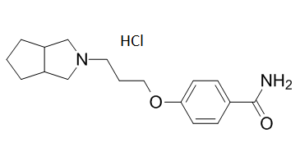
S 38093 is a novel brain-penetrant antagonist (inverse agonist) of the H3 (histamine H3) receptor with Ki of 8.8, 1.44 and 1.2 µM for rat, mouse and human H3 receptors, respectively. It may provide an innovative strategy to improve age-associated cognitive deficits. In cellular models, S 38093 is able to antagonize mice H3 receptors (KB=0.65 µM) and to suppress cAMP decrease induced by an H3 agonist via human H3 receptors (KB=0.11 µM). In cells expressing a high H3 density, S 38093 behaves as a moderate inverse agonist at rat and human H3 receptors (EC50=9 and 1.7 µM, respectively). S 38093, as a novel H3 inverse agonist, is a good candidate for further in vivo evaluations, in particular in animal models of cognition.
Physicochemical Properties
| Molecular Formula | C17H25CLN2O2 | |
| Molecular Weight | 324.85 | |
| Exact Mass | 324.16 | |
| Elemental Analysis | C, 62.86; H, 7.76; Cl, 10.91; N, 8.62; O, 9.85 | |
| CAS # | 1222097-72-4 | |
| Related CAS # | S 38093;862896-30-8 | |
| PubChem CID | 45280145 | |
| Appearance | Solid powder | |
| Hydrogen Bond Donor Count | 2 | |
| Hydrogen Bond Acceptor Count | 3 | |
| Rotatable Bond Count | 6 | |
| Heavy Atom Count | 22 | |
| Complexity | 341 | |
| Defined Atom Stereocenter Count | 0 | |
| SMILES | Cl.O(C1C=CC(C(N)=O)=CC=1)CCCN1CC2CCCC2C1 |
|
| InChi Key | AFSVOZDCVFYWFG-UHFFFAOYSA-N | |
| InChi Code | InChI=1S/C17H24N2O2.ClH/c18-17(20)13-5-7-16(8-6-13)21-10-2-9-19-11-14-3-1-4-15(14)12-19;/h5-8,14-15H,1-4,9-12H2,(H2,18,20);1H | |
| Chemical Name | 4-[3-(3,3a,4,5,6,6a-hexahydro-1H-cyclopenta[c]pyrrol-2-yl)propoxy]benzamide;hydrochloride | |
| Synonyms |
|
|
| HS Tariff Code | 2934.99.9001 | |
| Storage |
Powder-20°C 3 years 4°C 2 years In solvent -80°C 6 months -20°C 1 month |
|
| Shipping Condition | Room temperature (This product is stable at ambient temperature for a few days during ordinary shipping and time spent in Customs) |
Biological Activity
| Targets |
Histamine H3 receptor (Ki: 0.8 nM; IC50 for inverse agonist activity: 3.7 nM; no EC50 values provided) [2] - Histamine H3 receptor [1] |
||
| ln Vitro |
In cell models, S 38093 antagonizes mouse H3 receptors (KB=0.65 µM) and inhibits H3 agonists through human H3 receptors (KB=0.11 µM). In cells expressing high H3 densities, S 38093 functions as a mild inverse agonist at rat and human H3 receptors (EC50 9 µM and 1.7 µM, respectively) [2]. 1. High affinity binding to histamine H3 receptor: S 38093 HCl exhibited potent binding affinity to human, rat, and mouse histamine H3 receptors with Ki values of 0.8 nM, 1.2 nM, and 1.5 nM, respectively [2] 2. Histamine H3 receptor inverse agonist activity: In GTPγS binding assays using rat brain membranes, S 38093 HCl dose-dependently inhibited basal GTPγS binding (a measure of receptor constitutive activity) with an IC50 of 3.7 nM, confirming its inverse agonist property [2] 3. High selectivity for histamine H3 receptor: S 38093 HCl showed no significant binding to histamine H1, H2, or H4 receptors (Ki > 10 μM for all), and no activity against other G protein-coupled receptors (GPCRs) tested (e.g., adrenergic, serotonergic, dopaminergic receptors) at concentrations up to 10 μM [2] 4. Modulation of cyclic AMP (cAMP) levels: In HEK293 cells stably expressing human H3 receptors, S 38093 HCl reversed the inhibitory effect of histamine on forskolin-induced cAMP accumulation in a dose-dependent manner, with an IC50 of 4.2 nM [2] |
||
| ln Vivo |
In the hippocampus DG of young adult mice, 38093 (0.3 and 3 mg/kg/d, oral, 28 days) markedly boosted the proliferation of progenitor cells. The number of DCX+ cells with third-order dendrites was dramatically increased upon treatment with S 38093 (0.3 mg/kg/d). S 38093 (0.3, 1 and/or 3 mg/kg) dramatically enhanced cell proliferation, survival, and maturation in the DG of the hippocampus regions of aged mice as compared to vehicle. Only in APPSWETG mice did S 38093 (3 mg/kg/d, po, 28 days) have a significant effect from 50 to 80. It also boosted dendritic crossing and had a robust effect on cell survival in both genotypes (one-way ANOVA with repeated measures, p < 0.01). Chronic delivery of S 38093 (1 and/or 3 mg/kg/day, po, for 28 days) corrected this age-dependent reduction in the transcripts of BDNF-IX, BDNF-IV, and BDNF-I in elderly mice. Furthermore, in comparison to the vehicle aging group, S 38093 enhanced VEGF transcripts at three tested doses (0.3, 1 and 3 mg/kg/d) [1]. At an oral dose of 3 mg/kg, S 38093 markedly elevated ex vivo N-tele-Mmethylhistamine levels in the mouse brain. A 10 mg/kg intraperitoneal injection can counteract the addictive effects of R-α-methylhistamine [2]. 1. Promotion of hippocampal neurogenesis in aged mice: Oral administration of S 38093 HCl (10 mg/kg/day for 21 days) to 20-month-old C57BL/6 mice significantly increased the number of BrdU-positive (proliferating) cells in the dentate gyrus of the hippocampus by ~65% compared to vehicle-treated mice. It also increased the number of doublecortin (DCX)-positive (neuroblast) cells by ~58% and NeuN/BrdU double-positive (newly differentiated neuron) cells by ~42% [1] 2. Improvement of context discrimination memory in aged mice: Aged mice treated with S 38093 HCl (10 mg/kg/day, p.o., 21 days) showed enhanced performance in the context discrimination task. The discrimination index (a measure of memory accuracy) was increased by ~35% compared to vehicle controls, indicating improved contextual memory [1] 3. Modulation of neurogenic and signaling pathway gene expression: In the hippocampus of aged mice treated with S 38093 HCl, qPCR analysis revealed upregulated expression of genes related to neurogenesis (e.g., Bdnf: ~1.8-fold, Nestin: ~1.5-fold) and CREB signaling (e.g., Creb1: ~1.4-fold, Pcreb: ~1.6-fold) [1] |
||
| Enzyme Assay |
1. Radioligand binding assay for H3 receptor affinity: - Preparation of receptor-containing membranes: Membranes were isolated from rat brain homogenates (enriched in H3 receptors) or HEK293 cells stably expressing human/mouse/rat H3 receptors by differential centrifugation [2] - Binding reaction setup: Membrane preparations were incubated with various concentrations of S 38093 HCl (0.1 nM-1 μM) and a fixed concentration of radiolabeled H3 receptor ligand (e.g., [³H]-Nα-methylhistamine) in binding buffer at 25°C for 60 minutes [2] - Separation and detection: Bound and free radioligand were separated by rapid filtration through glass fiber filters. Filters were washed, and radioactivity was quantified using a liquid scintillation counter. Ki values were calculated using competition binding curves [2] 2. GTPγS binding assay for inverse agonist activity: - Membrane preparation: Rat brain membranes were prepared as described above [2] - Reaction setup: Membranes were incubated with S 38093 HCl (0.1 nM-10 μM) in the presence of GDP (to enhance basal GTPγS binding) and [³⁵S]-GTPγS in assay buffer at 30°C for 90 minutes [2] - Separation and detection: Bound [³⁵S]-GTPγS was separated by filtration, and radioactivity was measured. The percentage inhibition of basal GTPγS binding was calculated, and IC50 values were derived from dose-response curves [2] 3. Cyclic AMP (cAMP) accumulation assay: - Cell preparation: HEK293 cells stably expressing human H3 receptors were seeded into 96-well plates and cultured overnight [2] - Drug treatment: Cells were pretreated with S 38093 HCl (0.1 nM-10 μM) for 30 minutes, followed by incubation with histamine (1 μM) and forskolin (10 μM) for 45 minutes [2] - cAMP detection: Cells were lysed, and cAMP concentration was measured using a competitive ELISA kit. The ability of S 38093 HCl to reverse histamine-induced inhibition of cAMP accumulation was analyzed to determine IC50 [2] |
||
| Cell Assay |
1. Neurogenesis-related gene expression assay (in vitro neural progenitor cells, implied in [1]): - Cell isolation and culture: Neural progenitor cells (NPCs) were isolated from the hippocampus of aged mice, seeded into culture plates, and maintained in neurogenic medium [1] - Drug treatment: NPCs were treated with S 38093 HCl (1 nM-100 nM) for 72 hours [1] - Gene expression detection: Total RNA was extracted, reverse-transcribed into cDNA, and qPCR was performed to measure the expression of neurogenesis-related genes (Bdnf, Nestin) and CREB signaling genes (Creb1, Pcreb). Expression levels were normalized to GAPDH [1] |
||
| Animal Protocol |
|
||
| Toxicity/Toxicokinetics |
1. In vitro toxicity: S 38093 HCl showed no significant cytotoxicity to HEK293 cells (expressing H3 receptors) or primary neural progenitor cells at concentrations up to 1 μM (the maximum concentration used in functional assays) [1, 2] 2. In vivo toxicity: In aged mice treated with S 38093 HCl (10 mg/kg/day, p.o., 21 days), no significant changes in body weight, food intake, or organ weights (brain, liver, kidney) were observed. No signs of acute toxicity (e.g., convulsions, lethargy, abnormal behavior) were recorded during the study [1] |
||
| References |
[1]. S 38093, a histamine H3 antagonist/inverse agonist, promotes hippocampal neurogenesis and improves context discrimination task in aged mice. Sci Rep. 2017 Feb 20;7:42946. [2]. Mechanistic characterization of S 38093, a novel inverse agonist at histamine H3 receptors. Eur J Pharmacol. 2017 May 15;803:11-23. |
||
| Additional Infomation |
1. S 38093 HCl is a novel, highly selective, and potent inverse agonist of the histamine H3 receptor [2] 2. Histamine H3 receptors are predominantly expressed in the central nervous system (CNS), where they regulate neurotransmitter release (e.g., histamine, acetylcholine, glutamate) and neurogenesis. Age-related decline in H3 receptor function is associated with impaired neurogenesis and cognitive deficits [1, 2] 3. The inverse agonist activity of S 38093 HCl is thought to reduce the constitutive activity of H3 receptors, thereby promoting hippocampal neurogenesis and improving contextual memory in aged mice—providing a potential therapeutic strategy for age-related cognitive decline [1] 4. S 38093 HCl exhibits high selectivity for H3 receptors over other histamine receptor subtypes and unrelated GPCRs, minimizing off-target effects [2] |
Solubility Data
| Solubility (In Vitro) |
|
|||
| Solubility (In Vivo) |
Note: Listed below are some common formulations that may be used to formulate products with low water solubility (e.g. < 1 mg/mL), you may test these formulations using a minute amount of products to avoid loss of samples. Injection Formulations (e.g. IP/IV/IM/SC) Injection Formulation 1: DMSO : Tween 80: Saline = 10 : 5 : 85 (i.e. 100 μL DMSO stock solution → 50 μL Tween 80 → 850 μL Saline) *Preparation of saline: Dissolve 0.9 g of sodium chloride in 100 mL ddH ₂ O to obtain a clear solution. Injection Formulation 2: DMSO : PEG300 :Tween 80 : Saline = 10 : 40 : 5 : 45 (i.e. 100 μL DMSO → 400 μLPEG300 → 50 μL Tween 80 → 450 μL Saline) Injection Formulation 3: DMSO : Corn oil = 10 : 90 (i.e. 100 μL DMSO → 900 μL Corn oil) Example: Take the Injection Formulation 3 (DMSO : Corn oil = 10 : 90) as an example, if 1 mL of 2.5 mg/mL working solution is to be prepared, you can take 100 μL 25 mg/mL DMSO stock solution and add to 900 μL corn oil, mix well to obtain a clear or suspension solution (2.5 mg/mL, ready for use in animals). Injection Formulation 4: DMSO : 20% SBE-β-CD in saline = 10 : 90 [i.e. 100 μL DMSO → 900 μL (20% SBE-β-CD in saline)] *Preparation of 20% SBE-β-CD in Saline (4°C,1 week): Dissolve 2 g SBE-β-CD in 10 mL saline to obtain a clear solution. Injection Formulation 5: 2-Hydroxypropyl-β-cyclodextrin : Saline = 50 : 50 (i.e. 500 μL 2-Hydroxypropyl-β-cyclodextrin → 500 μL Saline) Injection Formulation 6: DMSO : PEG300 : castor oil : Saline = 5 : 10 : 20 : 65 (i.e. 50 μL DMSO → 100 μLPEG300 → 200 μL castor oil → 650 μL Saline) Injection Formulation 7: Ethanol : Cremophor : Saline = 10: 10 : 80 (i.e. 100 μL Ethanol → 100 μL Cremophor → 800 μL Saline) Injection Formulation 8: Dissolve in Cremophor/Ethanol (50 : 50), then diluted by Saline Injection Formulation 9: EtOH : Corn oil = 10 : 90 (i.e. 100 μL EtOH → 900 μL Corn oil) Injection Formulation 10: EtOH : PEG300:Tween 80 : Saline = 10 : 40 : 5 : 45 (i.e. 100 μL EtOH → 400 μLPEG300 → 50 μL Tween 80 → 450 μL Saline) Oral Formulations Oral Formulation 1: Suspend in 0.5% CMC Na (carboxymethylcellulose sodium) Oral Formulation 2: Suspend in 0.5% Carboxymethyl cellulose Example: Take the Oral Formulation 1 (Suspend in 0.5% CMC Na) as an example, if 100 mL of 2.5 mg/mL working solution is to be prepared, you can first prepare 0.5% CMC Na solution by measuring 0.5 g CMC Na and dissolve it in 100 mL ddH2O to obtain a clear solution; then add 250 mg of the product to 100 mL 0.5% CMC Na solution, to make the suspension solution (2.5 mg/mL, ready for use in animals). Oral Formulation 3: Dissolved in PEG400 Oral Formulation 4: Suspend in 0.2% Carboxymethyl cellulose Oral Formulation 5: Dissolve in 0.25% Tween 80 and 0.5% Carboxymethyl cellulose Oral Formulation 6: Mixing with food powders Note: Please be aware that the above formulations are for reference only. InvivoChem strongly recommends customers to read literature methods/protocols carefully before determining which formulation you should use for in vivo studies, as different compounds have different solubility properties and have to be formulated differently. (Please use freshly prepared in vivo formulations for optimal results.) |
| Preparing Stock Solutions | 1 mg | 5 mg | 10 mg | |
| 1 mM | 3.0783 mL | 15.3917 mL | 30.7834 mL | |
| 5 mM | 0.6157 mL | 3.0783 mL | 6.1567 mL | |
| 10 mM | 0.3078 mL | 1.5392 mL | 3.0783 mL |