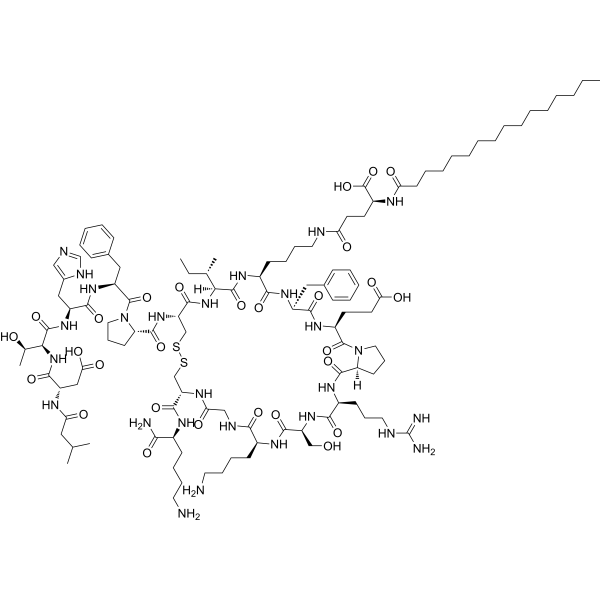
Physicochemical Properties
| Molecular Formula | C114H181N27O28S2 |
| Molecular Weight | 2441.95 |
| Exact Mass | 2441.304 |
| CAS # | 1628323-80-7 |
| PubChem CID | 155884410 |
| Appearance | Solid powder |
| Density | 1.41±0.1 g/cm3(Predicted) |
| LogP | -1.5 |
| Hydrogen Bond Donor Count | 29 |
| Hydrogen Bond Acceptor Count | 34 |
| Rotatable Bond Count | 67 |
| Heavy Atom Count | 171 |
| Complexity | 5090 |
| Defined Atom Stereocenter Count | 19 |
| SMILES | S1C[C@@H](C(N[C@H](C(N[C@@H](CCCCNC(CC[C@@H](C(=O)O)NC(CCCCCCCCCCCCCCC)=O)=O)C(N[C@@H](CC2C=CC=CC=2)C(N[C@@H](CCC(=O)O)C(N2CCC[C@H]2C(N[C@H](C(N[C@H](C(N[C@H](C(NCC(N[C@H](C(N[C@H](C(N)=O)CCCCN)=O)CS1)=O)=O)CCCCN)=O)CO)=O)CCCNC(=N)N)=O)=O)=O)=O)=O)[C@@H](C)CC)=O)NC([C@@H]1CCCN1C([C@H](CC1C=CC=CC=1)NC([C@H](CC1=CNC=N1)NC([C@H]([C@@H](C)O)NC([C@H](CC(=O)O)NC(CC(C)C)=O)=O)=O)=O)=O)=O |
| InChi Key | JRVOBXXOZFTSRF-GVIPULMVSA-N |
| InChi Code | InChI=1S/C114H181N27O28S2/c1-7-9-10-11-12-13-14-15-16-17-18-19-26-46-90(145)125-79(113(168)169)47-49-89(144)121-53-32-29-42-76-99(154)133-80(58-71-36-22-20-23-37-71)101(156)132-78(48-50-93(148)149)111(166)140-55-34-44-87(140)107(162)130-77(43-33-54-122-114(118)119)100(155)136-84(64-142)104(159)129-75(41-28-31-52-116)98(153)123-63-92(147)127-85(105(160)128-74(97(117)152)40-27-30-51-115)65-170-171-66-86(106(161)138-95(69(5)8-2)109(164)131-76)137-108(163)88-45-35-56-141(88)112(167)83(59-72-38-24-21-25-39-72)135-102(157)81(60-73-62-120-67-124-73)134-110(165)96(70(6)143)139-103(158)82(61-94(150)151)126-91(146)57-68(3)4/h20-25,36-39,62,67-70,74-88,95-96,142-143H,7-19,26-35,40-61,63-66,115-116H2,1-6H3,(H2,117,152)(H,120,124)(H,121,144)(H,123,153)(H,125,145)(H,126,146)(H,127,147)(H,128,160)(H,129,159)(H,130,162)(H,131,164)(H,132,156)(H,133,154)(H,134,165)(H,135,157)(H,136,155)(H,137,163)(H,138,161)(H,139,158)(H,148,149)(H,150,151)(H,168,169)(H4,118,119,122)/t69-,70+,74-,75-,76-,77-,78-,79-,80-,81-,82-,83-,84-,85-,86-,87-,88-,95-,96-/m0/s1 |
| Chemical Name | (2S)-5-[4-[(3S,6S,9S,12S,15R,20R,26S,29S,32S,35S)-26-(4-aminobutyl)-6-benzyl-12-[(2S)-butan-2-yl]-32-(3-carbamimidamidopropyl)-3-(2-carboxyethyl)-15-[[(2S)-1-[(2S)-2-[[(2S)-2-[[(2S,3R)-2-[[(2S)-3-carboxy-2-(3-methylbutanoylamino)propanoyl]amino]-3-hydroxybutanoyl]amino]-3-(1H-imidazol-4-yl)propanoyl]amino]-3-phenylpropanoyl]pyrrolidine-2-carbonyl]amino]-20-[[(2S)-1,6-diamino-1-oxohexan-2-yl]carbamoyl]-29-(hydroxymethyl)-2,5,8,11,14,22,25,28,31,34-decaoxo-17,18-dithia-1,4,7,10,13,21,24,27,30,33-decazabicyclo[33.3.0]octatriacontan-9-yl]butylamino]-2-(hexadecanoylamino)-5-oxopentanoic acid |
| Synonyms | PTG-300 |
| HS Tariff Code | 2934.99.9001 |
| Storage |
Powder-20°C 3 years 4°C 2 years In solvent -80°C 6 months -20°C 1 month Note: Please store this product in a sealed and protected environment, avoid exposure to moisture. |
| Shipping Condition | Room temperature (This product is stable at ambient temperature for a few days during ordinary shipping and time spent in Customs) |
Biological Activity
| ln Vivo | Rusfertide limits iron toxicity in red blood cells (RBCs) (1 mg/kg, subcutaneous injection, once every two days for 49 days) and transferrin saturation (2.5 mg/kg, subcutaneous injection, once every two days for 2 weeks), improves the oxygen-carrying capacity of RBCs, and improves anemia and iron deposition in mouse models of β-thalassemia and hereditary hemochromatosis [1]. |
| Animal Protocol |
Animal/Disease Models:Hbbth3/+ mice model for β-thalassemia and hereditary hemochromatosis[1] Doses: 1 and 2.5 mg/kg Route of Administration: s.c., once every two days, for 49 days (1 mg/kg); or for 2 weeks (2.5 mg/kg) Experimental Results: Improved the survival rate of RBCs in β-thalassemia model. Reduced transferrin-saturation and iron deposition. |
| References |
[1]. Regulation of iron homeostasis by PTG-300 improves disease parameters in mouse models for beta-thalassemia and hereditary hemochromatosis[J]. Blood, 2019, 134: 3540. [2]. , PTG-300 eliminates the need for therapeutic phlebotomy in both low and high-risk polycythemia vera patients[J]. Blood, 2020, 136: 33-35. |
| Additional Infomation |
Rusfertide is a hepcidin mimetic currently being developed by Protagonist Therapeutics for the treatment of polycythemia vera and beta-thalassemia. Rusfertide is an injectable peptide mimetic of hepcidin (hepcidin antimicrobial peptide; HAMP; putative liver tumor regressor; PLTR; liver-expressed antimicrobial peptide 1; LEAP-1) with potential use in the treatment of iron deficiency anemia and iron overload secondary to hematologic disorders. Upon administration, rusfertide mimics endogenous hepcidin, a protein primarily produced in hepatocytes, and increases hepcidin levels. As hepcidin plays a key role in the homeostasis of systemic iron, rusfertide may serve to normalize iron levels. Low levels of endogenous hepcidin are associated with iron overload secondary to excessive absorption of iron as seen in beta thalassemia and paradoxically with iron deficiency anemia. Drug Indication Treatment of polycythaemia vera |
Solubility Data
| Solubility (In Vitro) | DMSO : ≥ 100 mg/mL (40.95 mM) |
| Solubility (In Vivo) |
Note: Listed below are some common formulations that may be used to formulate products with low water solubility (e.g. < 1 mg/mL), you may test these formulations using a minute amount of products to avoid loss of samples. Injection Formulations (e.g. IP/IV/IM/SC) Injection Formulation 1: DMSO : Tween 80: Saline = 10 : 5 : 85 (i.e. 100 μL DMSO stock solution → 50 μL Tween 80 → 850 μL Saline) *Preparation of saline: Dissolve 0.9 g of sodium chloride in 100 mL ddH ₂ O to obtain a clear solution. Injection Formulation 2: DMSO : PEG300 :Tween 80 : Saline = 10 : 40 : 5 : 45 (i.e. 100 μL DMSO → 400 μLPEG300 → 50 μL Tween 80 → 450 μL Saline) Injection Formulation 3: DMSO : Corn oil = 10 : 90 (i.e. 100 μL DMSO → 900 μL Corn oil) Example: Take the Injection Formulation 3 (DMSO : Corn oil = 10 : 90) as an example, if 1 mL of 2.5 mg/mL working solution is to be prepared, you can take 100 μL 25 mg/mL DMSO stock solution and add to 900 μL corn oil, mix well to obtain a clear or suspension solution (2.5 mg/mL, ready for use in animals). Injection Formulation 4: DMSO : 20% SBE-β-CD in saline = 10 : 90 [i.e. 100 μL DMSO → 900 μL (20% SBE-β-CD in saline)] *Preparation of 20% SBE-β-CD in Saline (4°C,1 week): Dissolve 2 g SBE-β-CD in 10 mL saline to obtain a clear solution. Injection Formulation 5: 2-Hydroxypropyl-β-cyclodextrin : Saline = 50 : 50 (i.e. 500 μL 2-Hydroxypropyl-β-cyclodextrin → 500 μL Saline) Injection Formulation 6: DMSO : PEG300 : castor oil : Saline = 5 : 10 : 20 : 65 (i.e. 50 μL DMSO → 100 μLPEG300 → 200 μL castor oil → 650 μL Saline) Injection Formulation 7: Ethanol : Cremophor : Saline = 10: 10 : 80 (i.e. 100 μL Ethanol → 100 μL Cremophor → 800 μL Saline) Injection Formulation 8: Dissolve in Cremophor/Ethanol (50 : 50), then diluted by Saline Injection Formulation 9: EtOH : Corn oil = 10 : 90 (i.e. 100 μL EtOH → 900 μL Corn oil) Injection Formulation 10: EtOH : PEG300:Tween 80 : Saline = 10 : 40 : 5 : 45 (i.e. 100 μL EtOH → 400 μLPEG300 → 50 μL Tween 80 → 450 μL Saline) Oral Formulations Oral Formulation 1: Suspend in 0.5% CMC Na (carboxymethylcellulose sodium) Oral Formulation 2: Suspend in 0.5% Carboxymethyl cellulose Example: Take the Oral Formulation 1 (Suspend in 0.5% CMC Na) as an example, if 100 mL of 2.5 mg/mL working solution is to be prepared, you can first prepare 0.5% CMC Na solution by measuring 0.5 g CMC Na and dissolve it in 100 mL ddH2O to obtain a clear solution; then add 250 mg of the product to 100 mL 0.5% CMC Na solution, to make the suspension solution (2.5 mg/mL, ready for use in animals). Oral Formulation 3: Dissolved in PEG400 Oral Formulation 4: Suspend in 0.2% Carboxymethyl cellulose Oral Formulation 5: Dissolve in 0.25% Tween 80 and 0.5% Carboxymethyl cellulose Oral Formulation 6: Mixing with food powders Note: Please be aware that the above formulations are for reference only. InvivoChem strongly recommends customers to read literature methods/protocols carefully before determining which formulation you should use for in vivo studies, as different compounds have different solubility properties and have to be formulated differently. (Please use freshly prepared in vivo formulations for optimal results.) |
| Preparing Stock Solutions | 1 mg | 5 mg | 10 mg | |
| 1 mM | 0.4095 mL | 2.0475 mL | 4.0951 mL | |
| 5 mM | 0.0819 mL | 0.4095 mL | 0.8190 mL | |
| 10 mM | 0.0410 mL | 0.2048 mL | 0.4095 mL |