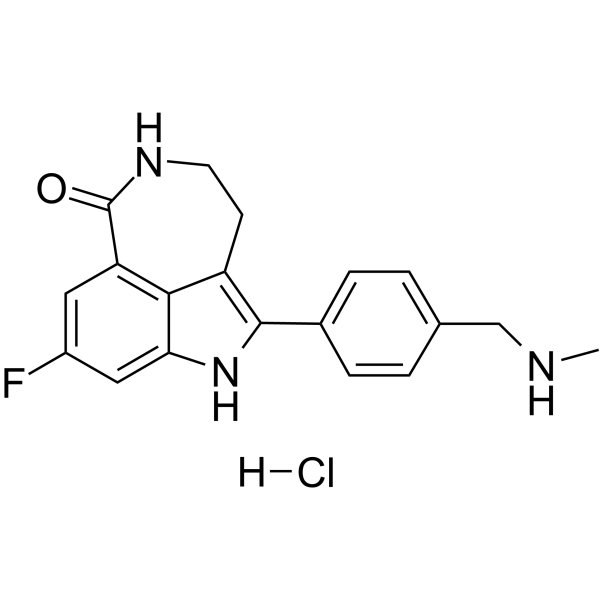
Rucaparib HCl (AG-014699 hydrochloride) is an orally bioactive inhibitor of PARP proteins (PARP-1, PARP-2 and PARP-3) with anticancer activity. It inhibits PARP1 with a Ki of 1.4 nM. Rucaparib is also a modest hexose-6-phosphate dehydrogenase (H6PD) inhibitor.
Physicochemical Properties
| Molecular Formula | C19H19CLFN3O |
| Molecular Weight | 359.82500 |
| Exact Mass | 359.12 |
| CAS # | 773059-19-1 |
| Related CAS # | Rucaparib;283173-50-2 |
| PubChem CID | 69552145 |
| Appearance | Typically exists as solid at room temperature |
| LogP | 4.501 |
| Hydrogen Bond Donor Count | 4 |
| Hydrogen Bond Acceptor Count | 3 |
| Rotatable Bond Count | 3 |
| Heavy Atom Count | 25 |
| Complexity | 466 |
| Defined Atom Stereocenter Count | 0 |
| SMILES | CNCC1=CC=C(C2=C3CCNC(C4C=C(F)C=C(C3=4)N2)=O)C=C1.Cl |
| InChi Key | DUCNHHCHWZPCLT-UHFFFAOYSA-N |
| InChi Code | InChI=1S/C19H18FN3O.ClH/c1-21-10-11-2-4-12(5-3-11)18-14-6-7-22-19(24)15-8-13(20)9-16(23-18)17(14)15;/h2-5,8-9,21,23H,6-7,10H2,1H3,(H,22,24);1H |
| Chemical Name | 6-fluoro-2-[4-(methylaminomethyl)phenyl]-3,10-diazatricyclo[6.4.1.04,13]trideca-1,4,6,8(13)-tetraen-9-one;hydrochloride |
| HS Tariff Code | 2934.99.9001 |
| Storage |
Powder-20°C 3 years 4°C 2 years In solvent -80°C 6 months -20°C 1 month |
| Shipping Condition | Room temperature (This product is stable at ambient temperature for a few days during ordinary shipping and time spent in Customs) |
Biological Activity
| ln Vitro | AG14644 may hydrolyze rutapib (AG014699) as an N-demethylation metabolite[1]. Rucaparib hydrochloride (0.1, 1, 10, 100 μM; 24 hours) is cytotoxic; in Capan-1 (BRCA2 mutant) cells, its LC50 is 5 μM, whereas in MX-1 (BRCA1 mutant) cells, it is only 100 nM[2]. Rucaparib hydrochloride produces radiosensitization independent of SSB repair inhibition because it inhibits NF-κB activation downstream. Without impairing other essential inflammatory functions, rucaparib hydrochloride can target NF-κB that is triggered by DNA damage and circumvent the toxicity seen with standard NF-κB inhibitors[5]. In permeabilized D283Med cells, rucaparib hydrochloride inhibits PARP-1 activity by 97.1% at a dose of 1 μM[6]. |
| ln Vivo | The hydrochloride of rutcaparib (AG014699) and AG14584 greatly increase the toxicity of temozolomide. Temozolomide-induced body weight loss is considerably increased by rucaparib hydrochloride (1 mg/kg). The tumor development delay induced by temozolomide is increased by 50% when rucaparib hydrochloride (0.1 mg/kg) is administered[1]. The tumor is significantly inhibited by rucaparib hydrochloride (10 mg/kg for ip or 50, 150 mg/kg for po; daily for 5 days per week for 6 weeks). One complete tumor remission and two persistent partial regressions are observed[2]. With three full regressions, rucaparib hydrochloride (150 mg/kg; po; once weekly for six weeks or three times weekly for six weeks) exhibits the most anticancer effect[2]. In NB1691 and SHSY5Y xenografts, rucaparib (1 mg/kg; ip; daily for 5d) hydrochloride shows complete and sustained tumor shrinkage and improves the anticancer efficacy of temozolomide[6]. |
| Animal Protocol |
Animal/Disease Models: Female athymic nude mice, implanted SW620 colorectal tumor cells (1 × 10⁷ cells per animal) sc[1] Doses: 0.1 mg/kg in combination with Temozolomide (po, 200 mg/kg), 0.05, 0.15, and 0.5 mg/kg in combination with Temozolomide (po, 68 mg/kg) or 10 mg/ kg Route of Administration: IP, single dose for 0.1 mg/kg and 10 mg/kg, five daily doses for 0-0.5 mg/kg Experimental Results: Dramatically increased Temozolomide toxicity, demonstrated outstanding chemosensitization potency and caused enhancement of Temozolomide-induced tumor growth delay. Animal/Disease Models: CD-1 nude mice bearing established Capan-1 xenografts[2] Doses: 10 mg/kg or 50, 100 and 150 mg/kg Route of Administration: IP for 10 mg/kg; PO for 50, 100 and 150 mg/ kg, single dose (pharmacokinetic/PKs) Experimental Results: Parent drug was detectable in the plasma only at 30 min after 10 mg/kg ip and up to 4 h for 50–150 mg/kg po. Was still detectable in most mice receiving oral rucaparib at 3 days. Does not easily cross the plasma membrane. Animal/Disease Models: CD-1 nude mice beari |
| References |
[1]. Preclinical selection of a novel poly(ADP-ribose) polymerase inhibitor for clinical trial. Mol Cancer Ther, 2007, 6(3), 945-956. [2]. Tumour cell retention of rucaparib, sustained PARP inhibition and efficacy of weekly as well as daily schedules. Br J Cancer. 2014 Apr 15;110(8):1977-84. [3]. Rucaparib: A Review in Ovarian Cancer. Target Oncol. 2019 Apr;14(2):237-246. [4]. Hexose-6-phosphate dehydrogenase blockade reverses prostate cancer drug resistance in xenograft models by glucocorticoid inactivation. Sci Transl Med. 2021 May 26;13(595):eabe8226. [5]. NF-κB mediates radio-sensitization by the PARP-1 inhibitor, AG-014699. Oncogene, 2012, 31(2), 251-264. [6]. Inhibition of poly(ADP-ribose) polymerase-1 enhances temozolomide and topotecan activity against childhood neuroblastoma. Clin Cancer Res, 2009, 15(4), 1241-1249. |
Solubility Data
| Solubility (In Vitro) | May dissolve in DMSO (in most cases), if not, try other solvents such as H2O, Ethanol, or DMF with a minute amount of products to avoid loss of samples |
| Solubility (In Vivo) |
Note: Listed below are some common formulations that may be used to formulate products with low water solubility (e.g. < 1 mg/mL), you may test these formulations using a minute amount of products to avoid loss of samples. Injection Formulations (e.g. IP/IV/IM/SC) Injection Formulation 1: DMSO : Tween 80: Saline = 10 : 5 : 85 (i.e. 100 μL DMSO stock solution → 50 μL Tween 80 → 850 μL Saline) *Preparation of saline: Dissolve 0.9 g of sodium chloride in 100 mL ddH ₂ O to obtain a clear solution. Injection Formulation 2: DMSO : PEG300 :Tween 80 : Saline = 10 : 40 : 5 : 45 (i.e. 100 μL DMSO → 400 μLPEG300 → 50 μL Tween 80 → 450 μL Saline) Injection Formulation 3: DMSO : Corn oil = 10 : 90 (i.e. 100 μL DMSO → 900 μL Corn oil) Example: Take the Injection Formulation 3 (DMSO : Corn oil = 10 : 90) as an example, if 1 mL of 2.5 mg/mL working solution is to be prepared, you can take 100 μL 25 mg/mL DMSO stock solution and add to 900 μL corn oil, mix well to obtain a clear or suspension solution (2.5 mg/mL, ready for use in animals). Injection Formulation 4: DMSO : 20% SBE-β-CD in saline = 10 : 90 [i.e. 100 μL DMSO → 900 μL (20% SBE-β-CD in saline)] *Preparation of 20% SBE-β-CD in Saline (4°C,1 week): Dissolve 2 g SBE-β-CD in 10 mL saline to obtain a clear solution. Injection Formulation 5: 2-Hydroxypropyl-β-cyclodextrin : Saline = 50 : 50 (i.e. 500 μL 2-Hydroxypropyl-β-cyclodextrin → 500 μL Saline) Injection Formulation 6: DMSO : PEG300 : castor oil : Saline = 5 : 10 : 20 : 65 (i.e. 50 μL DMSO → 100 μLPEG300 → 200 μL castor oil → 650 μL Saline) Injection Formulation 7: Ethanol : Cremophor : Saline = 10: 10 : 80 (i.e. 100 μL Ethanol → 100 μL Cremophor → 800 μL Saline) Injection Formulation 8: Dissolve in Cremophor/Ethanol (50 : 50), then diluted by Saline Injection Formulation 9: EtOH : Corn oil = 10 : 90 (i.e. 100 μL EtOH → 900 μL Corn oil) Injection Formulation 10: EtOH : PEG300:Tween 80 : Saline = 10 : 40 : 5 : 45 (i.e. 100 μL EtOH → 400 μLPEG300 → 50 μL Tween 80 → 450 μL Saline) Oral Formulations Oral Formulation 1: Suspend in 0.5% CMC Na (carboxymethylcellulose sodium) Oral Formulation 2: Suspend in 0.5% Carboxymethyl cellulose Example: Take the Oral Formulation 1 (Suspend in 0.5% CMC Na) as an example, if 100 mL of 2.5 mg/mL working solution is to be prepared, you can first prepare 0.5% CMC Na solution by measuring 0.5 g CMC Na and dissolve it in 100 mL ddH2O to obtain a clear solution; then add 250 mg of the product to 100 mL 0.5% CMC Na solution, to make the suspension solution (2.5 mg/mL, ready for use in animals). Oral Formulation 3: Dissolved in PEG400 Oral Formulation 4: Suspend in 0.2% Carboxymethyl cellulose Oral Formulation 5: Dissolve in 0.25% Tween 80 and 0.5% Carboxymethyl cellulose Oral Formulation 6: Mixing with food powders Note: Please be aware that the above formulations are for reference only. InvivoChem strongly recommends customers to read literature methods/protocols carefully before determining which formulation you should use for in vivo studies, as different compounds have different solubility properties and have to be formulated differently. (Please use freshly prepared in vivo formulations for optimal results.) |
| Preparing Stock Solutions | 1 mg | 5 mg | 10 mg | |
| 1 mM | 2.7791 mL | 13.8955 mL | 27.7909 mL | |
| 5 mM | 0.5558 mL | 2.7791 mL | 5.5582 mL | |
| 10 mM | 0.2779 mL | 1.3895 mL | 2.7791 mL |