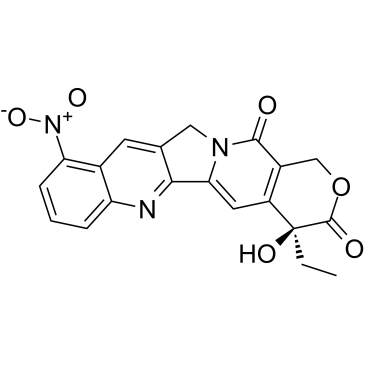
Rubitecan (RFS-2000), a semisynthetic camptothecin analog, is an orally bioactive topoisomerase I inhibitor antitumor and antiviral activity. It inhibits DNA and RNA synthesis in dividing cells, induces protein-linked DNA single-strand breaks, and binds to topoisomerase I. prevents reversible single-strand DNA breaks from being repaired as well.
Physicochemical Properties
| Molecular Formula | C20H15N3O6 |
| Molecular Weight | 393.35 |
| Exact Mass | 393.096 |
| Elemental Analysis | C, 61.07; H, 3.84; N, 10.68; O, 24.40 |
| CAS # | 91421-42-0 |
| PubChem CID | 472335 |
| Appearance | Light yellow to yellow solid powder |
| Density | 1.6±0.1 g/cm3 |
| Boiling Point | 816.3±65.0 °C at 760 mmHg |
| Melting Point | 182-186ºC |
| Flash Point | 447.5±34.3 °C |
| Vapour Pressure | 0.0±3.1 mmHg at 25°C |
| Index of Refraction | 1.762 |
| LogP | 1.38 |
| Hydrogen Bond Donor Count | 1 |
| Hydrogen Bond Acceptor Count | 7 |
| Rotatable Bond Count | 1 |
| Heavy Atom Count | 29 |
| Complexity | 861 |
| Defined Atom Stereocenter Count | 1 |
| SMILES | O=C1C2COC([C@](C=2C=C2C3N=C4C=CC=C(C4=CC=3CN12)[N+](=O)[O-])(O)CC)=O |
| InChi Key | VHXNKPBCCMUMSW-FQEVSTJZSA-N |
| InChi Code | InChI=1S/C20H15N3O6/c1-2-20(26)13-7-16-17-10(8-22(16)18(24)12(13)9-29-19(20)25)6-11-14(21-17)4-3-5-15(11)23(27)28/h3-7,26H,2,8-9H2,1H3/t20-/m0/s1 |
| Chemical Name | (19S)-19-ethyl-19-hydroxy-8-nitro-17-oxa-3,13-diazapentacyclo[11.8.0.02,11.04,9.015,20]henicosa-1(21),2,4(9),5,7,10,15(20)-heptaene-14,18-dione |
| Synonyms | 9-nitro-camptothecin; RFS-2000; RFS2000; RFS 2000; 9NC; nitrocamptothecin; 9-nitro-CPT; trade names: Camptogen; Orathecin |
| HS Tariff Code | 2934.99.9001 |
| Storage |
Powder-20°C 3 years 4°C 2 years In solvent -80°C 6 months -20°C 1 month |
| Shipping Condition | Room temperature (This product is stable at ambient temperature for a few days during ordinary shipping and time spent in Customs) |
Biological Activity
| Targets | Topoisomerase I |
| ln Vitro | Rubitecan (RFS 2000) suppresses CCL4, U-CH1, and U-CH2 cells with IC50 values of 7.7 µM, 0.83, and 0.32 µM, respectively[4]. |
| References |
[1]. Phase II trial of oral rubitecan in previously treated pancreatic cancer patients. Oncologist. 2005 Mar;10(3):183-90. [2]. Rubitecan: 9-NC, 9-Nitro-20(S)-camptothecin, 9-nitro-camptothecin, 9-nitrocamptothecin, RFS 2000, RFS2000. Drugs R D. 2004;5(5):305-11. [3]. Rubitecan. [4]. Identification of repurposed small molecule drugs for chordoma therapy. Cancer Biol Ther. 2013 Jul;14(7):638-47. |
| Additional Infomation |
Rubitecan is a pyranoindolizinoquinoline that is camptothecin in which the hydrogen at position 9 has been replaced by a nitro group. It is a prodrug for 9-aminocamptothecin. It has a role as an antineoplastic agent, an EC 5.99.1.2 (DNA topoisomerase) inhibitor and a prodrug. It is a pyranoindolizinoquinoline, a C-nitro compound, a semisynthetic derivative, a tertiary alcohol and a delta-lactone. Rubitecan is a semisynthetic agent related to camptothecin with potent antitumor and antiviral properties. Rubitecan binds to and inhibits the enzyme topoisomerase I and induces protein-linked DNA single-strand breaks, thereby blocking DNA and RNA synthesis in dividing cells; this agent also prevents repair of reversible single-strand DNA breaks. (NCI04) Drug Indication Investigated for use/treatment in pancreatic cancer, leukemia (unspecified), melanoma, ovarian cancer, and cancer/tumors (unspecified). Mechanism of Action Rubitecan prevents DNA from unwinding during replication via DNA topoisomerase 1, therefore interfering with tumor growth. |
Solubility Data
| Solubility (In Vitro) | DMSO: 58~62.5 mg/mL (147.5~158.9 mM) |
| Solubility (In Vivo) |
Solubility in Formulation 1: ≥ 2.08 mg/mL (5.29 mM) (saturation unknown) in 10% DMSO + 40% PEG300 +5% Tween-80 + 45% Saline (add these co-solvents sequentially from left to right, and one by one), clear solution. For example, if 1 mL of working solution is to be prepared, you can add 100 μL of 20.8 mg/mL clear DMSO stock solution to 400 μL PEG300 and mix evenly; then add 50 μL Tween-80 + to the above solution and mix evenly; then add 450 μL normal saline to adjust the volume to 1 mL. Preparation of saline: Dissolve 0.9 g of sodium chloride in 100 mL ddH₂ O to obtain a clear solution. (Please use freshly prepared in vivo formulations for optimal results.) |
| Preparing Stock Solutions | 1 mg | 5 mg | 10 mg | |
| 1 mM | 2.5423 mL | 12.7113 mL | 25.4227 mL | |
| 5 mM | 0.5085 mL | 2.5423 mL | 5.0845 mL | |
| 10 mM | 0.2542 mL | 1.2711 mL | 2.5423 mL |