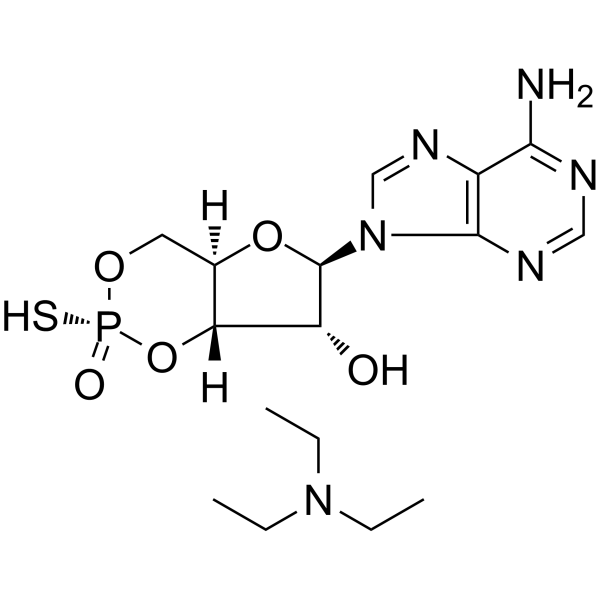
Physicochemical Properties
| Molecular Formula | C₁₆H₂₇N₆O₅PS |
| Molecular Weight | 446.46 |
| Exact Mass | 446.15 |
| CAS # | 151837-09-1 |
| Related CAS # | Sp-cAMPS sodium salt;142439-95-0;Rp-cAMPS sodium salt;142439-94-9;Rp-cAMPS;73208-40-9;Sp-cAMPS;71774-13-5 |
| PubChem CID | 16218857 |
| Appearance | White to off-white solid powder |
| Melting Point | 212 - 213 ℃ |
| LogP | 2.049 |
| Hydrogen Bond Donor Count | 3 |
| Hydrogen Bond Acceptor Count | 11 |
| Rotatable Bond Count | 4 |
| Heavy Atom Count | 29 |
| Complexity | 528 |
| Defined Atom Stereocenter Count | 4 |
| SMILES | CCN(CC)CC.C1[C@@H]2[C@H]([C@H]([C@@H](O2)N3C=NC4=C(N=CN=C43)N)O)OP(=S)(O1)O |
| InChi Key | OXIPZMKSNMRTIV-NVGWRVNNSA-N |
| InChi Code | InChI=1S/C10H12N5O5PS.C6H15N/c11-8-5-9(13-2-12-8)15(3-14-5)10-6(16)7-4(19-10)1-18-21(17,22)20-7;1-4-7(5-2)6-3/h2-4,6-7,10,16H,1H2,(H,17,22)(H2,11,12,13);4-6H2,1-3H3/t4-,6-,7-,10-,21?;/m1./s1 |
| Chemical Name | (4aR,6R,7R,7aS)-6-(6-aminopurin-9-yl)-2-hydroxy-2-sulfanylidene-4a,6,7,7a-tetrahydro-4H-furo[3,2-d][1,3,2]dioxaphosphinin-7-ol;N,N-diethylethanamine |
| Synonyms | RpcAMPS triethylammonium salt; Rp cAMPS triethylammonium salt |
| HS Tariff Code | 2934.99.9001 |
| Storage |
Powder-20°C 3 years 4°C 2 years In solvent -80°C 6 months -20°C 1 month Note: Please store this product in a sealed and protected environment, avoid exposure to moisture. |
| Shipping Condition | Room temperature (This product is stable at ambient temperature for a few days during ordinary shipping and time spent in Customs) |
Biological Activity
| ln Vitro | In order to prevent PKA activation, a membrane-permeable competitive cAMP antagonist (Rp-cAMPS) binds to the regulatory subunit without causing the kinase holoenzyme to dissociate. It has little effect on regular synaptic transmission, but it also suppresses synaptic plasticity [2]. |
| ln Vivo | In slices from arthritic rats, Rp-cAMPS (10 μM, 15 min) decreases monosynaptic EPSCs evoked by PB-CeLC and BLA-CeLC synapses, but not in control neurons from normal animals. When compared to pre-drug (ACSF) control values obtained in the same neurons, the inhibitory effect of Rp-cAMPS was significant [2]. |
| References |
[1]. Inhibitory action of certain cyclophosphate derivatives of cAMP on cAMP-dependent protein kinases. Eur J Biochem. 1984 Jul 16;142(2):255-60. [2]. A mechanistic and kinetic analysis of the interactions of the diastereoisomers of adenosine 3',5'-(cyclic)phosphorothioate with purified cyclic AMP-dependent protein kinase. Biochem J. 1988 May 1;251(3):757-62. [3]. PKA and ERK, but not PKC, in the amygdala contribute to pain-related synaptic plasticity and behavior. Mol Pain. 2008 Jul 16;4:26. [4]. Isoproterenol inhibits rod outer segment phagocytosis by both cAMP-dependent and independent pathways. Invest Ophthalmol Vis Sci. 1995 Mar;36(3):730-6. [5]. Probing the cyclic nucleotide binding sites of cAMP-dependent protein kinases I and II with analogs of adenosine 3',5'-cyclic phosphorothioates. J Biol Chem. 1990 Jun 25;265(18):10484-91. [6]. Competitive cAMP antagonists for cAMP-receptor proteins. J Biol Chem. 1984 Aug 25;259(16):10020-4. |
Solubility Data
| Solubility (In Vitro) | May dissolve in DMSO (in most cases), if not, try other solvents such as H2O, Ethanol, or DMF with a minute amount of products to avoid loss of samples |
| Solubility (In Vivo) |
Note: Listed below are some common formulations that may be used to formulate products with low water solubility (e.g. < 1 mg/mL), you may test these formulations using a minute amount of products to avoid loss of samples. Injection Formulations (e.g. IP/IV/IM/SC) Injection Formulation 1: DMSO : Tween 80: Saline = 10 : 5 : 85 (i.e. 100 μL DMSO stock solution → 50 μL Tween 80 → 850 μL Saline) *Preparation of saline: Dissolve 0.9 g of sodium chloride in 100 mL ddH ₂ O to obtain a clear solution. Injection Formulation 2: DMSO : PEG300 :Tween 80 : Saline = 10 : 40 : 5 : 45 (i.e. 100 μL DMSO → 400 μLPEG300 → 50 μL Tween 80 → 450 μL Saline) Injection Formulation 3: DMSO : Corn oil = 10 : 90 (i.e. 100 μL DMSO → 900 μL Corn oil) Example: Take the Injection Formulation 3 (DMSO : Corn oil = 10 : 90) as an example, if 1 mL of 2.5 mg/mL working solution is to be prepared, you can take 100 μL 25 mg/mL DMSO stock solution and add to 900 μL corn oil, mix well to obtain a clear or suspension solution (2.5 mg/mL, ready for use in animals). Injection Formulation 4: DMSO : 20% SBE-β-CD in saline = 10 : 90 [i.e. 100 μL DMSO → 900 μL (20% SBE-β-CD in saline)] *Preparation of 20% SBE-β-CD in Saline (4°C,1 week): Dissolve 2 g SBE-β-CD in 10 mL saline to obtain a clear solution. Injection Formulation 5: 2-Hydroxypropyl-β-cyclodextrin : Saline = 50 : 50 (i.e. 500 μL 2-Hydroxypropyl-β-cyclodextrin → 500 μL Saline) Injection Formulation 6: DMSO : PEG300 : castor oil : Saline = 5 : 10 : 20 : 65 (i.e. 50 μL DMSO → 100 μLPEG300 → 200 μL castor oil → 650 μL Saline) Injection Formulation 7: Ethanol : Cremophor : Saline = 10: 10 : 80 (i.e. 100 μL Ethanol → 100 μL Cremophor → 800 μL Saline) Injection Formulation 8: Dissolve in Cremophor/Ethanol (50 : 50), then diluted by Saline Injection Formulation 9: EtOH : Corn oil = 10 : 90 (i.e. 100 μL EtOH → 900 μL Corn oil) Injection Formulation 10: EtOH : PEG300:Tween 80 : Saline = 10 : 40 : 5 : 45 (i.e. 100 μL EtOH → 400 μLPEG300 → 50 μL Tween 80 → 450 μL Saline) Oral Formulations Oral Formulation 1: Suspend in 0.5% CMC Na (carboxymethylcellulose sodium) Oral Formulation 2: Suspend in 0.5% Carboxymethyl cellulose Example: Take the Oral Formulation 1 (Suspend in 0.5% CMC Na) as an example, if 100 mL of 2.5 mg/mL working solution is to be prepared, you can first prepare 0.5% CMC Na solution by measuring 0.5 g CMC Na and dissolve it in 100 mL ddH2O to obtain a clear solution; then add 250 mg of the product to 100 mL 0.5% CMC Na solution, to make the suspension solution (2.5 mg/mL, ready for use in animals). Oral Formulation 3: Dissolved in PEG400 Oral Formulation 4: Suspend in 0.2% Carboxymethyl cellulose Oral Formulation 5: Dissolve in 0.25% Tween 80 and 0.5% Carboxymethyl cellulose Oral Formulation 6: Mixing with food powders Note: Please be aware that the above formulations are for reference only. InvivoChem strongly recommends customers to read literature methods/protocols carefully before determining which formulation you should use for in vivo studies, as different compounds have different solubility properties and have to be formulated differently. (Please use freshly prepared in vivo formulations for optimal results.) |
| Preparing Stock Solutions | 1 mg | 5 mg | 10 mg | |
| 1 mM | 2.2398 mL | 11.1992 mL | 22.3984 mL | |
| 5 mM | 0.4480 mL | 2.2398 mL | 4.4797 mL | |
| 10 mM | 0.2240 mL | 1.1199 mL | 2.2398 mL |