Physicochemical Properties
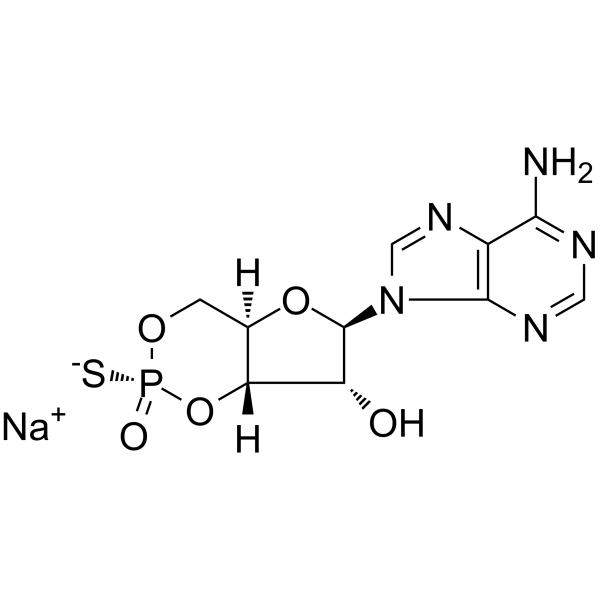
| Molecular Formula | C10H11N5NAO5PS |
| Molecular Weight | 367.25 |
| Exact Mass | 367.011 |
| CAS # | 142439-94-9 |
| Related CAS # | Rp-cAMPS triethylammonium salt;151837-09-1;Sp-cAMPS sodium salt;142439-95-0;Rp-cAMPS;73208-40-9 |
| PubChem CID | 23682235 |
| Appearance | White to pink solid powder |
| Hydrogen Bond Donor Count | 2 |
| Hydrogen Bond Acceptor Count | 10 |
| Rotatable Bond Count | 1 |
| Heavy Atom Count | 23 |
| Complexity | 508 |
| Defined Atom Stereocenter Count | 4 |
| SMILES | C1[C@@H]2[C@H]([C@H]([C@@H](O2)N3C=NC4=C(N=CN=C43)N)O)OP(=S)(O1)[O-].[Na+] |
| InChi Key | YTUKZYORDGLGPR-NVGWRVNNSA-M |
| InChi Code | InChI=1S/C10H12N5O5PS.Na/c11-8-5-9(13-2-12-8)15(3-14-5)10-6(16)7-4(19-10)1-18-21(17,22)20-7;/h2-4,6-7,10,16H,1H2,(H,17,22)(H2,11,12,13);/q;+1/p-1/t4-,6-,7-,10-,21?;/m1./s1 |
| Chemical Name | sodium;(4aR,6R,7R,7aS)-6-(6-aminopurin-9-yl)-2-oxido-2-sulfanylidene-4a,6,7,7a-tetrahydro-4H-furo[3,2-d][1,3,2]dioxaphosphinin-7-ol |
| HS Tariff Code | 2934.99.9001 |
| Storage |
Powder-20°C 3 years 4°C 2 years In solvent -80°C 6 months -20°C 1 month Note: Please store this product in a sealed and protected environment (e.g. under nitrogen), avoid exposure to moisture and light. |
| Shipping Condition | Room temperature (This product is stable at ambient temperature for a few days during ordinary shipping and time spent in Customs) |
Biological Activity
| Targets | Ki: 6.05 µM (PKA I) and 9.75 µM (PKA II)[1] |
| ln Vitro | By attaching to regulatory subunits without dissociating the kinase holoenzyme, a membrane-permeable competitive cAMP antagonist (Rp-cAMPS) inhibits PKA activation and suppresses synaptic plasticity while having no effect on regular synaptic transmission. [2]. |
| ln Vivo | In slices from arthritic rats, monosynaptic EPSCs triggered by PB-CeLC and BLA-CelC synapses are reduced by Rp-cAMPS sodium salt (10 μM, 15 min), but control neurons from normal animals are not affected. When comparing Rp-cAMPS sodium salt's inhibitory impact to pre-drug (ACSF) control values found in the same neurons, a significant difference was seen [2]. |
| References |
[1]. Inhibitory action of certain cyclophosphate derivatives of cAMP on cAMP-dependent protein kinases. Eur J Biochem. 1984 Jul 16;142(2):255-60. [2]. A mechanistic and kinetic analysis of the interactions of the diastereoisomers of adenosine 3',5'-(cyclic)phosphorothioate with purified cyclic AMP-dependent protein kinase. Biochem J. 1988 May 1;251(3):757-62. [3]. PKA and ERK, but not PKC, in the amygdala contribute to pain-related synaptic plasticity and behavior. Mol Pain. 2008 Jul 16;4:26. [4]. Isoproterenol inhibits rod outer segment phagocytosis by both cAMP-dependent and independent pathways. Invest Ophthalmol Vis Sci. 1995 Mar;36(3):730-6. [5]. Probing the cyclic nucleotide binding sites of cAMP-dependent protein kinases I and II with analogs of adenosine 3',5'-cyclic phosphorothioates. J Biol Chem. 1990 Jun 25;265(18):10484-91. [6]. Competitive cAMP antagonists for cAMP-receptor proteins. J Biol Chem. 1984 Aug 25;259(16):10020-4. |
Solubility Data
| Solubility (In Vitro) | H2O: 250 mg/mL (680.74 mM) |
| Solubility (In Vivo) |
Solubility in Formulation 1: 100 mg/mL (272.29 mM) in PBS (add these co-solvents sequentially from left to right, and one by one), clear solution; with sonication. (Please use freshly prepared in vivo formulations for optimal results.) |
| Preparing Stock Solutions | 1 mg | 5 mg | 10 mg | |
| 1 mM | 2.7229 mL | 13.6147 mL | 27.2294 mL | |
| 5 mM | 0.5446 mL | 2.7229 mL | 5.4459 mL | |
| 10 mM | 0.2723 mL | 1.3615 mL | 2.7229 mL |