|
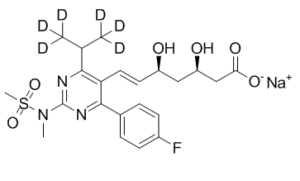
Rosuvastatin D6 Sodium is deuterium labeled Rosuvastatin (also known as S-4522 and ZD 4522, trade name: Crestor) which is a member of the statin class of drugs and a competitive inhibitor of HMG-CoA reductase with IC50 of 11 nM in a cell-free assay. Rosuvastatin belongs to the statin class that is used for the treatment of high cholesterol and related conditions such as dyslipidemia, and to prevent cardiovascular disease. Its approximate elimination half life is 19 h and its time to peak plasma concentration is reached in 3–5 h following oral administration. In 2013 Crestor was the fourth-highest selling drug in the United States, accounting for approx. $5.2 billion in sales.
|
Physicochemical Properties
| Molecular Formula |
C₂₂H₂₁D₆FN₃NAO₆S
|
| Molecular Weight |
509.56
|
| Exact Mass |
509.187
|
| CAS # |
2070009-41-3
|
| Related CAS # |
Rosuvastatin Calcium;147098-20-2;Rosuvastatin Sodium;147098-18-8;Rosuvastatin-d3 sodium;1279031-70-7;Rosuvastatin;287714-41-4;Rosuvastatin-d3;1133429-16-9;Rosuvastatin-d6 calcium
|
| PubChem CID |
71752109
|
| Appearance |
White to off-white solid powder
|
| Hydrogen Bond Donor Count |
2
|
| Hydrogen Bond Acceptor Count |
10
|
| Rotatable Bond Count |
10
|
| Heavy Atom Count |
34
|
| Complexity |
773
|
| Defined Atom Stereocenter Count |
2
|
| SMILES |
S(C)(N(C)C1=NC(C2C=CC(=CC=2)F)=C(/C=C/[C@H](C[C@H](CC(=O)[O-])O)O)C(C(C([2H])([2H])[2H])C([2H])([2H])[2H])=N1)(=O)=O.[Na+]
|
| InChi Key |
RGEBGDYYHAFODH-HPECXWNWSA-M
|
| InChi Code |
InChI=1S/C22H28FN3O6S.Na/c1-13(2)20-18(10-9-16(27)11-17(28)12-19(29)30)21(14-5-7-15(23)8-6-14)25-22(24-20)26(3)33(4,31)32;/h5-10,13,16-17,27-28H,11-12H2,1-4H3,(H,29,30);/q;+1/p-1/b10-9+;/t16-,17-;/m1./s1/i1D3,2D3;
|
| Chemical Name |
|
| Synonyms |
Rosuvastatin: (ZD 4522; ZD-4522; ZD4522; S-4522; S 4522; S4522; Brand name: Crestor).
|
| HS Tariff Code |
2934.99.9001
|
| Storage |
Powder-20°C 3 years
4°C 2 years
In solvent -80°C 6 months
-20°C 1 month
|
| Shipping Condition |
Room temperature (This product is stable at ambient temperature for a few days during ordinary shipping and time spent in Customs)
|
|
Biological Activity
| ln Vitro |
In vitro activity: Rosuvastatin is relatively hydrophilic and is highly selective for hepatic cells; its uptake is mediated by the liver-specific organic anion transporter OATP-C. Rosuvastatin is a high-affinity substrate for OATP-C with apparent association constant of 8.5 μM. Rosuvastatin inhibits cholesterol biosynthesis in rat liver isolated hepatocytes with IC50 of 1.12 nM. Rosuvastatin causes approximately 10 times greater increase of mRNA of LDL receptors than pravastatin. Rosuvastatin (100 μM) decreases the extent of U937 adhesion to TNF-α-stimulated HUVEC. Rosuvastatin inhibits the expressions of ICAM-1, MCP-1, IL-8, IL-6, and COX-2 mRNA and protein levels through inhibition of c-Jun N-terminal kinase and nuclear factor-kB in endothelial cells.
Kinase Assay: Rosuvastatin Calcium is a competitive inhibitor of HMG-CoA reductase with IC50 of 11 nM.
Cell Assay: Rosuvastatin is relatively hydrophilic and is highly selective for hepatic cells; its uptake is mediated by the liver-specific organic anion transporter OATP-C. Rosuvastatin is a high-affinity substrate for OATP-C with apparent association constant of 8.5 μM. Rosuvastatin inhibits cholesterol biosynthesis in rat liver isolated hepatocytes with IC50 of 1.12 nM. Rosuvastatin causes approximately 10 times greater increase of mRNA of LDL receptors than pravastatin. Rosuvastatin (100 μM) decreases the extent of U937 adhesion to TNF-α-stimulated HUVEC. Rosuvastatin inhibits the expressions of ICAM-1, MCP-1, IL-8, IL-6, and COX-2 mRNA and protein levels through inhibition of c-Jun N-terminal kinase and nuclear factor-kB in endothelial cells. |
|
| ln Vivo |
| Rosuvastatin is efficient on reducing plasma liquids. Rosuvastatin (3 mg/kg) daily administration for 14 days decreases plasma cholesterol levels by 26% in male beagle dogs with normal cholesterol levels. In cynomolgus monkeys, Rosuvastatin decreases plasma cholesterol levels by 22% Rosuvastatin (20 mg/kg/day) administration for 2 weeks, significantly reduces very low-density lipoproteins (VLDL) in diabetes mellitus rats induced by Streptozocin. Rosuvastatin shows antiatherothromhotic effects in vivo. Rosuvastatin (1.25 mg/kg) significantly inhibits thrombin-induced transmigration of monocvtes across mesenteric venules via inhibition of the endothelial cell surface expression of P-selectin, and increases the basal rate of nitric oxide in aortic segments by 2-fold times. Rosuvastatin (20 mg/kg) inhibits ROS production, normalizes NO-dependent endothelial function and reduces platelet activation in diabetic rats induced by Streptozocin. Rosuvastatin displays cardioprotective effects in vivo. Rosuvastatin (80 mg) is shows to decrease infarct size and improve cardiac mechanical function after ischemia/reperfusion in animal model. The cardioprotective properties of Rosuvastatin may be due to the improvement of coronary blood flow, decrease in resistance of coronary arteries mediated by enhanced eNOS expression, and the subsequent increase in the production of vascular endothelial NO. Rosuvastatin (2.0 mg/kg) attenuates left ventricular hypertrophy produced by transaortic constriction in mice through regulation of Racl protein and NADPH oxidase activities. |
|
| Animal Protocol |
| 20 mg/kg/day | | Male beagle dogs and Monkey | |
|
| References |
Clin Pharmacol Ther.2004 May;75(5):455-63;Bioorg Med Chem.1997 Feb;5(2):437-44.
|
|
Solubility Data
| Solubility (In Vitro) |
| DMSO: 10 mM | | Water: | | Ethanol: |
|
| Solubility (In Vivo) |
(Please use freshly prepared in vivo formulations for optimal results.)
|
| Preparing Stock Solutions |
|
1 mg |
5 mg |
10 mg |
| 1 mM |
1.9625 mL |
9.8124 mL |
19.6248 mL |
| 5 mM |
0.3925 mL |
1.9625 mL |
3.9250 mL |
| 10 mM |
0.1962 mL |
0.9812 mL |
1.9625 mL |
*Note: Please select an appropriate solvent for the preparation of stock solution based on your experiment needs. For most products, DMSO can be used for preparing stock solutions (e.g. 5 mM, 10 mM, or 20 mM concentration); some products with high aqueous solubility may be dissolved in water directly. Solubility information is available at the above Solubility Data section. Once the stock solution is prepared, aliquot it to routine usage volumes and store at -20°C or -80°C. Avoid repeated freeze and thaw cycles. |