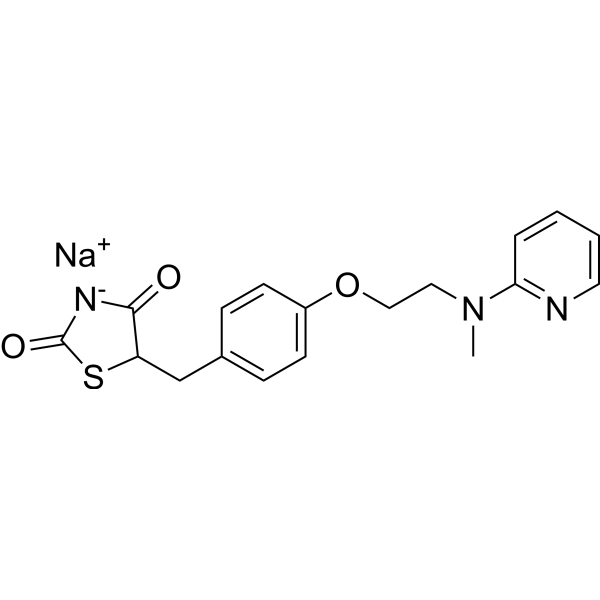
Physicochemical Properties
| Molecular Formula | C18H18N3NAO3S |
| Molecular Weight | 379.41 |
| CAS # | 316371-83-2 |
| Appearance | Typically exists as solids at room temperature |
| SMILES | O=C(N1)SC(CC2=CC=C(OCCN(C)C3=NC=CC=C3)C=C2)C1=O.[Na] |
| Synonyms | Rosiglitazone sodium; BRL 49653 sodium |
| HS Tariff Code | 2934.99.9001 |
| Storage |
Powder-20°C 3 years 4°C 2 years In solvent -80°C 6 months -20°C 1 month |
| Shipping Condition | Room temperature (This product is stable at ambient temperature for a few days during ordinary shipping and time spent in Customs) |
Biological Activity
| Targets | PPARγ1 30 nM (EC50) PPARγ2 100 nM (EC50) |
| ln Vitro | Rosiglitazone sodium is a potent and selective activator of PPARγ, with EC50s of 30 nM and 100 nM for PPARγ1 and PPARγ2, respectively, and a Kd of appr 40 nM for PPARγ. Rosiglitazone (BRL49653, 0.1, 1,10 μM) promotes differentiation of C3H10T1/2 stem cells to adipocytes[1]. Rosiglitazone (Compound 6) activates PPARγ, with an EC50 of 60 nM[2]. Rosiglitazone (1 μM) activates PPARγ, which binds to NF-α1 promoter to activate gene transcription in neurons. Rosiglitazone (1 μM) also protects Neuro2A cells and hippocampal neurons against oxidative stress, and up-regulates BCL-2 expression in an NF-α1-dependent manner[3]. Rosiglitazone completely inhibits TRPM3 with IC50 values of 9.5 and 4.6 μM against nifedipine- and PregS-evoked activity, but such effects are not via PPARγ. Rosiglitazone inhibits TRPM2 at higher concentration, with an IC50 of appr 22.5 μM. Rosiglitazone is a strong stimulator of TRPC5 channels, with an EC50 of ∼30 μM[4]. |
| ln Vivo | Rosiglitazone (5 mg/kg, p.o.) decreases the serum glucose in diabetic rats. Rosiglitazone also decreases IL-6, TNF-α, and VCAM-1 levels in diabetic group. Rosiglitazone in combination with losartan increases glucose compared to diabetic and Los-treated groups. Rosiglitazone significantly ameliorates endothelial dysfunction indicated by a significantly lower contractile response to PE and Ang II and enhancement of ACh-provoked relaxation in aortas isolated from diabetic rats[5]. |
| References |
[1]. An antidiabetic thiazolidinedione is a high affinity ligand for peroxisome proliferator-activated receptor gamma (PPAR gamma). J Biol Chem. 1995 Jun 2;270(22):12953-6. [2]. The structure-activity relationship between peroxisome proliferator-activated receptor gamma agonism and the antihyperglycemic activity of thiazolidinediones. J Med Chem. 1996 Feb 2;39(3):665-8. [3]. Rosiglitazone-activated PPARγ induces neurotrophic factor-α1 transcription contributing to neuroprotection. J Neurochem. 2015 Aug;134(3):463-70. [4]. Rapid and contrasting effects of rosiglitazone on transient receptor potential TRPM3 and TRPC5 channels. Mol Pharmacol. 2011 Jun;79(6):1023-30. [5]. Beneficial effects of rosiglitazone and losartan combination in diabetic rats. Can J Physiol Pharmacol. 2018 Mar;96(3):215-220. [6]. An antidiabetic thiazolidinedione is a high affinity ligand for peroxisome proliferator-activated receptor gamma (PPAR gamma). J Biol Chem. 1995 Jun 2;270(22):12953-6. [7]. The structure-activity relationship between peroxisome proliferator-activated receptor gamma agonism and the antihyperglycemic activity of thiazolidinediones. J Med Chem. 1996 Feb 2;39(3):665-8. [8]. Rosiglitazone-activated PPARγ induces neurotrophic factor-α1 transcription contributing to neuroprotection. J Neurochem. 2015 Aug;134(3):463-70. [9]. Rapid and contrasting effects of rosiglitazone on transient receptor potential TRPM3 and TRPC5 channels. Mol Pharmacol. 2011 Jun;79(6):1023-30. [10]. Beneficial effects of rosiglitazone and losartan combination in diabetic rats. Can J Physiol Pharmacol. 2018 Mar;96(3):215-220. |
Solubility Data
| Solubility (In Vitro) | May dissolve in DMSO (in most cases), if not, try other solvents such as H2O, Ethanol, or DMF with a minute amount of products to avoid loss of samples |
| Solubility (In Vivo) |
Note: Listed below are some common formulations that may be used to formulate products with low water solubility (e.g. < 1 mg/mL), you may test these formulations using a minute amount of products to avoid loss of samples. Injection Formulations (e.g. IP/IV/IM/SC) Injection Formulation 1: DMSO : Tween 80: Saline = 10 : 5 : 85 (i.e. 100 μL DMSO stock solution → 50 μL Tween 80 → 850 μL Saline) *Preparation of saline: Dissolve 0.9 g of sodium chloride in 100 mL ddH ₂ O to obtain a clear solution. Injection Formulation 2: DMSO : PEG300 :Tween 80 : Saline = 10 : 40 : 5 : 45 (i.e. 100 μL DMSO → 400 μLPEG300 → 50 μL Tween 80 → 450 μL Saline) Injection Formulation 3: DMSO : Corn oil = 10 : 90 (i.e. 100 μL DMSO → 900 μL Corn oil) Example: Take the Injection Formulation 3 (DMSO : Corn oil = 10 : 90) as an example, if 1 mL of 2.5 mg/mL working solution is to be prepared, you can take 100 μL 25 mg/mL DMSO stock solution and add to 900 μL corn oil, mix well to obtain a clear or suspension solution (2.5 mg/mL, ready for use in animals). Injection Formulation 4: DMSO : 20% SBE-β-CD in saline = 10 : 90 [i.e. 100 μL DMSO → 900 μL (20% SBE-β-CD in saline)] *Preparation of 20% SBE-β-CD in Saline (4°C,1 week): Dissolve 2 g SBE-β-CD in 10 mL saline to obtain a clear solution. Injection Formulation 5: 2-Hydroxypropyl-β-cyclodextrin : Saline = 50 : 50 (i.e. 500 μL 2-Hydroxypropyl-β-cyclodextrin → 500 μL Saline) Injection Formulation 6: DMSO : PEG300 : castor oil : Saline = 5 : 10 : 20 : 65 (i.e. 50 μL DMSO → 100 μLPEG300 → 200 μL castor oil → 650 μL Saline) Injection Formulation 7: Ethanol : Cremophor : Saline = 10: 10 : 80 (i.e. 100 μL Ethanol → 100 μL Cremophor → 800 μL Saline) Injection Formulation 8: Dissolve in Cremophor/Ethanol (50 : 50), then diluted by Saline Injection Formulation 9: EtOH : Corn oil = 10 : 90 (i.e. 100 μL EtOH → 900 μL Corn oil) Injection Formulation 10: EtOH : PEG300:Tween 80 : Saline = 10 : 40 : 5 : 45 (i.e. 100 μL EtOH → 400 μLPEG300 → 50 μL Tween 80 → 450 μL Saline) Oral Formulations Oral Formulation 1: Suspend in 0.5% CMC Na (carboxymethylcellulose sodium) Oral Formulation 2: Suspend in 0.5% Carboxymethyl cellulose Example: Take the Oral Formulation 1 (Suspend in 0.5% CMC Na) as an example, if 100 mL of 2.5 mg/mL working solution is to be prepared, you can first prepare 0.5% CMC Na solution by measuring 0.5 g CMC Na and dissolve it in 100 mL ddH2O to obtain a clear solution; then add 250 mg of the product to 100 mL 0.5% CMC Na solution, to make the suspension solution (2.5 mg/mL, ready for use in animals). Oral Formulation 3: Dissolved in PEG400 Oral Formulation 4: Suspend in 0.2% Carboxymethyl cellulose Oral Formulation 5: Dissolve in 0.25% Tween 80 and 0.5% Carboxymethyl cellulose Oral Formulation 6: Mixing with food powders Note: Please be aware that the above formulations are for reference only. InvivoChem strongly recommends customers to read literature methods/protocols carefully before determining which formulation you should use for in vivo studies, as different compounds have different solubility properties and have to be formulated differently. (Please use freshly prepared in vivo formulations for optimal results.) |
| Preparing Stock Solutions | 1 mg | 5 mg | 10 mg | |
| 1 mM | 2.6357 mL | 13.1784 mL | 26.3567 mL | |
| 5 mM | 0.5271 mL | 2.6357 mL | 5.2713 mL | |
| 10 mM | 0.2636 mL | 1.3178 mL | 2.6357 mL |