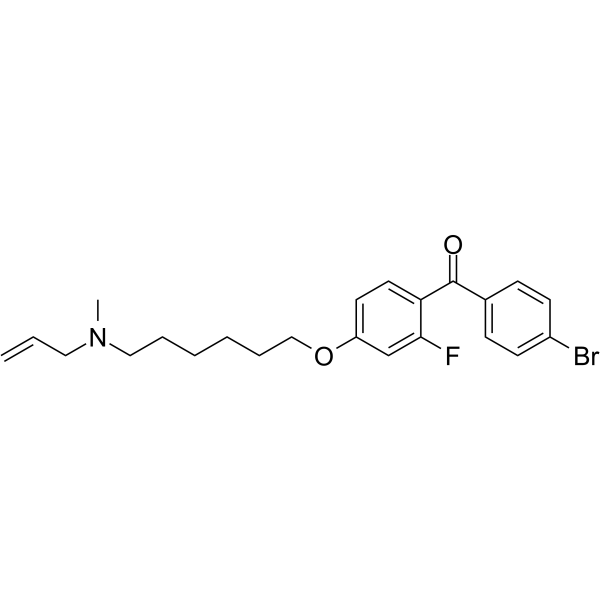
Physicochemical Properties
| Molecular Formula | C23H27NO2FBR |
| Molecular Weight | 448.36838 |
| Exact Mass | 447.12 |
| CAS # | 161582-11-2 |
| Related CAS # | Ro 48-8071 fumarate;189197-69-1 |
| PubChem CID | 1949 |
| Appearance | Typically exists as solid at room temperature |
| Density | 1.2±0.1 g/cm3 |
| Boiling Point | 522.8±50.0 °C at 760 mmHg |
| Flash Point | 270.0±30.1 °C |
| Vapour Pressure | 0.0±1.4 mmHg at 25°C |
| Index of Refraction | 1.550 |
| LogP | 6.24 |
| Hydrogen Bond Donor Count | 0 |
| Hydrogen Bond Acceptor Count | 4 |
| Rotatable Bond Count | 12 |
| Heavy Atom Count | 28 |
| Complexity | 468 |
| Defined Atom Stereocenter Count | 0 |
| SMILES | O=C(C1=CC=C(Br)C=C1)C2=CC=C(OCCCCCCN(C)CC=C)C=C2F |
| InChi Key | CMYCCJYVZIMDFU-UHFFFAOYSA-N |
| InChi Code | InChI=1S/C23H27BrFNO2/c1-3-14-26(2)15-6-4-5-7-16-28-20-12-13-21(22(25)17-20)23(27)18-8-10-19(24)11-9-18/h3,8-13,17H,1,4-7,14-16H2,2H3 |
| Chemical Name | (4-bromophenyl)-[2-fluoro-4-[6-[methyl(prop-2-enyl)amino]hexoxy]phenyl]methanone |
| HS Tariff Code | 2934.99.9001 |
| Storage |
Powder-20°C 3 years 4°C 2 years In solvent -80°C 6 months -20°C 1 month |
| Shipping Condition | Room temperature (This product is stable at ambient temperature for a few days during ordinary shipping and time spent in Customs) |
Biological Activity
| ln Vitro | In HepG2 cells, Ro 48-8071 dose-dependently decreases cholesterol production with an IC50 value of around 1.5 nM [1]. Ro 48-8071 (10 μM) dramatically lowers the viability of PC-3 prostate cancer cells but not of normal prostate cells. Ro 48-8071 (10-30 μM) causes apoptosis in LNCaP and C4-2 cell lines in a dose-dependent manner. Castration-resistant PC-3 and DU145 cells also demonstrated considerable levels of apoptosis following 24 hours of treatment with Ro 48-8071. Ro 48-8071 (10-25 μM) decreases AR protein expression in a dose-dependent manner. Ro 48-8071 (0.1-1 μM) stimulates ERβ protein expression in a dose-dependent manner in hormone-dependent LNCaP and castration-resistant PC-3 cells [2]. Using mammalian cells designed to express human ERα or ERβ proteins, coupled with the ER-responsive luciferase promoter, Ro 48-8071 dose-dependently suppresses 17β-estradiol (E2)-induced ERα-responsive luciferase activity (IC50, around 10 µM), lower than non-toxic circumstances for cells [3]. |
| ln Vivo | In hamsters, Ro 48-8071 decreased HDL-C at all doses but decreased LDL-C by about 60% at 150 μmol/kg per day and up to 300 μmol/kg per day. The amount of MOS in hamster liver is increased by Ro 48-8071 (≥00 μmol/kg daily). In hamsters, Ro 48-8071 (300 μmol/kg daily) dramatically lowers VLDL secretion [1]. Without causing weight loss, Ro 48-8071 (5 or 20 mg/kg) dramatically slowed the growth of tumors in mice. Additionally, two of the twelve tumors that were observed in mice during the testing period were totally eradicated by Ro 48-8071 at a dosage of 20 mg/kg [2]. In the entire small intestine of BALB/c mice, Ro 48-8071 (20 mg/day/kg body weight) rapidly and sustainably inhibits cholesterol synthesis (>50%). Additionally, the stomach and large intestine produce less cholesterol [4]. |
| References |
[1]. Ro 48-8.071, a new 2,3-oxidosqualene:lanosterol cyclase inhibitor lowering plasma cholesterol in hamsters, squirrel monkeys, and minipigs: comparison to simvastatin. J Lipid Res. 1997 Feb;38(2):373-90. [2]. Cholesterol biosynthesis inhibitor RO 48-8071 suppresses growth of hormone-dependent and castration-resistant prostate cancer cells. Onco Targets Ther. 2016 May 30;9:3223-32. [3]. Cholesterol biosynthesis inhibitors as potent novel anti-cancer agents: suppression of hormone-dependent breast cancer by the oxidosqualene cyclase inhibitor RO 48-8071. Breast Cancer Res Treat. 2014 Jul;146(1):51-62. [4]. Sustained and selective suppression of intestinal cholesterol synthesis by Ro 48-8071, an inhibitor of 2,3-oxidosqualene:lanosterol cyclase, in the BALB/c mouse. Biochem Pharmacol. 2014 Apr 1;88(3):351-63. |
| Additional Infomation | Ro 48-8071 is an aromatic ketone that is 2-fluoro-4'-bromobenzophenone in which the hydrogen at position 4 (meta to the fluoro group) is replaced by a 6-[methyl(prop-2-en-1-yl)amino]hexyl}oxy group. An inhibitor of lanosterol synthase. It has a role as an EC 5.4.99.7 (lanosterol synthase) inhibitor and an antineoplastic agent. It is an aromatic ketone, an aromatic ether, a member of monofluorobenzenes, a member of bromobenzenes, a tertiary amino compound and an olefinic compound. It is functionally related to a benzophenone. It is a conjugate base of a Ro 48-8071(1+). |
Solubility Data
| Solubility (In Vitro) | May dissolve in DMSO (in most cases), if not, try other solvents such as H2O, Ethanol, or DMF with a minute amount of products to avoid loss of samples |
| Solubility (In Vivo) |
Note: Listed below are some common formulations that may be used to formulate products with low water solubility (e.g. < 1 mg/mL), you may test these formulations using a minute amount of products to avoid loss of samples. Injection Formulations (e.g. IP/IV/IM/SC) Injection Formulation 1: DMSO : Tween 80: Saline = 10 : 5 : 85 (i.e. 100 μL DMSO stock solution → 50 μL Tween 80 → 850 μL Saline) *Preparation of saline: Dissolve 0.9 g of sodium chloride in 100 mL ddH ₂ O to obtain a clear solution. Injection Formulation 2: DMSO : PEG300 :Tween 80 : Saline = 10 : 40 : 5 : 45 (i.e. 100 μL DMSO → 400 μLPEG300 → 50 μL Tween 80 → 450 μL Saline) Injection Formulation 3: DMSO : Corn oil = 10 : 90 (i.e. 100 μL DMSO → 900 μL Corn oil) Example: Take the Injection Formulation 3 (DMSO : Corn oil = 10 : 90) as an example, if 1 mL of 2.5 mg/mL working solution is to be prepared, you can take 100 μL 25 mg/mL DMSO stock solution and add to 900 μL corn oil, mix well to obtain a clear or suspension solution (2.5 mg/mL, ready for use in animals). Injection Formulation 4: DMSO : 20% SBE-β-CD in saline = 10 : 90 [i.e. 100 μL DMSO → 900 μL (20% SBE-β-CD in saline)] *Preparation of 20% SBE-β-CD in Saline (4°C,1 week): Dissolve 2 g SBE-β-CD in 10 mL saline to obtain a clear solution. Injection Formulation 5: 2-Hydroxypropyl-β-cyclodextrin : Saline = 50 : 50 (i.e. 500 μL 2-Hydroxypropyl-β-cyclodextrin → 500 μL Saline) Injection Formulation 6: DMSO : PEG300 : castor oil : Saline = 5 : 10 : 20 : 65 (i.e. 50 μL DMSO → 100 μLPEG300 → 200 μL castor oil → 650 μL Saline) Injection Formulation 7: Ethanol : Cremophor : Saline = 10: 10 : 80 (i.e. 100 μL Ethanol → 100 μL Cremophor → 800 μL Saline) Injection Formulation 8: Dissolve in Cremophor/Ethanol (50 : 50), then diluted by Saline Injection Formulation 9: EtOH : Corn oil = 10 : 90 (i.e. 100 μL EtOH → 900 μL Corn oil) Injection Formulation 10: EtOH : PEG300:Tween 80 : Saline = 10 : 40 : 5 : 45 (i.e. 100 μL EtOH → 400 μLPEG300 → 50 μL Tween 80 → 450 μL Saline) Oral Formulations Oral Formulation 1: Suspend in 0.5% CMC Na (carboxymethylcellulose sodium) Oral Formulation 2: Suspend in 0.5% Carboxymethyl cellulose Example: Take the Oral Formulation 1 (Suspend in 0.5% CMC Na) as an example, if 100 mL of 2.5 mg/mL working solution is to be prepared, you can first prepare 0.5% CMC Na solution by measuring 0.5 g CMC Na and dissolve it in 100 mL ddH2O to obtain a clear solution; then add 250 mg of the product to 100 mL 0.5% CMC Na solution, to make the suspension solution (2.5 mg/mL, ready for use in animals). Oral Formulation 3: Dissolved in PEG400 Oral Formulation 4: Suspend in 0.2% Carboxymethyl cellulose Oral Formulation 5: Dissolve in 0.25% Tween 80 and 0.5% Carboxymethyl cellulose Oral Formulation 6: Mixing with food powders Note: Please be aware that the above formulations are for reference only. InvivoChem strongly recommends customers to read literature methods/protocols carefully before determining which formulation you should use for in vivo studies, as different compounds have different solubility properties and have to be formulated differently. (Please use freshly prepared in vivo formulations for optimal results.) |
| Preparing Stock Solutions | 1 mg | 5 mg | 10 mg | |
| 1 mM | 2.2303 mL | 11.1515 mL | 22.3030 mL | |
| 5 mM | 0.4461 mL | 2.2303 mL | 4.4606 mL | |
| 10 mM | 0.2230 mL | 1.1152 mL | 2.2303 mL |