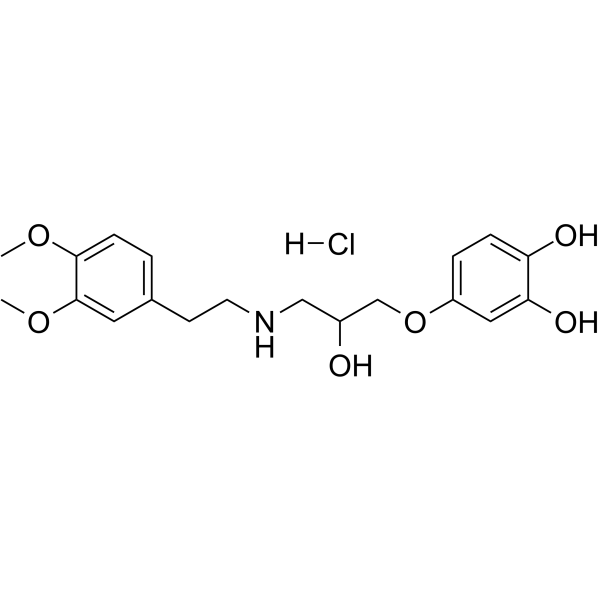
Physicochemical Properties
| Molecular Formula | C19H26CLNO6 |
| Molecular Weight | 399.8658 |
| Exact Mass | 399.144 |
| CAS # | 250580-70-2 |
| Related CAS # | 74513-77-2; 250580-70-2 (HCl) |
| PubChem CID | 129317790 |
| Appearance | White to pink solid powder |
| Hydrogen Bond Donor Count | 5 |
| Hydrogen Bond Acceptor Count | 7 |
| Rotatable Bond Count | 10 |
| Heavy Atom Count | 27 |
| Complexity | 385 |
| Defined Atom Stereocenter Count | 0 |
| SMILES | Cl[H].O([H])C([H])(C([H])([H])OC1C([H])=C([H])C(=C(C=1[H])O[H])O[H])C([H])([H])N([H])C([H])([H])C([H])([H])C1C([H])=C([H])C(=C(C=1[H])OC([H])([H])[H])OC([H])([H])[H] |
| InChi Key | OGVPZFCVECYADQ-UHFFFAOYSA-N |
| InChi Code | InChI=1S/C19H25NO6.ClH/c1-24-18-6-3-13(9-19(18)25-2)7-8-20-11-14(21)12-26-15-4-5-16(22)17(23)10-15;/h3-6,9-10,14,20-23H,7-8,11-12H2,1-2H3;1H |
| Chemical Name | 4-[3-[2-(3,4-dimethoxyphenyl)ethylamino]-2-hydroxypropoxy]benzene-1,2-diol;hydrochloride |
| Synonyms | Ro 363 hydrochloride; Ro 363 (hydrochloride); 250580-70-2; 1,2-Benzenediol, 4-[3-[[2-(3,4-dimethoxyphenyl)ethyl]amino]-2-hydroxypropoxy]-, hydrochloride (1:1) |
| HS Tariff Code | 2934.99.9001 |
| Storage |
Powder-20°C 3 years 4°C 2 years In solvent -80°C 6 months -20°C 1 month Note: Please store this product in a sealed and protected environment (e.g. under nitrogen), avoid exposure to moisture. |
| Shipping Condition | Room temperature (This product is stable at ambient temperature for a few days during ordinary shipping and time spent in Customs) |
Biological Activity
| Targets | β1-adrenoceptor |
| ln Vitro |
The guinea-pig cardiac preparations that were isolated and perfused experienced an arrhythmic contraction after being administered dosages of Ro 363 that produced 70–100% of their peak chronotropic responses[1]. In guinea-pig tracheal preparations that spontaneously contract, RO 363 is a complete agonist and has half the potency of (-)-isoprenaline. The activation of β1-receptors in the tissue is the cause of RO 363's actions, as (-)-Isoprenaline and RO 363 had similar relative potencies in trachea, cardiac, and ileal preparations[2]. 1 The beta-adrenoceptor stimulant effects of Ro-363 and (--)-isoprenaline have been compared in a variety of isolated tissue preparations. 2 Ro-363 is approximately half as potent as (--)-isoprenaline in tissues where actions are due to beta1-receptor activation (guinea-pig atrial and ileal preparations and ventricular strips from the rabbit, rat and guinea-pig. 3 In uterine and lung strip preparations from the guinea-pig, where responses are due to beta2-receptor stimulation. RO363 is 100 to 350 times less active than (--)-isoprenaline and has a low intrinsic activity. 4 In spontaneously contracted tracheal preparations from the guinea-pig, RO363 is a full agonist and is approximately half as potent as (--)-isoprenaline. These effects of RO363 are due to the activation of a population of beta1-receptors in the tissue since RO363 and (--)-isoprenaline have the same relative potencies in trachea, cardiac and ileal preparations. In addition the Kb values for practolol are similar in all these preparations when RO363 is used as the agonist. 5 The results show that RO363 is a potent and highly selective beta1-receptor agonist [2]. |
| ln Vivo |
Ro 363 is virtually free of arrhythmogenic activity in cats under chloralose anesthesia, in contrast to epinephrine (adrenaline), in animals where U-0882 or halothane produce cardiac sensitization[1]. In guinea-pig left atrial preparations, concentrations of (-)-isoprenaline and (+/-)-(1-[3',4'-dihydroxyphenoxy] -2-hydroxy-[3",4"-dimethoxyphenethylamino]-propane)-oxalate (Ro-363) causing maximal inotropic responses produced small reductions in effective refractory period. Dobutamine had little effect on the refractory period except at supramaximal inotropic concentrations, when increases in effective refractory period were produced. Isolated perfused heart preparations from guinea-pigs developed arrhythmic contractions following the administration of (-)-isoprenaline, Ro 363 and dobutamine in doses producing 70-100% of their maximal chronotropic responses. The arrhythmogenic activity of the three agonists paralleled their respective beta 1-receptor stimulant properties. In chloralose-anaesthetized cats, the 3 agonists, (-)-isoprenaline, Ro 363 and dobutamine, when compared to epinephrine (adrenaline), were essentially devoid of arrhythmogenic activity in animals in which cardiac sensitization was induced by 3-dimethylamino-2-methyl-2-phenoxypropiophenone hydrochloride (U-0882) or halothane. However, all 3 agonists elicited ventricular arrhythmias following the administration of subarrhythmic doses of ouabain and increased the number of subauricular escape beats which occurred during vagal nerve stimulation in non-ouabain treated animals. In all cases the arrhythmogenic activity of the drugs paralleled their relative activity for eliciting rises in heart rate. [1] The cardiovascular effects of some beta-adrenoreceptor agonists on heart rate, blood pressure and myocardial contractility (maximum rate of change of left ventricular pressure/integrated isometric tension) were measured in pentobarbitone-anaesthetised and conscious, instrumented greyhounds. In anaesthetised dogs isoprenaline increased heart rate and myocardial contractility and reduced blood pressure. Prenalterol and Ro-363, in equiactive inotropic doses, induced greater increases in heart rate than isoprenaline if blood pressure fell by less than 25 mmHg. Salbutamol had hypotensive activity at all doses and appeared to be a relatively selective inotrope. None of the agonists caused blood pressure to fall in the conscious dogs. Prenalterol and Ro-363 were more effective inotropic stimulants, producing smaller increases in heart rate and more pronounced increases in myocardial contractility. Salbutamol, however, elicited greater increases in heart rate in the conscious animals and the inotropic selectivity demonstrated in the anaesthetised animals was lost. The direct effects of the beta-adrenoreceptor agonists, without modification by reflexes could be observed in the anaesthetised animals. The differences in the actions of the agonists in the conscious animals appear to be attributable to the state of the baroreceptor reflex control system and the relatively enhanced responsiveness of the heart[3]. |
| Enzyme Assay |
Affinities of (−)-RO363 for β1/β2Chimeric Receptors. [4] The receptor binding analysis with human recombinant β1- and β2-adrenergic receptors showed that (−)-RO363 has 40-fold higher affinity for β1-adrenergic receptor than β2-adrenergic receptor (Table 1). To determine the domain responsible for this selectivity, we constructed eight chimeric receptors of β1- and β2-adrenergic receptors (Fig. 2). The binding characteristics of these chimeric receptors for (−)-RO363 are summarized in Table 1. No significant differences were found when transmembrane... (-)-1-(3,4-Dimethoxyphenetylamino)-3-(3,4-dihydroxy)-2-propanol [(-)-RO363] is a highly selective beta(1)-adrenergic receptor (beta(1)AR) agonist. To study the binding site of beta(1)-selective agonist, chimeric beta(1)/beta(2)ARs and Ala-substituted beta(1)ARs were constructed. Several key residues of beta(1)AR [Leu(110) and Thr(117) in transmembrane domain (TMD) 2], and Phe(359) in TMD 7] were found to be responsible for beta(1)-selective binding of (-)-RO363, as determined by competitive binding. Based on these results, we built a three-dimensional model of the binding domain for (-)-RO363. The model indicated that TMD 2 and TMD 7 of beta(1)AR form a binding pocket; the methoxyphenyl group of N-substituent of (-)-RO363 seems to locate within the cavity surrounded by Leu(110), Thr(117), and Phe(359). The amino acids Leu(110) and Phe(359) interact with the phenyl ring of (-)-RO363, whereas Thr(117) forms hydrogen bond with the methoxy group of (-)-RO363. To examine the interaction of these residues with beta(1)AR in an active state, each of the amino acids was changed to Ala in a constitutively active (CA)-beta(1)AR mutant. The degree of decrease in the affinity of CA-beta(1)AR for (-)-RO363 was essentially the same as that of wild-type beta(1)AR when mutated at Leu(110) and Thr(117). However, the affinity was decreased in Ala-substituted mutant of Phe(359) compared with that of wild-type beta(1)AR. These results indicated that Leu(110) and Thr(117) are necessary for the initial binding of (-)-RO363 with beta(1)-selectivity, and interaction of Phe(359) with the N-substituent of (-)-RO363 in an active state is stronger than in the resting state [14]. |
| References |
[1]. Comparison of the Arrhythmogenic Actions of (-)-Isoprenaline, Dobutamine and the selective beta 1-adrenoceptor agonist, (+/-)-(1-[3',4'-dihydroxyphenoxy] -2-hydroxy-[3",4"-dimethoxy phenethylamino]-propane)-oxalate (Ro 363). Arzneimittelforschung. 1985;35(3):592-8. [2]. In vitro activity of RO363, a beta1-adrenoceptor selective agonist. Br J Pharmacol. 1980 Apr;68(4):677-85. [3]. Comparison of the cardiac effects of beta-adrenoreceptor agonists in anaesthetised and conscious dogs. J Auton Pharmacol. 1986 Mar;6(1):9-14. [4]. Beta(1)-selective agonist (-)-1-(3,4-dimethoxyphenetylamino)-3-(3,4-dihydroxy)-2-propanol [(-)-RO363] differentially interacts with key amino acids responsible for beta(1)-selective binding in resting and active states. J Pharmacol Exp Ther. 2002 Apr;301(1):51-8. |
| Additional Infomation | In this study, we analyzed the site on β1-adrenergic receptor conferring the β1-selective binding. Based on analysis of the binding characteristics of several chimeric β1/β2-adrenergic receptors, transmembrane domains 2 and 7 were found to be involved in the β1-selective binding of (−)-RO363. This result is consistent with our previous reports that transmembrane domains 2 and 7 of β1- and β2-adrenergic receptors form a binding pocket for the β1- and β2-selective agonists (Isogaya et al., 1998,..[4] |
Solubility Data
| Solubility (In Vitro) |
DMSO: 125 mg/mL (312.60 mM) H2O: 50 mg/mL (125.04 mM) |
| Solubility (In Vivo) |
Solubility in Formulation 1: ≥ 2.5 mg/mL (6.25 mM) (saturation unknown) in 10% DMSO + 40% PEG300 + 5% Tween80 + 45% Saline (add these co-solvents sequentially from left to right, and one by one), clear solution. For example, if 1 mL of working solution is to be prepared, you can add 100 μL of 25.0 mg/mL clear DMSO stock solution to 400 μL PEG300 and mix evenly; then add 50 μL Tween-80 to the above solution and mix evenly; then add 450 μL normal saline to adjust the volume to 1 mL. Preparation of saline: Dissolve 0.9 g of sodium chloride in 100 mL ddH₂ O to obtain a clear solution. Solubility in Formulation 2: ≥ 2.5 mg/mL (6.25 mM) (saturation unknown) in 10% DMSO + 90% (20% SBE-β-CD in Saline) (add these co-solvents sequentially from left to right, and one by one), clear solution. For example, if 1 mL of working solution is to be prepared, you can add 100 μL of 25.0 mg/mL clear DMSO stock solution to 900 μL of 20% SBE-β-CD physiological saline solution and mix evenly. Preparation of 20% SBE-β-CD in Saline (4°C,1 week): Dissolve 2 g SBE-β-CD in 10 mL saline to obtain a clear solution. Solubility in Formulation 3: ≥ 2.5 mg/mL (6.25 mM) (saturation unknown) in 10% DMSO + 90% Corn Oil (add these co-solvents sequentially from left to right, and one by one), clear solution. For example, if 1 mL of working solution is to be prepared, you can add 100 μL of 25.0 mg/mL clear DMSO stock solution to 900 μL of corn oil and mix evenly. Solubility in Formulation 4: 16.67 mg/mL (41.69 mM) in PBS (add these co-solvents sequentially from left to right, and one by one), clear solution; with ultrasonication (<60°C). (Please use freshly prepared in vivo formulations for optimal results.) |
| Preparing Stock Solutions | 1 mg | 5 mg | 10 mg | |
| 1 mM | 2.5008 mL | 12.5041 mL | 25.0081 mL | |
| 5 mM | 0.5002 mL | 2.5008 mL | 5.0016 mL | |
| 10 mM | 0.2501 mL | 1.2504 mL | 2.5008 mL |