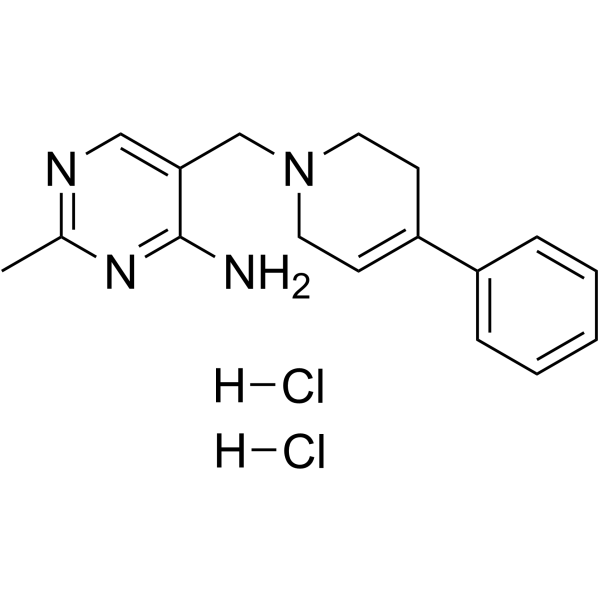
Physicochemical Properties
| Molecular Formula | C17H22CL2N4 |
| Molecular Weight | 353.289381504059 |
| Exact Mass | 352.122 |
| CAS # | 189744-94-3 |
| PubChem CID | 16759174 |
| Appearance | Typically exists as solid at room temperature |
| Hydrogen Bond Donor Count | 3 |
| Hydrogen Bond Acceptor Count | 4 |
| Rotatable Bond Count | 3 |
| Heavy Atom Count | 23 |
| Complexity | 362 |
| Defined Atom Stereocenter Count | 0 |
| SMILES | NC1=NC(C)=NC=C1CN2CC=C(C3=CC=CC=C3)CC2.[H]Cl.[H]Cl |
| InChi Key | UZHMRJRDYCRKIZ-UHFFFAOYSA-N |
| InChi Code | InChI=1S/C17H20N4.2ClH/c1-13-19-11-16(17(18)20-13)12-21-9-7-15(8-10-21)14-5-3-2-4-6-14;;/h2-7,11H,8-10,12H2,1H3,(H2,18,19,20);2*1H |
| Chemical Name | 2-methyl-5-[(4-phenyl-3,6-dihydro-2H-pyridin-1-yl)methyl]pyrimidin-4-amine;dihydrochloride |
| HS Tariff Code | 2934.99.9001 |
| Storage |
Powder-20°C 3 years 4°C 2 years In solvent -80°C 6 months -20°C 1 month Note: Please store this product in a sealed and protected environment, avoid exposure to moisture. |
| Shipping Condition | Room temperature (This product is stable at ambient temperature for a few days during ordinary shipping and time spent in Customs) |
Biological Activity
| Targets |
1. Dopamine D4 receptor (D4R, Ki = 0.8 nM for human recombinant D4R binding; EC50 = 2.5 nM for D4R-mediated cAMP inhibition in transfected cells, partial agonist with 65% maximal efficacy relative to full agonist dopamine) [1][2] 2. No significant binding to dopamine D1/D2/D3/D5 receptors (Ki > 1000 nM for D1/D2/D3/D5 at concentrations up to 10 μM), or adrenergic/serotonin receptors (residual binding > 90% for α1/α2-adrenergic, 5-HT1A/5-HT2A receptors) [2] |
| ln Vitro |
RO-10-5824 demonstrates 250-fold selectivity relative to human D3R receptors, high affinity binding with Ki=5.2±0.9 nM (n=3), and selectivity for D4 similar to human D2, D1, and D5 receptors. in contrast to over 1000 times. With an EC50 value of 205±67 nM (n=7) and a maximal induction of 36±4% above basal levels, RO-10-5824 promotes 35S-GTPγS binding [2]. 1. D4R binding and functional selectivity: Ro 10-5824 dihydrochloride exhibited high-affinity and selective binding to human recombinant D4R, with a Ki of 0.8 nM in radioligand displacement assays. In CHO cells stably transfected with human D4R, it acted as a partial agonist, inhibiting forskolin-induced cAMP accumulation with an EC50 of 2.5 nM and a maximal efficacy of 65% (relative to dopamine, 100% efficacy). At concentrations up to 10 μM, it showed no significant functional activity at D1/D2/D3/D5 receptors (cAMP response change < 5%) or off-target GPCRs (adrenergic/serotonin receptors) [2] 2. D4R-mediated intracellular signaling modulation: In HEK293 cells expressing D4R, Ro 10-5824 dihydrochloride (1–10 nM) dose-dependently activated ERK1/2 phosphorylation (2.1-fold increase at 5 nM, normalized to dopamine) and promoted β-arrestin recruitment to D4R (recruitment efficiency 60% of dopamine at 5 nM), confirming its partial agonist profile for D4R-mediated signaling cascades [1] |
| ln Vivo |
Ro 10-5824 (3 mg/kg) increases the likelihood that ORD missions will succeed. At dosages of 1 and 3 mg/kg, Ro 10-5824 enhanced baseline gamma band activity in the frontal brain. On spontaneous motions, Ro 10-5824 had no effect [1]. In preliminary trials with C57 mice, RO-10-5824 (10.0 mg/kg) did not improve total turnover or central entrance in a single 60-minute open field in the absence of novel objects [2]. 1. Novel object exploration enhancement in C57BL/6 mice: In the novel object recognition (NOR) test, intraperitoneal administration of Ro 10-5824 dihydrochloride (0.1 mg/kg, 0.3 mg/kg, 1 mg/kg) 30 min prior to testing dose-dependently increased the time spent exploring novel objects (vs familiar objects). At 0.3 mg/kg, the discrimination index (DI) rose from 0.22 (vehicle control) to 0.68 (maximal effect), with no significant change in total locomotor activity (distance traveled change < 10%). The effect was blocked by co-administration of a selective D4R antagonist (L-745,870), confirming D4R-mediated action [2] 2. Neurophysiological and behavioral effects in common marmosets: - In freely moving marmosets, subcutaneous administration of Ro 10-5824 dihydrochloride (0.5 mg/kg, 1 mg/kg) increased prefrontal cortex (PFC) pyramidal neuron firing rate (1.8-fold and 2.5-fold relative to baseline at 0.5 mg/kg and 1 mg/kg, respectively) within 30 min of administration, with the effect lasting for 2 h. The firing pattern shift was from irregular to regular spiking, consistent with D4R modulation of PFC circuit activity [1] - In the marmoset five-choice serial reaction time task (5-CSRTT, a measure of attention/impulsivity), 1 mg/kg Ro 10-5824 dihydrochloride improved attention accuracy (from 68% to 85%) and reduced premature responses (from 18% to 7%) without altering response latency (change < 5%), indicating enhanced cognitive control via D4R activation [1] |
| Enzyme Assay |
1. Human D4R radioligand binding assay: Purified membrane preparations from CHO cells stably expressing human D4R were incubated with a fixed concentration of radiolabeled D4R ligand ([³H]Nemonapride) and serial dilutions of Ro 10-5824 dihydrochloride (0.01–100 nM) in a pH 7.4 buffer system containing Mg²⁺ and protease inhibitors. The mixture was incubated at 25℃ for 60 min to reach binding equilibrium, then filtered through glass fiber filters to separate bound and free radioligand. Radioactivity of the filters was quantified via liquid scintillation counting, non-specific binding was determined in the presence of excess unlabeled D4R agonist, and Ki values were calculated using the Cheng-Prusoff equation [2] 2. D4R-mediated cAMP inhibition functional assay: CHO cells stably expressing human D4R were seeded in 96-well plates and pre-incubated with Ro 10-5824 dihydrochloride (0.1–100 nM) for 15 min at 37℃, then stimulated with forskolin (10 μM, a cAMP activator) for 30 min. Intracellular cAMP levels were measured using a homogeneous time-resolved fluorescence (HTRF) cAMP detection kit, with fluorescence signals (excitation 320 nm, emission 665 nm/620 nm) quantified via microplate reader. The EC50 for cAMP inhibition and maximal efficacy (relative to dopamine) were derived from dose-response curve fitting [2] |
| Cell Assay |
1. D4R-expressing HEK293 cell ERK1/2 phosphorylation assay: HEK293 cells stably transfected with human D4R were seeded in 6-well plates and serum-starved for 12 h to basalize signaling. The cells were treated with Ro 10-5824 dihydrochloride (1–10 nM) or dopamine (100 nM, positive control) for 15 min at 37℃, then lysed and processed for western blot analysis. Equal amounts of protein were separated by SDS-PAGE, transferred to membranes, and probed with antibodies against phosphorylated ERK1/2 (p-ERK1/2) and total ERK1/2 (loading control). Band densitometry was used to calculate p-ERK1/2/total ERK1/2 ratios, with results normalized to dopamine-induced phosphorylation to determine partial agonist efficacy [1] 2. β-arrestin recruitment assay for D4R: HEK293 cells co-transfected with D4R and β-arrestin-GFP fusion protein were seeded in 96-well plates and treated with Ro 10-5824 dihydrochloride (0.5–10 nM) for 30 min at 37℃. β-arrestin recruitment to the cell membrane (a marker of D4R activation) was visualized via fluorescence microscopy, and the percentage of cells with membrane-localized β-arrestin was quantified via image analysis software, with efficacy compared to dopamine (100 nM) [1] |
| Animal Protocol |
1. C57BL/6 mouse novel object recognition (NOR) assay: Male C57BL/6 mice (8–10 weeks old, 20–25 g) were randomly divided into 5 groups (vehicle control, 0.1 mg/kg, 0.3 mg/kg, 1 mg/kg Ro 10-5824 dihydrochloride, 0.3 mg/kg + D4R antagonist), with 10 mice per group. Ro 10-5824 dihydrochloride was dissolved in sterile 0.9% saline (with 0.1% Tween 80 for solubility) to prepare injection solutions, administered via intraperitoneal injection at a volume of 10 μL/g body weight, 30 min before the NOR test. The NOR test included a training phase (two identical objects, 10 min exploration) and a testing phase (one familiar/one novel object, 5 min exploration) 24 h later, with object interaction time recorded by a blinded observer to calculate the discrimination index (DI = (novel time - familiar time)/(total time)) [2] 2. Common marmoset neurophysiology and 5-CSRTT assay: Adult common marmosets (3–5 years old, 300–400 g) were randomly divided into 3 groups (vehicle control, 0.5 mg/kg, 1 mg/kg Ro 10-5824 dihydrochloride), with 6 marmosets per group. The compound was dissolved in sterile PBS (pH 7.4) to prepare subcutaneous injection solutions (1 mg/mL), administered at a volume of 0.5–1 mL per marmoset (0.5–1 mg/kg) 30 min before testing. For neurophysiology, chronic microelectrodes were implanted in the PFC to record single-unit neuron firing rate and pattern before/after drug administration (0–2 h post-dose). For 5-CSRTT, marmosets were trained to respond to visual cues in 5 spatial locations, with attention accuracy (correct responses/total trials) and premature responses (responses before cue onset) recorded during a 1 h session post-drug administration [1] |
| Toxicity/Toxicokinetics |
1. In vitro cell cytotoxicity: Ro 10-5824 dihydrochloride (up to 10 μM) exhibited no significant cytotoxicity to CHO/D4R or HEK293/D4R cells (cell viability > 95% after 72 h incubation, measured via viability reagent), with no induction of apoptosis (caspase-3/7 activity < 10% of positive control staurosporine) [1][2] 2. In vivo acute toxicity in rodents: In C57BL/6 mice administered Ro 10-5824 dihydrochloride (up to 10 mg/kg, intraperitoneal, single dose), no significant body weight loss (change < 4% of baseline) or gross neurological/visceral toxicity was observed within 7 days post-administration. Serum ALT/AST and creatinine levels remained within normal ranges, with no evidence of liver/kidney damage [2] |
| References |
[1]. Nakazawa S, et al. Behavioral and neurophysiological effects of Ro 10-5824, a dopamine D4 receptor partial agonist, in common marmosets. Psychopharmacology (Berl). 2015 Sep;232(17):3287-95. [2]. Powell SB, et al. RO-10-5824 is a selective dopamine D4 receptor agonist that increases novel object exploration in C57 mice. Neuropharmacology. 2003 Mar;44(4):473-81 |
| Additional Infomation |
1. Ro 10-5824 dihydrochloride is a synthetic small-molecule selective dopamine D4 receptor (D4R) partial agonist, initially developed for preclinical investigation of D4R-mediated cognitive and neurophysiological functions [1][2] 2. Mechanism of action: The compound binds to the D4R orthosteric binding site, acting as a partial agonist to modulate G protein (Gi/o)-mediated cAMP inhibition and β-arrestin-dependent signaling, with preferential activation of prefrontal cortical D4R circuits to enhance attention, reduce impulsivity, and promote novel object exploration [1][2] 3. Research application: It is widely used as a D4R-selective tool compound in preclinical studies to dissect D4R roles in cognitive function (attention/working memory), neurophysiology (PFC neuron firing), and psychiatric disease models (schizophrenia/attention-deficit hyperactivity disorder, ADHD) [1] 4. Selectivity advantage: Its high selectivity for D4R (vs other dopamine receptors and off-target GPCRs) eliminates confounding effects from D1/D2 receptor activation, making it a gold-standard tool for D4R-specific mechanistic studies [2] |
Solubility Data
| Solubility (In Vitro) |
H2O : ~100 mg/mL (~283.05 mM) DMSO : ~8.33 mg/mL (~23.58 mM) |
| Solubility (In Vivo) |
Solubility in Formulation 1: 50 mg/mL (141.53 mM) in PBS (add these co-solvents sequentially from left to right, and one by one), clear solution; with sonication. (Please use freshly prepared in vivo formulations for optimal results.) |
| Preparing Stock Solutions | 1 mg | 5 mg | 10 mg | |
| 1 mM | 2.8305 mL | 14.1527 mL | 28.3054 mL | |
| 5 mM | 0.5661 mL | 2.8305 mL | 5.6611 mL | |
| 10 mM | 0.2831 mL | 1.4153 mL | 2.8305 mL |