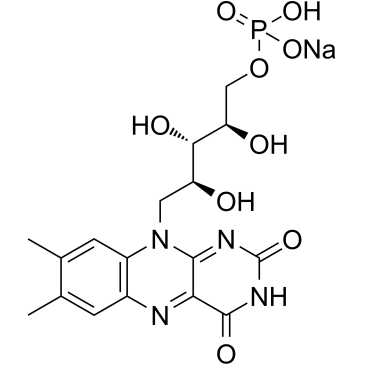
Riboflavin Sodium Phosphate (Lactoflavin Phosphate Sodium Salt; Vitamin B2 Phosphate Sodium Salt) is an coenzyme and photoinitiator of polymerization which can be used in both acid and alkaline buffer systems.
Physicochemical Properties
| Molecular Formula | C17H20N4NAO9P |
| Molecular Weight | 478.32 |
| Exact Mass | 478.086 |
| CAS # | 130-40-5 |
| Related CAS # | 146-17-8 (Parent);146-17-8 (Parent) |
| PubChem CID | 23666409 |
| Appearance | Light yellow to orange solid powder |
| Melting Point | >300°C |
| Index of Refraction | 41 ° (C=1.5, 5mol/L HCl) |
| Hydrogen Bond Donor Count | 5 |
| Hydrogen Bond Acceptor Count | 10 |
| Rotatable Bond Count | 7 |
| Heavy Atom Count | 32 |
| Complexity | 856 |
| Defined Atom Stereocenter Count | 3 |
| SMILES | CC1=CC2=C(C=C1C)N(C3=NC(=O)NC(=O)C3=N2)C[C@@H]([C@@H]([C@@H](COP(=O)(O)[O-])O)O)O.[Na+] |
| InChi Key | OHSHFZJLPYLRIP-BMZHGHOISA-M |
| InChi Code | InChI=1S/C17H21N4O9P.Na/c1-7-3-9-10(4-8(7)2)21(15-13(18-9)16(25)20-17(26)19-15)5-11(22)14(24)12(23)6-30-31(27,28)29;/h3-4,11-12,14,22-24H,5-6H2,1-2H3,(H,20,25,26)(H2,27,28,29);/q;+1/p-1/t11-,12+,14-;/m0./s1 |
| Chemical Name | sodium;[(2R,3S,4S)-5-(7,8-dimethyl-2,4-dioxobenzo[g]pteridin-10-yl)-2,3,4-trihydroxypentyl] hydrogen phosphate |
| Synonyms | Flavin mononucleotide Hyryl Riboflavin Sodium Phosphate |
| HS Tariff Code | 2934.99.9001 |
| Storage |
Powder-20°C 3 years 4°C 2 years In solvent -80°C 6 months -20°C 1 month Note: (1). This product requires protection from light (avoid light exposure) during transportation and storage.(2). Please store this product in a sealed and protected environment (e.g. under nitrogen), avoid exposure to moisture. |
| Shipping Condition | Room temperature (This product is stable at ambient temperature for a few days during ordinary shipping and time spent in Customs) |
Biological Activity
| ln Vitro | It is evident that riboflavine phosphate sodium is a very effective NAD+-recycling agent because it regularly achieves high levels of NAP turnover together with good yields of the cyclohexanone product[3]. |
| References |
[1]. Bioproduction of riboflavin: a bright yellow history. J Ind Microbiol Biotechnol. 2017 May;44(4-5):659-665. [2]. Enhancement of corneal permeation of riboflavin-5'-phosphate through vitamin E TPGS: a promising approach in corneal trans-epithelial cross linking treatment. Int J Pharm. 2013 Jan 20;440(2):148-53. [3]. Nicotinamide coenzyme regeneration. Flavin mononucleotide (riboflavin phosphate) as an efficient, economical, and enzyme-compatible recycling agent. Can J Chem. 1976, 54(19): 2969-2973,. |
| Additional Infomation |
Riboflavin sodium phosphate is a ribitol phosphate and a vitamin B2. It is functionally related to a riboflavin. A coenzyme for a number of oxidative enzymes including NADH DEHYDROGENASE. It is the principal form in which RIBOFLAVIN is found in cells and tissues. See also: riboflavin 5'-phosphate sodium anhydrous (annotation moved to). |
Solubility Data
| Solubility (In Vitro) |
H2O : ~20.83 mg/mL (~43.55 mM) DMSO : ~1 mg/mL (~2.09 mM) |
| Solubility (In Vivo) |
Solubility in Formulation 1: 4.17 mg/mL (8.72 mM) in PBS (add these co-solvents sequentially from left to right, and one by one), clear solution; with sonication (<60°C). (Please use freshly prepared in vivo formulations for optimal results.) |
| Preparing Stock Solutions | 1 mg | 5 mg | 10 mg | |
| 1 mM | 2.0907 mL | 10.4533 mL | 20.9065 mL | |
| 5 mM | 0.4181 mL | 2.0907 mL | 4.1813 mL | |
| 10 mM | 0.2091 mL | 1.0453 mL | 2.0907 mL |