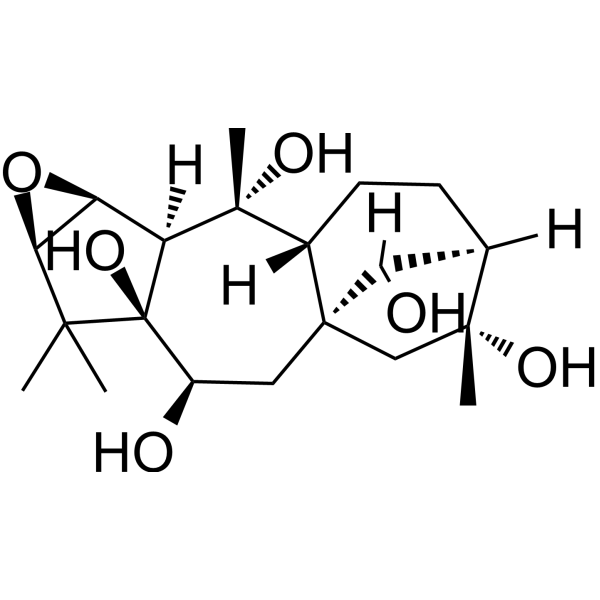
Physicochemical Properties
| Molecular Formula | C20H32O6 |
| Molecular Weight | 368.4645 |
| Exact Mass | 368.219 |
| CAS # | 26342-66-5 |
| PubChem CID | 21151017 |
| Appearance | White to off-white solid powder |
| Density | 1.4±0.1 g/cm3 |
| Boiling Point | 557.3±50.0 °C at 760 mmHg |
| Melting Point | 285-287 °C |
| Flash Point | 290.9±30.1 °C |
| Vapour Pressure | 0.0±3.4 mmHg at 25°C |
| Index of Refraction | 1.632 |
| LogP | 1.09 |
| Hydrogen Bond Donor Count | 5 |
| Hydrogen Bond Acceptor Count | 6 |
| Rotatable Bond Count | 0 |
| Heavy Atom Count | 26 |
| Complexity | 667 |
| Defined Atom Stereocenter Count | 11 |
| SMILES | C[C@]1(C[C@@]23C[C@H]([C@]4([C@@H]([C@H]5[C@@H](C4(C)C)O5)[C@]([C@@H]2CC[C@@H]1[C@H]3O)(C)O)O)O)O |
| InChi Key | VUMZHZYKXUYIHM-GLHQSWFFSA-N |
| InChi Code | InChI=1S/C20H32O6/c1-16(2)15-12(26-15)13-18(4,24)10-6-5-9-14(22)19(10,8-17(9,3)23)7-11(21)20(13,16)25/h9-15,21-25H,5-8H2,1-4H3/t9-,10+,11-,12+,13+,14-,15+,17-,18-,19+,20-/m1/s1 |
| Chemical Name | (1S,3R,4R,6R,8S,9S,10R,11R,14R,15R,17R)-5,5,10,15-tetramethyl-7-oxapentacyclo[12.2.1.01,11.04,9.06,8]heptadecane-3,4,10,15,17-pentol |
| HS Tariff Code | 2934.99.9001 |
| Storage |
Powder-20°C 3 years 4°C 2 years In solvent -80°C 6 months -20°C 1 month Note: This product requires protection from light (avoid light exposure) during transportation and storage. |
| Shipping Condition | Room temperature (This product is stable at ambient temperature for a few days during ordinary shipping and time spent in Customs) |
Biological Activity
| Targets |
Rhodojaponin III binds to NF-κB-inducing kinase (NIK) with a binding energy of -7.2 kcal/mol (determined by molecular docking) [1] |
| ln Vitro |
Rhodojaponin III inhibited LPS-induced nitric oxide (NO) production in RAW264.7 mouse macrophages with an IC₅₀ value of 7 μM (assessed by Griess assay) [1] It dose-dependently reduced the production of pro-inflammatory cytokines (IL-6, IL-1β, TNF-α) in LPS-stimulated RAW264.7 cells [1] It suppressed LPS-induced COX-2 and iNOS protein expression in macrophage cells [1] The compound directly interacted with NIK, inhibiting the NIK/NF-κB pathway activation and preventing nuclear translocation of NF-κB, thereby reducing transcription of inflammatory genes [1] It also reduced phosphorylation of IKKα and NF-κB p65 in LPS-stimulated cells [1] |
| Cell Assay |
RAW264.7 cells were cultured in DMEM medium supplemented with 10% fetal bovine serum and 1% penicillin-streptomycin at 37°C in a 5% CO₂ incubator until 80-90% confluent [1] Cells were seeded in 96-well plates at 1 × 10⁵ cells/well, allowed to attach overnight, pretreated with Rhodojaponin III (1, 5, 10, 20 μM) for 2 h, then stimulated with LPS (1 μg/mL) for 24 h; control groups included untreated cells and LPS-treated cells without the compound [1] For NO measurement: 100 μL of culture supernatant was mixed with 100 μL of Griess reagent, incubated at room temperature for 15 min, absorbance was measured at 540 nm, and NO concentration was calculated using a sodium nitrite standard curve [1] For cytokine assay: Culture supernatants were collected, and IL-6, IL-1β, TNF-α levels were measured by ELISA [1] For Western blot: Cells were lysed in RIPA buffer with protease and phosphatase inhibitors, protein concentration was determined by BCA assay, equal amounts of protein (30-50 μg) were separated by SDS-PAGE, transferred to PVDF membranes, blocked with 5% non-fat milk, incubated with primary antibodies (COX-2, iNOS, p-IKKα, IKKα, p-NF-κB p65, NF-κB p65, β-actin) overnight at 4°C, followed by HRP-conjugated secondary antibodies for 1 h at room temperature, and protein bands were visualized by ECL detection system [1] |
| Toxicity/Toxicokinetics |
Rhodojaponin III showed high acute toxicity in mice with an LD₅₀ value of 0.271 mg/kg via intraperitoneal injection [1] It has a limited therapeutic window due to toxicity concerns [1] |
| References |
[1]. Anti-inflammatory Grayanane Diterpenoids from the Leaves of Rhododendron molle. J Nat Prod. 2018 Jan 26;81(1):151-161. |
| Additional Infomation |
Rhodojaponin III has been reported in Elliottia paniculata, Rhododendron japonoheptamerum, and other organisms with data available. Rhodojaponin III is a grayanane-type diterpenoid isolated from the leaves of Rhododendron molle [1] Its anti-inflammatory activity is structure-dependent, with the grayanane skeleton being essential for activity [1] Despite potent anti-inflammatory effects, its clinical development is restricted by its high toxicity [1] Its interaction with NIK provides a novel mechanism for anti-inflammatory therapy [1] |
Solubility Data
| Solubility (In Vitro) | May dissolve in DMSO (in most cases), if not, try other solvents such as H2O, Ethanol, or DMF with a minute amount of products to avoid loss of samples |
| Solubility (In Vivo) |
Note: Listed below are some common formulations that may be used to formulate products with low water solubility (e.g. < 1 mg/mL), you may test these formulations using a minute amount of products to avoid loss of samples. Injection Formulations (e.g. IP/IV/IM/SC) Injection Formulation 1: DMSO : Tween 80: Saline = 10 : 5 : 85 (i.e. 100 μL DMSO stock solution → 50 μL Tween 80 → 850 μL Saline) *Preparation of saline: Dissolve 0.9 g of sodium chloride in 100 mL ddH ₂ O to obtain a clear solution. Injection Formulation 2: DMSO : PEG300 :Tween 80 : Saline = 10 : 40 : 5 : 45 (i.e. 100 μL DMSO → 400 μLPEG300 → 50 μL Tween 80 → 450 μL Saline) Injection Formulation 3: DMSO : Corn oil = 10 : 90 (i.e. 100 μL DMSO → 900 μL Corn oil) Example: Take the Injection Formulation 3 (DMSO : Corn oil = 10 : 90) as an example, if 1 mL of 2.5 mg/mL working solution is to be prepared, you can take 100 μL 25 mg/mL DMSO stock solution and add to 900 μL corn oil, mix well to obtain a clear or suspension solution (2.5 mg/mL, ready for use in animals). Injection Formulation 4: DMSO : 20% SBE-β-CD in saline = 10 : 90 [i.e. 100 μL DMSO → 900 μL (20% SBE-β-CD in saline)] *Preparation of 20% SBE-β-CD in Saline (4°C,1 week): Dissolve 2 g SBE-β-CD in 10 mL saline to obtain a clear solution. Injection Formulation 5: 2-Hydroxypropyl-β-cyclodextrin : Saline = 50 : 50 (i.e. 500 μL 2-Hydroxypropyl-β-cyclodextrin → 500 μL Saline) Injection Formulation 6: DMSO : PEG300 : castor oil : Saline = 5 : 10 : 20 : 65 (i.e. 50 μL DMSO → 100 μLPEG300 → 200 μL castor oil → 650 μL Saline) Injection Formulation 7: Ethanol : Cremophor : Saline = 10: 10 : 80 (i.e. 100 μL Ethanol → 100 μL Cremophor → 800 μL Saline) Injection Formulation 8: Dissolve in Cremophor/Ethanol (50 : 50), then diluted by Saline Injection Formulation 9: EtOH : Corn oil = 10 : 90 (i.e. 100 μL EtOH → 900 μL Corn oil) Injection Formulation 10: EtOH : PEG300:Tween 80 : Saline = 10 : 40 : 5 : 45 (i.e. 100 μL EtOH → 400 μLPEG300 → 50 μL Tween 80 → 450 μL Saline) Oral Formulations Oral Formulation 1: Suspend in 0.5% CMC Na (carboxymethylcellulose sodium) Oral Formulation 2: Suspend in 0.5% Carboxymethyl cellulose Example: Take the Oral Formulation 1 (Suspend in 0.5% CMC Na) as an example, if 100 mL of 2.5 mg/mL working solution is to be prepared, you can first prepare 0.5% CMC Na solution by measuring 0.5 g CMC Na and dissolve it in 100 mL ddH2O to obtain a clear solution; then add 250 mg of the product to 100 mL 0.5% CMC Na solution, to make the suspension solution (2.5 mg/mL, ready for use in animals). Oral Formulation 3: Dissolved in PEG400 Oral Formulation 4: Suspend in 0.2% Carboxymethyl cellulose Oral Formulation 5: Dissolve in 0.25% Tween 80 and 0.5% Carboxymethyl cellulose Oral Formulation 6: Mixing with food powders Note: Please be aware that the above formulations are for reference only. InvivoChem strongly recommends customers to read literature methods/protocols carefully before determining which formulation you should use for in vivo studies, as different compounds have different solubility properties and have to be formulated differently. (Please use freshly prepared in vivo formulations for optimal results.) |
| Preparing Stock Solutions | 1 mg | 5 mg | 10 mg | |
| 1 mM | 2.7140 mL | 13.5700 mL | 27.1400 mL | |
| 5 mM | 0.5428 mL | 2.7140 mL | 5.4280 mL | |
| 10 mM | 0.2714 mL | 1.3570 mL | 2.7140 mL |