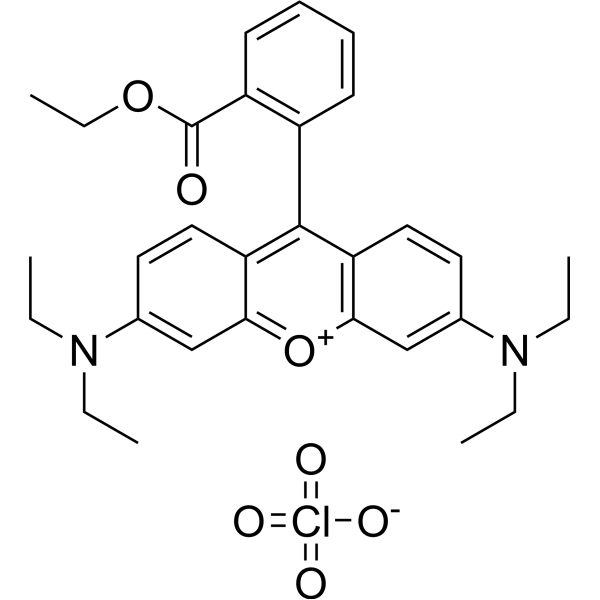
Physicochemical Properties
| Molecular Formula | C30H35N2O3+.O4CL- |
| Molecular Weight | 571.0611 |
| Exact Mass | 570.213 |
| CAS # | 23857-69-4 |
| PubChem CID | 65205 |
| Appearance | Typically exists as solid at room temperature |
| LogP | 7.617 |
| Hydrogen Bond Donor Count | 0 |
| Hydrogen Bond Acceptor Count | 8 |
| Rotatable Bond Count | 9 |
| Heavy Atom Count | 40 |
| Complexity | 937 |
| Defined Atom Stereocenter Count | 0 |
| SMILES | CCN(CC)C1=CC2=C(C=C1)C(=C3C=CC(=[N+](CC)CC)C=C3O2)C4=CC=CC=C4C(=O)OCC.[O-]Cl(=O)(=O)=O |
| InChi Key | KEPZSONXOSOCGC-UHFFFAOYSA-M |
| InChi Code | InChI=1S/C30H35N2O3.ClHO4/c1-6-31(7-2)21-15-17-25-27(19-21)35-28-20-22(32(8-3)9-4)16-18-26(28)29(25)23-13-11-12-14-24(23)30(33)34-10-5;2-1(3,4)5/h11-20H,6-10H2,1-5H3;(H,2,3,4,5)/q+1;/p-1 |
| Chemical Name | [6-(diethylamino)-9-(2-ethoxycarbonylphenyl)xanthen-3-ylidene]-diethylazanium;perchlorate |
| Synonyms | 23857-69-4; Rhodamine 3B (perchlorate); Xanthylium, 3,6-bis(diethylamino)-9-(2-(ethoxycarbonyl)phenyl)-, perchlorate; Xanthylium, 3,6-bis(diethylamino)-9-[2-(ethoxycarbonyl)phenyl]-, perchlorate; DTXSID2066937; Xanthylium, 3,6-bis(diethylamino)-9-(2-(ethoxycarbonyl)phenyl)-, perchlorate (1:1); Xanthylium, 3,6-bis(diethylamino)-9-[2-(ethoxycarbonyl)phenyl]-, perchlorate (1:1); SCHEMBL9638625; |
| HS Tariff Code | 2934.99.9001 |
| Storage |
Powder-20°C 3 years 4°C 2 years In solvent -80°C 6 months -20°C 1 month |
| Shipping Condition | Room temperature (This product is stable at ambient temperature for a few days during ordinary shipping and time spent in Customs) |
Biological Activity
| Targets | Plasmodium falciparum |
| ln Vitro | The effects of eight permeant fluorescent dyes on the in vitro growth of Plasmodium falciparum was investigated. First, P. falciparum-infected human erythrocytes were synchronized with D-sorbitol and treated with the cationic fluorescent dye rhodamine 123 at 37 degrees C for 30 minutes, and the growth of the treated parasites monitored by examining daily parasitaemias. Rhodamine 123 inhibited the parasite growth at more than 5 microM, the 50% effective concentration being 6 microM. Ring forms and trophozoites were more susceptible to the dye than schizonts. The development of dye-treated ring forms and trophozoites to schizonts was greatly inhibited, and so few new ring forms were produced. In contrast, the dye-treated schizonts produced a large number of new ring forms, though to a slightly lesser extent than untreated schizonts. The rhodamine 123-induced growth inhibition was partially reversed by treating the dye-pre-exposed infected erythrocytes with the proton ionophore carbonyl-cyanide m-chlorophenylhydrazone, which dissipates transmembrane proton gradients. A survey of seven other fluorescent dyes demonstrated that the cationic dyes, including rhodamine 123, rhodamine 6G, rhodamine 6G perchlorate and rhodamine 3B perchlorate, exerted the growth inhibitory effect, whereas the neutral dyes rhodamine B, rhodamine 110, and rhodamine 19 perchlorate, and the anionic dye fluorescein, did not. Fluorescent microscopy revealed that P. falciparum accumulated the cationic dyes but not the neutral and anionic dyes. These results indicate that the cationic rhodamine dyes, which accumulated in the parasite, inhibit the growth of P. falciparum.[1] |
| References | [1]. Inhibition of in vitro growth of Plasmodium falciparum by a brief exposure to the cationic rhodamine dyes. Ann Trop Med Parasitol . 1986 Jun;80(3):299-305. |
Solubility Data
| Solubility (In Vitro) | May dissolve in DMSO (in most cases), if not, try other solvents such as H2O, Ethanol, or DMF with a minute amount of products to avoid loss of samples |
| Solubility (In Vivo) |
Note: Listed below are some common formulations that may be used to formulate products with low water solubility (e.g. < 1 mg/mL), you may test these formulations using a minute amount of products to avoid loss of samples. Injection Formulations (e.g. IP/IV/IM/SC) Injection Formulation 1: DMSO : Tween 80: Saline = 10 : 5 : 85 (i.e. 100 μL DMSO stock solution → 50 μL Tween 80 → 850 μL Saline) *Preparation of saline: Dissolve 0.9 g of sodium chloride in 100 mL ddH ₂ O to obtain a clear solution. Injection Formulation 2: DMSO : PEG300 :Tween 80 : Saline = 10 : 40 : 5 : 45 (i.e. 100 μL DMSO → 400 μLPEG300 → 50 μL Tween 80 → 450 μL Saline) Injection Formulation 3: DMSO : Corn oil = 10 : 90 (i.e. 100 μL DMSO → 900 μL Corn oil) Example: Take the Injection Formulation 3 (DMSO : Corn oil = 10 : 90) as an example, if 1 mL of 2.5 mg/mL working solution is to be prepared, you can take 100 μL 25 mg/mL DMSO stock solution and add to 900 μL corn oil, mix well to obtain a clear or suspension solution (2.5 mg/mL, ready for use in animals). Injection Formulation 4: DMSO : 20% SBE-β-CD in saline = 10 : 90 [i.e. 100 μL DMSO → 900 μL (20% SBE-β-CD in saline)] *Preparation of 20% SBE-β-CD in Saline (4°C,1 week): Dissolve 2 g SBE-β-CD in 10 mL saline to obtain a clear solution. Injection Formulation 5: 2-Hydroxypropyl-β-cyclodextrin : Saline = 50 : 50 (i.e. 500 μL 2-Hydroxypropyl-β-cyclodextrin → 500 μL Saline) Injection Formulation 6: DMSO : PEG300 : castor oil : Saline = 5 : 10 : 20 : 65 (i.e. 50 μL DMSO → 100 μLPEG300 → 200 μL castor oil → 650 μL Saline) Injection Formulation 7: Ethanol : Cremophor : Saline = 10: 10 : 80 (i.e. 100 μL Ethanol → 100 μL Cremophor → 800 μL Saline) Injection Formulation 8: Dissolve in Cremophor/Ethanol (50 : 50), then diluted by Saline Injection Formulation 9: EtOH : Corn oil = 10 : 90 (i.e. 100 μL EtOH → 900 μL Corn oil) Injection Formulation 10: EtOH : PEG300:Tween 80 : Saline = 10 : 40 : 5 : 45 (i.e. 100 μL EtOH → 400 μLPEG300 → 50 μL Tween 80 → 450 μL Saline) Oral Formulations Oral Formulation 1: Suspend in 0.5% CMC Na (carboxymethylcellulose sodium) Oral Formulation 2: Suspend in 0.5% Carboxymethyl cellulose Example: Take the Oral Formulation 1 (Suspend in 0.5% CMC Na) as an example, if 100 mL of 2.5 mg/mL working solution is to be prepared, you can first prepare 0.5% CMC Na solution by measuring 0.5 g CMC Na and dissolve it in 100 mL ddH2O to obtain a clear solution; then add 250 mg of the product to 100 mL 0.5% CMC Na solution, to make the suspension solution (2.5 mg/mL, ready for use in animals). Oral Formulation 3: Dissolved in PEG400 Oral Formulation 4: Suspend in 0.2% Carboxymethyl cellulose Oral Formulation 5: Dissolve in 0.25% Tween 80 and 0.5% Carboxymethyl cellulose Oral Formulation 6: Mixing with food powders Note: Please be aware that the above formulations are for reference only. InvivoChem strongly recommends customers to read literature methods/protocols carefully before determining which formulation you should use for in vivo studies, as different compounds have different solubility properties and have to be formulated differently. (Please use freshly prepared in vivo formulations for optimal results.) |
| Preparing Stock Solutions | 1 mg | 5 mg | 10 mg | |
| 1 mM | 1.7511 mL | 8.7556 mL | 17.5113 mL | |
| 5 mM | 0.3502 mL | 1.7511 mL | 3.5023 mL | |
| 10 mM | 0.1751 mL | 0.8756 mL | 1.7511 mL |