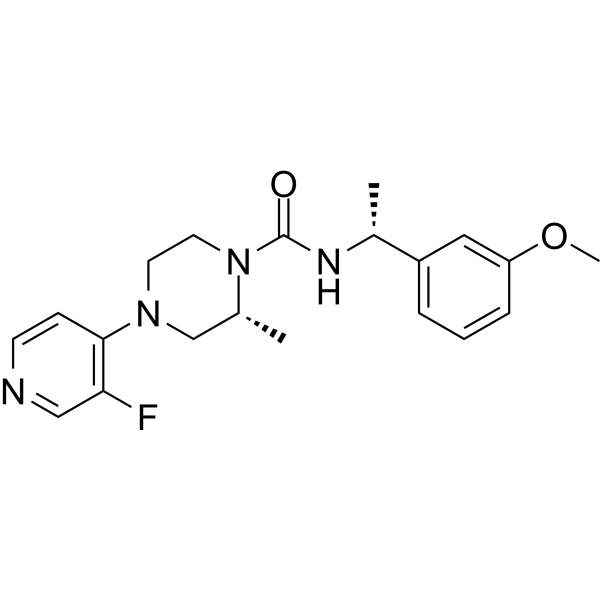
Physicochemical Properties
| Molecular Formula | C20H25FN4O2 |
| Molecular Weight | 372.436507940292 |
| Exact Mass | 372.196 |
| CAS # | 2573071-18-6 |
| PubChem CID | 155749520 |
| Appearance | Light yellow to yellow solid powder |
| LogP | 2.5 |
| Hydrogen Bond Donor Count | 1 |
| Hydrogen Bond Acceptor Count | 5 |
| Rotatable Bond Count | 4 |
| Heavy Atom Count | 27 |
| Complexity | 495 |
| Defined Atom Stereocenter Count | 2 |
| SMILES | N1(C(N[C@@H](C2=CC=CC(OC)=C2)C)=O)CCN(C2C=CN=CC=2F)C[C@H]1C |
| InChi Key | CIPXFTLGPVQJKN-HUUCEWRRSA-N |
| InChi Code | InChI=1S/C20H25FN4O2/c1-14-13-24(19-7-8-22-12-18(19)21)9-10-25(14)20(26)23-15(2)16-5-4-6-17(11-16)27-3/h4-8,11-12,14-15H,9-10,13H2,1-3H3,(H,23,26)/t14-,15-/m1/s1 |
| Chemical Name | (2R)-4-(3-fluoropyridin-4-yl)-N-[(1R)-1-(3-methoxyphenyl)ethyl]-2-methylpiperazine-1-carboxamide |
| HS Tariff Code | 2934.99.9001 |
| Storage |
Powder-20°C 3 years 4°C 2 years In solvent -80°C 6 months -20°C 1 month |
| Shipping Condition | Room temperature (This product is stable at ambient temperature for a few days during ordinary shipping and time spent in Customs) |
Biological Activity
| ln Vitro | Rho-Kinase-IN-2 (0–10 mM, 1 hour) therapy resulted in decreased MYPT1 phosphorylation and enhanced AKT phosphorylation [1]. |
| ln Vivo | Rho-Kinase-IN-2 (orally given; 10 mg/kg; 6 times; 0.5, 1, 2, 4, 8, and 12 hours) therapy exhibited dose- and time-dependent ROCK1 and ROCK2 target engagement [1]. Rho-Kinase-IN-2 (oral; 10 or 20 mg/kg; QD or BID; 2 weeks) treatment revealed excellent tolerance assessment [1]. Treatment with Rho-Kinase-IN-2 (oral; 1-20 mg/kg; once) indicates a direct dose- and time-dependent link between brain exposure and MYPT1 phosphorylation status [1]. Treatment with Rho-Kinase-IN-2 (oral; 10 or 20 mg/kg; once) decreases mean arterial pressure, systolic blood pressure, diastolic blood pressure, and heart rate [1]. Treatment with Rho-Kinase-IN-2 (orally; 10 mg/kg; twice daily; 90 days) resulted in lower than predicted brain concentrations [1]. |
| Cell Assay |
Western Blot Analysis[1] Cell Types: A7r5 and PANC1 Cell Tested Concentrations: 0-10 mM Incubation Duration: 1 hour Experimental Results: demonstrated concentration-dependent effects resulting in increased phosphorylation of AKT (EC50=28 nM) and diminished phosphorylation of MYPT1 (IC50 =14 nM). |
| Animal Protocol |
Animal/Disease Models: 3 to 4 months old heterozygous Q175DN KI and wild-type littermate mice [1] Doses: 10 or 20 mg/kg Route of Administration: po (po (oral gavage)) 10 or 20 mg/kg; one time/day or twice a day; 2-week Experimental Results: Neurologic indices were normal at all doses, although body weight diminished slightly (∼2%) in the 20 mg/kg treatment group. Animal/Disease Models: Heterozygous HTT zQ175DN knock-in mice [1] Doses: 1-20 mg/kg Route of Administration: Oral; 1-20 mg/kg; Experimental Results: Maintained over MYPT1 in free brain at 10 mg/kg dose IC50 exceeded 2 hrs (hrs (hours)), and dose- and time-dependent inhibition of MYPT1 phosphorylation in the striatum was observed after acute in vivo administration. Animal/Disease Models: CD1 mice [1] Doses: 10 and 20 mg/kg Route of Administration: Oral; 10 or 20 mg/kg; Experimental Results: Mean arterial pressure (maximum change from baseline 61.0 ± 8.5 mmHg), Systolic blood pressure (maximum change from baseline was 59.5 ± 8.4 mmHg), diastolic blood pressure (maximum change from baseline was 56.4 ± 9.0 mmHg), heart rate wi |
| References |
[1]. Identification of a Potent, Selective, and Brain-Penetrant Rho Kinase Inhibitor and its Activity in a Mouse Model of Huntington's Disease. J Med Chem. 2022 Jul 11. |
Solubility Data
| Solubility (In Vitro) | DMSO : ~50 mg/mL (~134.25 mM) |
| Solubility (In Vivo) |
Solubility in Formulation 1: ≥ 2 mg/mL (5.37 mM) (saturation unknown) in 10% DMSO + 40% PEG300 + 5% Tween80 + 45% Saline (add these co-solvents sequentially from left to right, and one by one), clear solution. For example, if 1 mL of working solution is to be prepared, you can add 100 μL of 20.0 mg/mL clear DMSO stock solution to 400 μL PEG300 and mix evenly; then add 50 μL Tween-80 to the above solution and mix evenly; then add 450 μL normal saline to adjust the volume to 1 mL. Preparation of saline: Dissolve 0.9 g of sodium chloride in 100 mL ddH₂ O to obtain a clear solution. Solubility in Formulation 2: ≥ 2 mg/mL (5.37 mM) (saturation unknown) in 10% DMSO + 90% (20% SBE-β-CD in Saline) (add these co-solvents sequentially from left to right, and one by one), clear solution. For example, if 1 mL of working solution is to be prepared, you can add 100 μL of 20.0 mg/mL clear DMSO stock solution to 900 μL of 20% SBE-β-CD physiological saline solution and mix evenly. Preparation of 20% SBE-β-CD in Saline (4°C,1 week): Dissolve 2 g SBE-β-CD in 10 mL saline to obtain a clear solution. Solubility in Formulation 3: ≥ 2 mg/mL (5.37 mM) (saturation unknown) in 10% DMSO + 90% Corn Oil (add these co-solvents sequentially from left to right, and one by one), clear solution. For example, if 1 mL of working solution is to be prepared, you can add 100 μL of 20.0 mg/mL clear DMSO stock solution to 900 μL of corn oil and mix evenly. (Please use freshly prepared in vivo formulations for optimal results.) |
| Preparing Stock Solutions | 1 mg | 5 mg | 10 mg | |
| 1 mM | 2.6850 mL | 13.4250 mL | 26.8500 mL | |
| 5 mM | 0.5370 mL | 2.6850 mL | 5.3700 mL | |
| 10 mM | 0.2685 mL | 1.3425 mL | 2.6850 mL |