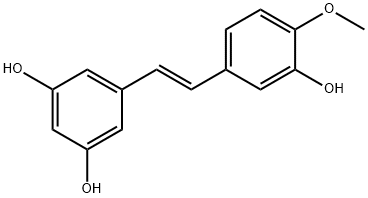
Rhapontigenin is a novel and potent analog of resveratrol with multipul bioactivities such as antifungal, anticancer, antioxidant and antibacterial activities. Rhapontigenin is amechanism-based cytochrome P450 1A1 inactivator with IC50 of 400 nM.
Physicochemical Properties
| Molecular Formula | C15H14O4 |
| Molecular Weight | 258.2693 |
| Exact Mass | 258.089 |
| CAS # | 500-65-2 |
| PubChem CID | 5320954 |
| Appearance | Light yellow to yellow solid powder |
| Density | 1.3±0.1 g/cm3 |
| Boiling Point | 503.6±38.0 °C at 760 mmHg |
| Melting Point | 186-187ºC |
| Flash Point | 258.4±26.8 °C |
| Vapour Pressure | 0.0±1.3 mmHg at 25°C |
| Index of Refraction | 1.722 |
| LogP | 2.82 |
| Hydrogen Bond Donor Count | 3 |
| Hydrogen Bond Acceptor Count | 4 |
| Rotatable Bond Count | 3 |
| Heavy Atom Count | 19 |
| Complexity | 295 |
| Defined Atom Stereocenter Count | 0 |
| SMILES | COC1=C(C=C(C=C1)/C=C/C2=CC(=CC(=C2)O)O)O |
| InChi Key | PHMHDRYYFAYWEG-NSCUHMNNSA-N |
| InChi Code | InChI=1S/C15H14O4/c1-19-15-5-4-10(8-14(15)18)2-3-11-6-12(16)9-13(17)7-11/h2-9,16-18H,1H3/b3-2+ |
| Chemical Name | 5-[(E)-2-(3-hydroxy-4-methoxyphenyl)ethenyl]benzene-1,3-diol |
| HS Tariff Code | 2934.99.9001 |
| Storage |
Powder-20°C 3 years 4°C 2 years In solvent -80°C 6 months -20°C 1 month Note: This product requires protection from light (avoid light exposure) during transportation and storage. |
| Shipping Condition | Room temperature (This product is stable at ambient temperature for a few days during ordinary shipping and time spent in Customs) |
Biological Activity
| ln Vitro | In HEP G2 cells, rhapontigenin (0-250 μM; 24 hours) demonstrates concentration-dependent anticancer activity with an IC50 of 115 μM [1]. 20 μM; 20 hours) of Rhapontigenin It reduces the amount of TGF-β that triggers certain collagens. TGF-β-induced expression of vimentin, N-cadherin, and CA9 is inhibited in a dependent way by hapontigenin (0 – 20 μM; 6 hours), with IC50 values of 4 and 70 μg/mL, respectively [2–3]. The release of the 13-hexose acidic enzyme brought on by DNP-BSA is inhibited by Rhein. in RBL 2H3 cells, and its IC50 value |
| ln Vivo | Rapontigenin (intraperitoneal injection; 25 mg/kg) has a significant protective effect against death from pulmonary artery thrombosis in mice administered orally 90 minutes before tail vein injection of rapontigenin and collagen [3]. |
| Cell Assay |
Western Blot analysis [2] Cell Types: HeLa, A549,769-P Cell Tested Concentrations: 0 μM; 0.03 mM[3]. 2.5μM; 5μM; 10μM; 20 μM Incubation Duration: 6 hrs (hours) Experimental Results: Induces HIF-1α ubiquitination and degradation. |
| Animal Protocol |
Animal/Disease Models: ICR mice [3] Doses: 25mg/kg Administration Doses: 25mg/kg; intraperitoneal (ip) injection Experimental Results:60% anti-thrombotic activity. |
| References |
[1]. Preparative enzymatic synthesis and HPLC analysis of rhapontigenin: applications to metabolism, pharmacokinetics and anti-cancer studies.J Pharm Pharm Sci. 2005 Aug 22;8(3):374-86. [2]. Rhapontigenin inhibits TGF-β-mediated epithelial‑mesenchymal transition via the PI3K/AKT/mTOR pathway and is not associated with HIF-1α degradation.Oncol Rep. 2016 May;35(5):2887-95. [3]. Antithrombotic and antiallergic activities of rhaponticin from Rhei Rhizoma are activated by human intestinal bacteria.Arch Pharm Res. 2002 Aug;25(4):528-33. |
| Additional Infomation |
Rhapontigenin is a stilbenoid. Rhapontigenin has been reported in Gnetum hainanense, Iris domestica, and other organisms with data available. |
Solubility Data
| Solubility (In Vitro) | DMSO : ~125 mg/mL (~483.99 mM) |
| Solubility (In Vivo) |
Solubility in Formulation 1: ≥ 2.08 mg/mL (8.05 mM) (saturation unknown) in 10% DMSO + 40% PEG300 + 5% Tween80 + 45% Saline (add these co-solvents sequentially from left to right, and one by one), clear solution. For example, if 1 mL of working solution is to be prepared, you can add 100 μL of 20.8 mg/mL clear DMSO stock solution to 400 μL PEG300 and mix evenly; then add 50 μL Tween-80 to the above solution and mix evenly; then add 450 μL normal saline to adjust the volume to 1 mL. Preparation of saline: Dissolve 0.9 g of sodium chloride in 100 mL ddH₂ O to obtain a clear solution. Solubility in Formulation 2: ≥ 2.08 mg/mL (8.05 mM) (saturation unknown) in 10% DMSO + 90% (20% SBE-β-CD in Saline) (add these co-solvents sequentially from left to right, and one by one), clear solution. For example, if 1 mL of working solution is to be prepared, you can add 100 μL of 20.8 mg/mL clear DMSO stock solution to 900 μL of 20% SBE-β-CD physiological saline solution and mix evenly. Preparation of 20% SBE-β-CD in Saline (4°C,1 week): Dissolve 2 g SBE-β-CD in 10 mL saline to obtain a clear solution. (Please use freshly prepared in vivo formulations for optimal results.) |
| Preparing Stock Solutions | 1 mg | 5 mg | 10 mg | |
| 1 mM | 3.8719 mL | 19.3596 mL | 38.7192 mL | |
| 5 mM | 0.7744 mL | 3.8719 mL | 7.7438 mL | |
| 10 mM | 0.3872 mL | 1.9360 mL | 3.8719 mL |