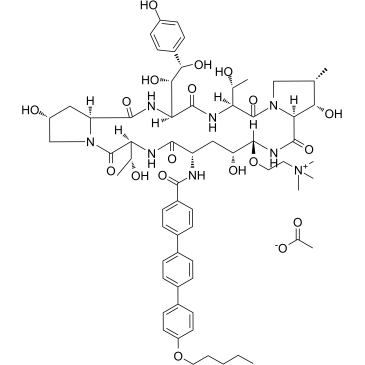
Rezafungin acetate (Biafungin; CD101 acetate; SP-3025 acetate; Rezzayo) is a novel, broad-spectrum, and long-lasting echinocandin with antifungal activity against Candida spp., Aspergillus spp., and Pneumocystis spp and subsets of echinocandin-resistant Candida auris and azole-resistant Aspergillus isolates. It is chemically related with anidulafungin, and acts as a 1,3-β-D-glucan synthase inhibitor. In Mar 2023, it has been approved by FDA for the treatment of Candidiasis.
Physicochemical Properties
| Molecular Formula | C65H88N8O19 |
| Molecular Weight | 1285.43643856049 |
| Exact Mass | 1225.602 |
| Elemental Analysis | C, 60.73; H, 6.90; N, 8.72; O, 23.65 |
| CAS # | 1631754-41-0 |
| Related CAS # | Rezafungin;1396640-59-7 |
| PubChem CID | 78318119 |
| Appearance | White to off-white solid powder |
| LogP | 2.9 |
| Hydrogen Bond Donor Count | 13 |
| Hydrogen Bond Acceptor Count | 17 |
| Rotatable Bond Count | 18 |
| Heavy Atom Count | 88 |
| Complexity | 2300 |
| Defined Atom Stereocenter Count | 15 |
| SMILES | CCCCCOC1=CC=C(C=C1)C2=CC=C(C=C2)C3=CC=C(C=C3)C(=O)N[C@H]4C[C@H]([C@H](NC(=O)[C@@H]5[C@H]([C@H](CN5C(=O)[C@@H](NC(=O)[C@@H](NC(=O)[C@@H]6C[C@H](CN6C(=O)[C@@H](NC4=O)[C@@H](C)O)O)[C@@H]([C@H](C7=CC=C(C=C7)O)O)O)[C@@H](C)O)C)O)OCC[N+](C)(C)C)O |
| InChi Key | MXMWJAPNUIKPGF-DPHATNFGSA-N |
| InChi Code | InChI=1S/C63H84N8O17.C2H4O2/c1-8-9-10-28-87-45-25-21-40(22-26-45)38-13-11-37(12-14-38)39-15-17-42(18-16-39)56(80)64-46-31-48(76)61(88-29-27-71(5,6)7)68-60(84)52-53(77)34(2)32-70(52)63(86)50(36(4)73)66-59(83)51(55(79)54(78)41-19-23-43(74)24-20-41)67-58(82)47-30-44(75)33-69(47)62(85)49(35(3)72)65-57(46)811-2(3)4/h11-26,34-36,44,46-55,61,72-73,75-79H,8-10,27-33H2,1-7H3,(H5-,64,65,66,67,68,74,80,81,82,83,84)1H3,(H,3,4)/t34-,35+,36+,44+,46-,47-,48+,49?,50-,51?,52-,53-,54-,55-,61+/m0./s1 |
| Chemical Name | 2-(((2R,9S,11R,12R,14aS,15S,16S,20S,25aS)-23-((1S,2S)-1,2-dihydroxy-2-(4-hydroxyphenyl)ethyl)-2,11,15-trihydroxy-6,20-bis((R)-1-hydroxyethyl)-16-methyl-5,8,14,19,22,25-hexaoxo-9-(4''-(pentyloxy)-[1,1' |
| Synonyms | Rezafungin; Rezzayo; Biafungin; SP-3025; 1396640-59-7; Rezafungin ion; Rezafungin cation; CD-101SP; 3025 CD101; SP3025; CD 101. |
| HS Tariff Code | 2934.99.9001 |
| Storage |
Powder-20°C 3 years 4°C 2 years In solvent -80°C 6 months -20°C 1 month Note: Please store this product in a sealed and protected environment, avoid exposure to moisture. |
| Shipping Condition | Room temperature (This product is stable at ambient temperature for a few days during ordinary shipping and time spent in Customs) |
Biological Activity
| Targets | 1,3-β-D-glucan synthase enzyme complex in the cell walls of fungi |
| ln Vitro | Rezafungin is an echinocandin antifungal drug. It inhibits the 1,3-β-D-glucan synthase enzyme complex present in the cell walls of fungi, responsible for the formation of 1,3-β-D-glucan. Since 1,3-β-D-glucan is an essential component of fungal cell walls, rezafungin disrupts the cell wall of fungal species, including _Candida_ spp., and acts as a concentration-dependent _in vitro_ fungicidal. Mammalian cells do not express β-1-3-glucan synthase; therefore, the action of rezafungin is specific to fungi. Rezafungin is a member of the family of echinocandins that inhibits 1,3-beta-D-glucan synthase. |
| ln Vivo | In a mouse infection model, rezafunginacetate (Biafunginacetate) (1 mg/kg; i.p. once daily for 6 days) has demonstrated efficient in vivo prophylaxis against Pneumocystis jiroveci [1]. |
| Animal Protocol |
Animal/Disease Models: C3H/HeN mice [1] Doses: 1 mg/kg Route of Administration: intraperitoneal (ip) injection; one time/day for 6 days Experimental Results: The burden of cell nuclei and ascus was Dramatically diminished. |
| ADME/Pharmacokinetics |
Absorption Between 50 mg (0.125 times the approved maximum recommended loading dose) and 400 mg and with single or multiple doses, the Cmax and AUC of rezafungin increase in a dose-proportional manner. In patients with candidemia and invasive candidias given an initial 400 mg loading dose of rezafungin, followed by a 200 mg dose once weekly, the Cmax, AUC from time zero to 168 hours post-dose (AUC0-168) and Cmin on day 1 were 19.2 mcg/mL, 827 mcg⋅h/mL and 2.4 mcg/mL, respectively. In the same group of patients, the Cmax, AUC0-168 and Cmin on day 15 were 11.8 mcg/mL, 667 mcg⋅h/mL and 2.2 mcg/mL, respectively. Compared to healthy subjects, the AUC0-168 and Cmax were 30% and 19% lower in patients with candidemia. Age, sex, race, weight and hepatic impairment did not have a clinically significant effect on rezafungin pharmacokinetics. Route of Elimination Rezafungin is mainly eliminated through fecal excretion. In healthy subjects, 74.3% was recovered in feces primarily as rezafungin, while 25.7% was recovered in urine primarily as inactive metabolites of rezafungin. Volume of Distribution Rezafungin has a volume of distribution of 67 L. Clearance Rezafungin has an elimination clearance of 0.35 L/hr. Protein Binding Rezafungin is highly protein bound. Protein binding goes from 87.5% to 93.6% in patients, and from 95.6% to >98.6% in healthy adults. Metabolism / Metabolites Rezafungin is metabolized by hydroxylation of the terphenyl, pentyl ether side chain, to form three hydroxylated metabolite isomers: 2’-, 3′-, or 4’-hydroxylpentyl rezafungin. Rezafungin can also be metabolized through a reaction that involves the loss of the pentyl group via O-dealkylation, forming despentyl-rezafungin. There is minimal subsequent conjugation (sulfation) of the hydroxyl metabolites. Rezafungin is not metabolized in the liver and is not expected to be a clinically relevant substrate of CYP450 enzymes. Biological Half-Life Rezafungin has a terminal half-life of 152 hours. |
| Toxicity/Toxicokinetics |
Effects During Pregnancy and Lactation ◉ Summary of Use during Lactation No information is available on the use of rezafungin during breastfeeding. Because rezafungin is about 90% bound to plasma proteins and has poor oral bioavailability, it is unlikely to reach the milk and be absorbed by the infant. If rezafungin is required by the mother, it is not a reason to discontinue breastfeeding. ◉ Effects in Breastfed Infants Relevant published information was not found as of the revision date. ◉ Effects on Lactation and Breastmilk Relevant published information was not found as of the revision date. |
| References |
[1]. Rezafungin Prophylactic Efficacy in a Mouse Model of Pneumocystis Pneumonia. VOLUME 25, ISSUE 3, SUPPLEMENT, S366, MARCH 01, 2019. [2]. Rezafungin (CD101), a next-generation echinocandin: A systematic literature review and assessment of possible place in therapy. J Glob Antimicrob Resist. 2018 Sep;14:58-64. |
| Additional Infomation |
Rezafungin is a member of the family of echinocandins that inhibits 1,3-beta-D-glucan synthase. It is developed by Cidara Therapeutics and approved for the treatment of candidaemia and invasive candidiasis in patients aged >= 18 years who have limited or no alternative treatment options. It is an echinocandin, a quaternary ammonium ion, an antibiotic antifungal drug, an azamacrocycle, a homodetic cyclic peptide and an aromatic ether. Rezafungin is an Echinocandin Antifungal. Rezafungin is a next-generation, semi-synthetic, cyclic lipopeptide and echinocandin derivative, with potential antifungal activity. Upon administration, rezafungin inhibits the fungal specific enzyme 1,3-beta-D-glucan synthase, which is essential for fungal cell wall synthesis, and results in decreased synthesis of beta(1,3)-D-glucan. This weakens the fungal cell wall thereby causing osmotic lysis, fungal cell wall rupture and fungal cell death. See Rezafungin is an echinocandin antifungal drug. Unlike other echinocandins such as [caspofungin] and [micafungin], rezafungin has long‐acting pharmacokinetics and a high stability that allows for it to have long dosing intervals maintaining high plasma exposure. Rezafungin has a half-life higher than 130 hours and can be administered once a week instead of daily. It can only be administered intravenously but does not reach therapeutic concentrations in the central nervous system, eye and urine. Rezafungin is active against Candida albicans, Candida glabrata, Candida parapsilosis and Candida tropicalis, as well as other Candida and Aspergillus spp. Clinical studies have shown that rezafungin is non-inferior to caspofungin for the treatment of candidaemia and invasive candidiasis. In March 2023, the FDA approved rezafungin for injection for the treatment of candidemia and invasive candidiasis in adults with limited or no alternative treatment options. It was subsequently approved in the EU in November of the same year. |
Solubility Data
| Solubility (In Vitro) | DMSO : ~230 mg/mL (~178.93 mM) |
| Solubility (In Vivo) |
Solubility in Formulation 1: ≥ 5.75 mg/mL (4.47 mM) (saturation unknown) in 10% DMSO + 40% PEG300 + 5% Tween80 + 45% Saline (add these co-solvents sequentially from left to right, and one by one), clear solution. For example, if 1 mL of working solution is to be prepared, you can add 100 μL of 57.5 mg/mL clear DMSO stock solution to 400 μL PEG300 and mix evenly; then add 50 μL Tween-80 to the above solution and mix evenly; then add 450 μL normal saline to adjust the volume to 1 mL. Preparation of saline: Dissolve 0.9 g of sodium chloride in 100 mL ddH₂ O to obtain a clear solution. Solubility in Formulation 2: ≥ 5.75 mg/mL (4.47 mM) (saturation unknown) in 10% DMSO + 90% (20% SBE-β-CD in Saline) (add these co-solvents sequentially from left to right, and one by one), clear solution. For example, if 1 mL of working solution is to be prepared, you can add 100 μL of 57.5 mg/mL clear DMSO stock solution to 900 μL of 20% SBE-β-CD physiological saline solution and mix evenly. Preparation of 20% SBE-β-CD in Saline (4°C,1 week): Dissolve 2 g SBE-β-CD in 10 mL saline to obtain a clear solution. Solubility in Formulation 3: ≥ 5.75 mg/mL (4.47 mM) (saturation unknown) in 10% DMSO + 90% Corn Oil (add these co-solvents sequentially from left to right, and one by one), clear solution. For example, if 1 mL of working solution is to be prepared, you can add 100 μL of 57.5 mg/mL clear DMSO stock solution to 900 μL of corn oil and mix evenly. (Please use freshly prepared in vivo formulations for optimal results.) |
| Preparing Stock Solutions | 1 mg | 5 mg | 10 mg | |
| 1 mM | 0.7779 mL | 3.8897 mL | 7.7794 mL | |
| 5 mM | 0.1556 mL | 0.7779 mL | 1.5559 mL | |
| 10 mM | 0.0778 mL | 0.3890 mL | 0.7779 mL |