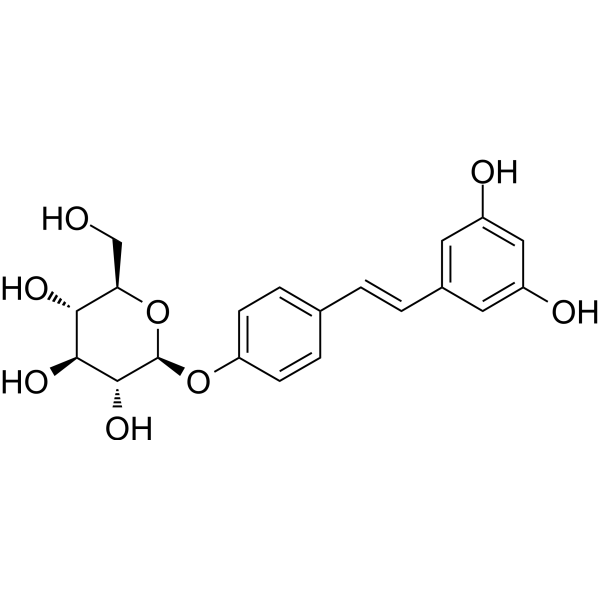
Physicochemical Properties
| Molecular Formula | C20H22O8 |
| Molecular Weight | 390.3839 |
| Exact Mass | 404.111 |
| CAS # | 38963-95-0 |
| PubChem CID | 5322089 |
| Appearance | White to off-white solid powder |
| Density | 1.521±0.06 g/cm3 |
| Melting Point | 235-238 ºC |
| LogP | 0.539 |
| Hydrogen Bond Donor Count | 6 |
| Hydrogen Bond Acceptor Count | 8 |
| Rotatable Bond Count | 5 |
| Heavy Atom Count | 28 |
| Complexity | 496 |
| Defined Atom Stereocenter Count | 5 |
| SMILES | C1=CC(=CC=C1/C=C/C2=CC(=CC(=C2)O)O)O[C@H]3[C@@H]([C@H]([C@@H]([C@H](O3)CO)O)O)O |
| InChi Key | RUOKEYJFAJITAG-CUYWLFDKSA-N |
| InChi Code | InChI=1S/C20H22O8/c21-10-16-17(24)18(25)19(26)20(28-16)27-15-5-3-11(4-6-15)1-2-12-7-13(22)9-14(23)8-12/h1-9,16-26H,10H2/b2-1+/t16-,17-,18+,19-,20-/m1/s1 |
| Chemical Name | (2S,3R,4S,5S,6R)-2-[4-[(E)-2-(3,5-dihydroxyphenyl)ethenyl]phenoxy]-6-(hydroxymethyl)oxane-3,4,5-triol |
| Synonyms | Resveratroloside; 38963-95-0; GOB C; 7DBS6RKM2S; (2S,3R,4S,5S,6R)-2-[4-[(E)-2-(3,5-dihydroxyphenyl)ethenyl]phenoxy]-6-(hydroxymethyl)oxane-3,4,5-triol; Resveratrol 4'-glucoside; (2S,3R,4S,5S,6R)-2-(4-((E)-3,5-Dihydroxystyryl)phenoxy)-6-(hydroxymethyl)tetrahydro-2H-pyran-3,4,5-triol; 4-(2-(3,5-Dihydroxyphenyl)ethenyl)phenyl beta-D-glucopyranoside; |
| HS Tariff Code | 2934.99.9001 |
| Storage |
Powder-20°C 3 years 4°C 2 years In solvent -80°C 6 months -20°C 1 month Note: This product requires protection from light (avoid light exposure) during transportation and storage. |
| Shipping Condition | Room temperature (This product is stable at ambient temperature for a few days during ordinary shipping and time spent in Customs) |
Biological Activity
| Targets | α-glucosidase (IC50 = 22.9 μM) |
| ln Vivo |
The regulation of postprandial blood glucose (PBG) levels is an effective therapeutic method to treat diabetes and prevent diabetes-related complications. Resveratroloside is a monoglucosylated form of stilbene that is present in red wine, grapes, and several traditional medicinal plants. In our study, the effect of resveratroloside on reducing PBG was studied in vitro and in vivo. In comparison to the starch treatment alone, the oral administration of resveratroloside-starch complexes significantly inhibited the PBG increase in a dose-dependent pattern in normal and diabetic mice. The PBG level treated with resveratrol (30 mg/kg) was not lower than that of resveratroloside. Further analyses demonstrated that resveratroloside strongly and effectively inhibited α-glucosidase, with an 50% inhibitory concentration value of 22.9 ± 0.17 μM, and its inhibition was significantly stronger than those of acarbose and resveratrol (264 ± 3.27 and 108 ± 2.13 μM). Moreover, a competitive inhibition mechanism of resveratroloside on α-glucosidase was determined by enzyme kinetic assays and molecular docking experiments. The molecular docking of resveratroloside with α-glucosidase demostrated the competitive inhibitory effect of resveratroloside, which occupies the catalytic site and forms strong hydrogen bonds with the residues of α-glucosidase. Resveratrol was also determined to be a competitive inhibition mechanism on α-glucosidase by enzyme kinetic assays and molecular docking experiments. This study suggested that resveratroloside had the ability to regulate PBG levels and can be considered a potential agent for the treatment of diabetes mellitus.[1] Cardioprotective effect of resveratrol and resveratroloside was determined in ischemia-reperfusion experiments on rats. It was found that single intraperitoneal administration of any compound (10 mg/kg) followed by 30-min ischemia and 120-min reperfusion resulted in statistically significant decrease of myocardial infarct area (55.0±4.0% for control group; 40.7±4.4% for the group 1 received resveratrol; 41.6±4.8% for the group 2 received resveratroloside). The cardioprotective effect of resveratroloside was detected for the first time.[2] |
| Enzyme Assay |
α-Glucosidase Inhibition Assay[1] The α-glucosidase inhibition assay was carried out on the basis of the method reported by Zhao et al., with minor modifications. Different concentrations of resveratroloside (13.0, 26.0, 52.0, 104, 208, 416, and 833 μM) and 50 μL of α-glucosidase (0.6 unit/mL) from S. cerevisiae in 0.1 M phosphate buffer (pH 6.5) were added to a 96-well microplate and incubated for 10 min at 37 °C. Then, 50 μL of pNPG (0.5 mM) was added to the above mixed solution as a substrate to initiate the reaction. The 96-well microplate was incubated at 37 °C for an additional 20 min, followed by adding 50 μL of Na2CO3 (0.1 M) to stop the reaction. The absorbance of the reaction mixture was detected at 405 nm by a microplate reader. Mechanism of α-Glucosidase Inhibition[1] The general operational steps of the mechanism study are similar to that for the above inhibition experiments. Various concentrations of α-glucosidase (0.4–4.0 units/mL) were incubated with two concentrations of resveratroloside for 10 min at 37 °C. Then, the reaction was initiated by adding 0.8 mM pNPG to the above mixture. The absorbance of the reaction mixture was monitored at 405 nm. All assays were carried out in triplicate. Kinetic Characterization of α-Glucosidase Inhibition[1] The general operational steps for the kinetics of α-glucosidase were also similar to that for the above inhibition experiments. Two concentrations of resveratroloside (16.0 and 32.0 μM) and 0.6 unit/mL α-glucosidase in sodium phosphate buffer were added to a 96-well microplate and incubated for 10 min at 37 °C. Then, the reaction was started by adding various concentrations of pNPG (1.8–0.6 mM) to the above mixture. The absorbance of the reaction mixture was monitored at 405 nm. All assays were carried out in triplicate. The kinetics of α-glucosidase inhibition was analyzed using Lineweaver–Burk plots. |
| Animal Protocol |
Oral Starch Tolerance Test in Normal and Diabetic Mice[1] Normal and diabetic mice were fasted overnight and were randomly assigned into 5 groups of 10 mice: group 1, normal or diabetic mice treated with starch at 6 g/kg; group 2, normal or diabetic mice treated with a low dose of resveratroloside (10 mg/kg) and starch (6 g/kg); group 3, normal or diabetic mice treated with a medium dose of resveratroloside (30 mg/kg) and starch (6 g/kg); group 4, normal or diabetic mice treated with a high dose of resveratroloside (50 mg/kg) and starch (6 g/kg); and group 5, normal or diabetic mice treated with acarbose (10 mg/kg) and starch (6 g/kg). Blood samples from the tail vein were collected at 0, 30, 60, and 120 min, and the blood glucose concentration was determined by a glucometer (Roche Diagnostics GmbH, China). The area under the curve (AUC) was counted on the basis of the following formula: where PBG0, PBG30, PBG60, and PBG120 are the PBG levels at 0, 30, 60, and 120 min, respectively. |
| References |
[1]. Resveratroloside Alleviates Postprandial Hyperglycemia in Diabetic Mice by Competitively Inhibiting α-Glucosidase. J Agric Food Chem. 2019 Mar 13;67(10):2886-2893. [2]. Cardioprotective effect of resveratrol and resveratroloside. Cardiovasc Hematol Agents Med Chem. 2013 Sep;11(3):207-10. |
| Additional Infomation | Resveratroloside has been reported in Pinus sylvestris, Paeonia lactiflora, and other organisms with data available. |
Solubility Data
| Solubility (In Vitro) | May dissolve in DMSO (in most cases), if not, try other solvents such as H2O, Ethanol, or DMF with a minute amount of products to avoid loss of samples |
| Solubility (In Vivo) |
Note: Listed below are some common formulations that may be used to formulate products with low water solubility (e.g. < 1 mg/mL), you may test these formulations using a minute amount of products to avoid loss of samples. Injection Formulations (e.g. IP/IV/IM/SC) Injection Formulation 1: DMSO : Tween 80: Saline = 10 : 5 : 85 (i.e. 100 μL DMSO stock solution → 50 μL Tween 80 → 850 μL Saline) *Preparation of saline: Dissolve 0.9 g of sodium chloride in 100 mL ddH ₂ O to obtain a clear solution. Injection Formulation 2: DMSO : PEG300 :Tween 80 : Saline = 10 : 40 : 5 : 45 (i.e. 100 μL DMSO → 400 μLPEG300 → 50 μL Tween 80 → 450 μL Saline) Injection Formulation 3: DMSO : Corn oil = 10 : 90 (i.e. 100 μL DMSO → 900 μL Corn oil) Example: Take the Injection Formulation 3 (DMSO : Corn oil = 10 : 90) as an example, if 1 mL of 2.5 mg/mL working solution is to be prepared, you can take 100 μL 25 mg/mL DMSO stock solution and add to 900 μL corn oil, mix well to obtain a clear or suspension solution (2.5 mg/mL, ready for use in animals). Injection Formulation 4: DMSO : 20% SBE-β-CD in saline = 10 : 90 [i.e. 100 μL DMSO → 900 μL (20% SBE-β-CD in saline)] *Preparation of 20% SBE-β-CD in Saline (4°C,1 week): Dissolve 2 g SBE-β-CD in 10 mL saline to obtain a clear solution. Injection Formulation 5: 2-Hydroxypropyl-β-cyclodextrin : Saline = 50 : 50 (i.e. 500 μL 2-Hydroxypropyl-β-cyclodextrin → 500 μL Saline) Injection Formulation 6: DMSO : PEG300 : castor oil : Saline = 5 : 10 : 20 : 65 (i.e. 50 μL DMSO → 100 μLPEG300 → 200 μL castor oil → 650 μL Saline) Injection Formulation 7: Ethanol : Cremophor : Saline = 10: 10 : 80 (i.e. 100 μL Ethanol → 100 μL Cremophor → 800 μL Saline) Injection Formulation 8: Dissolve in Cremophor/Ethanol (50 : 50), then diluted by Saline Injection Formulation 9: EtOH : Corn oil = 10 : 90 (i.e. 100 μL EtOH → 900 μL Corn oil) Injection Formulation 10: EtOH : PEG300:Tween 80 : Saline = 10 : 40 : 5 : 45 (i.e. 100 μL EtOH → 400 μLPEG300 → 50 μL Tween 80 → 450 μL Saline) Oral Formulations Oral Formulation 1: Suspend in 0.5% CMC Na (carboxymethylcellulose sodium) Oral Formulation 2: Suspend in 0.5% Carboxymethyl cellulose Example: Take the Oral Formulation 1 (Suspend in 0.5% CMC Na) as an example, if 100 mL of 2.5 mg/mL working solution is to be prepared, you can first prepare 0.5% CMC Na solution by measuring 0.5 g CMC Na and dissolve it in 100 mL ddH2O to obtain a clear solution; then add 250 mg of the product to 100 mL 0.5% CMC Na solution, to make the suspension solution (2.5 mg/mL, ready for use in animals). Oral Formulation 3: Dissolved in PEG400 Oral Formulation 4: Suspend in 0.2% Carboxymethyl cellulose Oral Formulation 5: Dissolve in 0.25% Tween 80 and 0.5% Carboxymethyl cellulose Oral Formulation 6: Mixing with food powders Note: Please be aware that the above formulations are for reference only. InvivoChem strongly recommends customers to read literature methods/protocols carefully before determining which formulation you should use for in vivo studies, as different compounds have different solubility properties and have to be formulated differently. (Please use freshly prepared in vivo formulations for optimal results.) |
| Preparing Stock Solutions | 1 mg | 5 mg | 10 mg | |
| 1 mM | 2.5616 mL | 12.8080 mL | 25.6161 mL | |
| 5 mM | 0.5123 mL | 2.5616 mL | 5.1232 mL | |
| 10 mM | 0.2562 mL | 1.2808 mL | 2.5616 mL |