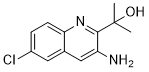
Reproxalap (ADX-102) is a reactive aldehyde species (RASP) sequestering agent for the treatment of dry eye. Reproxalap (ADX-102) covalently binds aldehydes including malondialdehyde and 4-hydroxynonenal. Reproxalap is a novel small-molecule immune-modulating covalent inhibitor of RASP (reactive aldehyde species), which are elevated in ocular and systemic inflammatory disease.
Physicochemical Properties
| Molecular Formula | C12H13CLN2O |
| Molecular Weight | 236.697421789169 |
| Exact Mass | 236.071 |
| Elemental Analysis | C, 60.89; H, 5.54; Cl, 14.98; N, 11.84; O, 6.76 |
| CAS # | 916056-79-6 |
| PubChem CID | 16088030 |
| Appearance | Typically exists as Light yellow to yellow solid at room temperature |
| LogP | 2.4 |
| Hydrogen Bond Donor Count | 2 |
| Hydrogen Bond Acceptor Count | 3 |
| Rotatable Bond Count | 1 |
| Heavy Atom Count | 16 |
| Complexity | 259 |
| Defined Atom Stereocenter Count | 0 |
| InChi Key | GUHFUVLKYSQIOQ-UHFFFAOYSA-N |
| InChi Code | InChI=1S/C12H13ClN2O/c1-12(2,16)11-9(14)6-7-5-8(13)3-4-10(7)15-11/h3-6,16H,14H2,1-2H3 |
| Chemical Name | 2-(3-amino-6-chloroquinolin-2-yl)propan-2-ol |
| Synonyms | NS-2; NS2 NS 2; ADX-102; Reproxalap; 916056-79-6; 2-(3-amino-6-chloroquinolin-2-yl)propan-2-ol; ADX-102; Reproxalap [USAN]; NS-2; ALD-102; F0GIZ22IJH; ADX102; ADX 102, |
| HS Tariff Code | 2934.99.9001 |
| Storage |
Powder-20°C 3 years 4°C 2 years In solvent -80°C 6 months -20°C 1 month |
| Shipping Condition | Room temperature (This product is stable at ambient temperature for a few days during ordinary shipping and time spent in Customs) |
Biological Activity
| Targets | RASP (reactive aldehyde species) sequestering agent |
| ln Vitro | ADX-102 is a novel small molecule that covalently binds aldehydes, including malondialdehyde and 4-hydroxynonenal, which have been shown to mediate inflammatory pain.[1] |
| ln Vivo |
In the CFA-induced pain model, treatment with 100 mg/kg QD or 100 mg/kg BID ADX-102 resulted in statistically significant reductions in thermal hypersensitivity as measured by the Hargreave’s plantar test (Figure 1). Only the 100 mg/kg BID dose of ADX-102 showed an effect on mechanical sensitivity, as assessed by the Von Frey force test (Figure 2). Paw thickness, a measure of swelling, showed a modest effect at the 30 and 100 mg/kg BID doses (Figure 3).[1] In the carrageenan-induced pain model, ADX-102 treatment resulted in statistically significant reductions in thermal hypersensitivity at ADX-102 doses of 30 mg/kg BID and 100 mg/kg BID (Figure 4), but did not affect mechanical hypersensitivity (Figure 5). Paw thickness, a measure of swelling, showed a modest effect at the 100 mg/kg QD dose (Figure 6). There were no changes in body weight as a result of treatment in any group.[1] |
| Animal Protocol | The effect of ADX-102 on acute inflammatory pain was tested in the carrageenaninduced and Complete Freund’s Adjuvant (CFA)-induced models in mice [1]. |
| References |
[1]. Susan Macdonald, et al. ADX-102, a novel aldehyde trap, reduces nociceptive behavior in mouse models of carrageenan and CFA induced pain.https://ir.aldeyra.com/static-files/527c5795-0792-4322-9f47-69c79879415a [2]. Reproxalap Phase 2b Dry Eye Disease Results.https://ir.aldeyra.com/static-files/c642ef41-fe14-47d1-ba0e-d2b6a90f6a57 |
| Additional Infomation |
Reproxalap (previously ADX 102 or NS-2) is a small molecule inhibitor being developed by Aldeyra Therapeutics investigated against dry eye disease, allergic conjunctivitis, noninfectious anterior uveitis, and Sjögren-Larsson syndrome. NS-2 has orphan drug status due to it being investigated for treatment of Sjogren-Larsson syndrome. Mechanism of Action Reproxalap inhibits Reactive Aldehyde Species (RASP) and is being investigated against dry eye disease, allergic conjunctivitis, noninfectious anterior uveitis, and Sjögren-Larsson syndrome. |
Solubility Data
| Solubility (In Vitro) | DMSO : ~100 mg/mL (~422.48 mM) |
| Solubility (In Vivo) |
Solubility in Formulation 1: ≥ 2.5 mg/mL (10.56 mM) (saturation unknown) in 10% DMSO + 40% PEG300 + 5% Tween80 + 45% Saline (add these co-solvents sequentially from left to right, and one by one), clear solution. For example, if 1 mL of working solution is to be prepared, you can add 100 μL of 25.0 mg/mL clear DMSO stock solution to 400 μL PEG300 and mix evenly; then add 50 μL Tween-80 to the above solution and mix evenly; then add 450 μL normal saline to adjust the volume to 1 mL. Preparation of saline: Dissolve 0.9 g of sodium chloride in 100 mL ddH₂ O to obtain a clear solution. Solubility in Formulation 2: 2.5 mg/mL (10.56 mM) in 10% DMSO + 90% (20% SBE-β-CD in Saline) (add these co-solvents sequentially from left to right, and one by one), suspension solution; with ultrasonication. For example, if 1 mL of working solution is to be prepared, you can add 100 μL of 25.0 mg/mL clear DMSO stock solution to 900 μL of 20% SBE-β-CD physiological saline solution and mix evenly. Preparation of 20% SBE-β-CD in Saline (4°C,1 week): Dissolve 2 g SBE-β-CD in 10 mL saline to obtain a clear solution. (Please use freshly prepared in vivo formulations for optimal results.) |
| Preparing Stock Solutions | 1 mg | 5 mg | 10 mg | |
| 1 mM | 4.2248 mL | 21.1238 mL | 42.2476 mL | |
| 5 mM | 0.8450 mL | 4.2248 mL | 8.4495 mL | |
| 10 mM | 0.4225 mL | 2.1124 mL | 4.2248 mL |