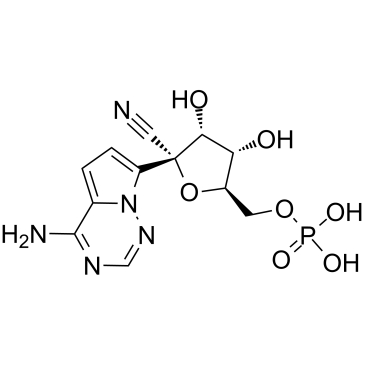
Remdesivir monophosphate is a remdesivir metabolite. Remdesivir is an approved antiviral drug with activity against SARS-CoV and MERS-CoV.
Physicochemical Properties
| Molecular Formula | C12H14N5O7P |
| Molecular Weight | 371.2426 |
| Related CAS # | 1911578-76-1; 1911578-74-9 |
| Appearance | Typically exists as solid at room temperature |
| HS Tariff Code | 2934.99.9001 |
| Storage |
Powder-20°C 3 years 4°C 2 years In solvent -80°C 6 months -20°C 1 month |
| Shipping Condition | Room temperature (This product is stable at ambient temperature for a few days during ordinary shipping and time spent in Customs) |
Biological Activity
| Targets |
Viral RNA-dependent RNA polymerase (RdRp) of coronaviruses (e.g., SARS-CoV-2, MERS-CoV) and filoviruses (e.g., Ebola virus), acting as the direct antiviral metabolite after intracellular phosphorylation [1] Mediated by the viral polymerase complex, with susceptibility influenced by viral proofreading exoribonuclease (ExoN) activity [2] |
| ln Vitro |
Viral RNA-dependent RNA polymerase (RdRp) of coronaviruses (e.g., SARS-CoV-2, MERS-CoV) and filoviruses (e.g., Ebola virus), acting as the direct antiviral metabolite after intracellular phosphorylation [1] Mediated by the viral polymerase complex, with susceptibility influenced by viral proofreading exoribonuclease (ExoN) activity [2] |
| Enzyme Assay |
• RdRp incorporation assay: Recombinant SARS-CoV-2 RdRp complex (nsp12/7/8) incubated with RNA template/primer and NTPs, including varying concentrations of the triphosphate metabolite (GS-443902). Incorporation efficiency measured by gel electrophoresis, showing competitive inhibition against ATP with preferential incorporation over natural nucleotides [1]. • ExoN proofreading assay: Purified SARS-CoV-2 ExoN (nsp14/nsp10 complex) incubated with RNA substrates containing incorporated Remdesivir monophosphate analog. ExoN efficiently excised the analog, reducing its antiviral effect. ExoN-deficient mutants lacked this excision capability [2] |
| Cell Assay |
• Viral replication inhibition: Vero E6 cells infected with SARS-CoV-2 (wild-type or ExoN-mutant) at MOI 0.01. Treated with Remdesivir (source of the monophosphate metabolite) for 48 hours. Viral RNA quantified by qRT-PCR; EC₅₀ calculated from dose-response curves. ExoN-deficient virus EC₅₀ = 0.009 μM vs wild-type EC₅₀ = 0.054 μM [2]. • Metabolite detection: Huh7 cells treated with Remdesivir (10 μM). Intracellular metabolites (including nucleoside monophosphate and triphosphate forms) extracted and quantified via LC-MS/MS at 24 hours, confirming efficient phosphorylation [1] |
| ADME/Pharmacokinetics |
• Metabolic activation: Remdesivir is hydrolyzed intracellularly to the nucleoside monophosphate (GS-441524 monophosphate) by cathepsin A/carboxylesterase 1, then phosphorylated to the active triphosphate (GS-443902) by cellular kinases [1]. • Intracellular half-life: The triphosphate metabolite (GS-443902) has a prolonged intracellular half-life (>14 hours) in primary human macrophages, supporting sustained antiviral activity [1] |
| References | [1]. US20160122374. [2]. Coronavirus Susceptibility to the Antiviral Remdesivir (GS-5734) Is Mediated by the Viral Polymerase and the Proofreading Exoribonuclease. MBio. 2018 Mar 6;9(2). pii: e00221-18. |
| Additional Infomation |
• Remdesivir nucleoside monophosphate is an obligate intracellular intermediate metabolite of the prodrug Remdesivir (GS-5734), essential for forming the active triphosphate inhibitor of viral RdRp [1]. • Viral ExoN proofreading activity (e.g., in SARS-CoV-2) can limit efficacy by excising the incorporated monophosphate analog from viral RNA, requiring higher drug concentrations for inhibition [2] |
Solubility Data
| Solubility (In Vitro) | May dissolve in DMSO (in most cases), if not, try other solvents such as H2O, Ethanol, or DMF with a minute amount of products to avoid loss of samples |
| Solubility (In Vivo) |
Note: Listed below are some common formulations that may be used to formulate products with low water solubility (e.g. < 1 mg/mL), you may test these formulations using a minute amount of products to avoid loss of samples. Injection Formulations (e.g. IP/IV/IM/SC) Injection Formulation 1: DMSO : Tween 80: Saline = 10 : 5 : 85 (i.e. 100 μL DMSO stock solution → 50 μL Tween 80 → 850 μL Saline) *Preparation of saline: Dissolve 0.9 g of sodium chloride in 100 mL ddH ₂ O to obtain a clear solution. Injection Formulation 2: DMSO : PEG300 :Tween 80 : Saline = 10 : 40 : 5 : 45 (i.e. 100 μL DMSO → 400 μLPEG300 → 50 μL Tween 80 → 450 μL Saline) Injection Formulation 3: DMSO : Corn oil = 10 : 90 (i.e. 100 μL DMSO → 900 μL Corn oil) Example: Take the Injection Formulation 3 (DMSO : Corn oil = 10 : 90) as an example, if 1 mL of 2.5 mg/mL working solution is to be prepared, you can take 100 μL 25 mg/mL DMSO stock solution and add to 900 μL corn oil, mix well to obtain a clear or suspension solution (2.5 mg/mL, ready for use in animals). Injection Formulation 4: DMSO : 20% SBE-β-CD in saline = 10 : 90 [i.e. 100 μL DMSO → 900 μL (20% SBE-β-CD in saline)] *Preparation of 20% SBE-β-CD in Saline (4°C,1 week): Dissolve 2 g SBE-β-CD in 10 mL saline to obtain a clear solution. Injection Formulation 5: 2-Hydroxypropyl-β-cyclodextrin : Saline = 50 : 50 (i.e. 500 μL 2-Hydroxypropyl-β-cyclodextrin → 500 μL Saline) Injection Formulation 6: DMSO : PEG300 : castor oil : Saline = 5 : 10 : 20 : 65 (i.e. 50 μL DMSO → 100 μLPEG300 → 200 μL castor oil → 650 μL Saline) Injection Formulation 7: Ethanol : Cremophor : Saline = 10: 10 : 80 (i.e. 100 μL Ethanol → 100 μL Cremophor → 800 μL Saline) Injection Formulation 8: Dissolve in Cremophor/Ethanol (50 : 50), then diluted by Saline Injection Formulation 9: EtOH : Corn oil = 10 : 90 (i.e. 100 μL EtOH → 900 μL Corn oil) Injection Formulation 10: EtOH : PEG300:Tween 80 : Saline = 10 : 40 : 5 : 45 (i.e. 100 μL EtOH → 400 μLPEG300 → 50 μL Tween 80 → 450 μL Saline) Oral Formulations Oral Formulation 1: Suspend in 0.5% CMC Na (carboxymethylcellulose sodium) Oral Formulation 2: Suspend in 0.5% Carboxymethyl cellulose Example: Take the Oral Formulation 1 (Suspend in 0.5% CMC Na) as an example, if 100 mL of 2.5 mg/mL working solution is to be prepared, you can first prepare 0.5% CMC Na solution by measuring 0.5 g CMC Na and dissolve it in 100 mL ddH2O to obtain a clear solution; then add 250 mg of the product to 100 mL 0.5% CMC Na solution, to make the suspension solution (2.5 mg/mL, ready for use in animals). Oral Formulation 3: Dissolved in PEG400 Oral Formulation 4: Suspend in 0.2% Carboxymethyl cellulose Oral Formulation 5: Dissolve in 0.25% Tween 80 and 0.5% Carboxymethyl cellulose Oral Formulation 6: Mixing with food powders Note: Please be aware that the above formulations are for reference only. InvivoChem strongly recommends customers to read literature methods/protocols carefully before determining which formulation you should use for in vivo studies, as different compounds have different solubility properties and have to be formulated differently. (Please use freshly prepared in vivo formulations for optimal results.) |
| Preparing Stock Solutions | 1 mg | 5 mg | 10 mg | |
| 1 mM | 2.6937 mL | 13.4684 mL | 26.9368 mL | |
| 5 mM | 0.5387 mL | 2.6937 mL | 5.3874 mL | |
| 10 mM | 0.2694 mL | 1.3468 mL | 2.6937 mL |