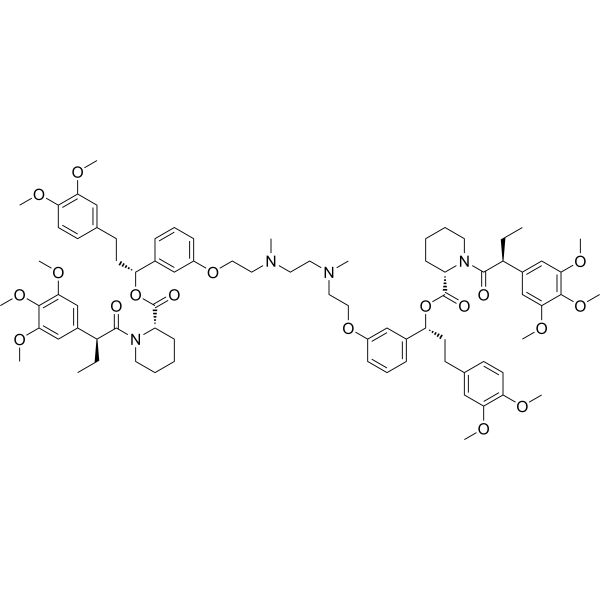
Physicochemical Properties
| Molecular Formula | C80H106N4O18 |
| Molecular Weight | 1411.7 |
| Exact Mass | 1410.75021 |
| CAS # | 2357217-22-0 |
| PubChem CID | 155157448 |
| Appearance | Typically exists as solid at room temperature |
| LogP | 13.3 |
| Hydrogen Bond Donor Count | 0 |
| Hydrogen Bond Acceptor Count | 20 |
| Rotatable Bond Count | 41 |
| Heavy Atom Count | 102 |
| Complexity | 2230 |
| Defined Atom Stereocenter Count | 6 |
| SMILES | CC[C@@H](C1=CC(=C(C(=C1)OC)OC)OC)C(=O)N2CCCC[C@H]2C(=O)O[C@H](CCC3=CC(=C(C=C3)OC)OC)C4=CC(=CC=C4)OCCN(C)CCN(C)CCOC5=CC=CC(=C5)[C@@H](CCC6=CC(=C(C=C6)OC)OC)OC(=O)[C@@H]7CCCCN7C(=O)[C@@H](CC)C8=CC(=C(C(=C8)OC)OC)OC |
| InChi Key | VIWYPOBHRWLWQA-BPNHAYRBSA-N |
| InChi Code | InChI=1S/C80H106N4O18/c1-15-61(57-49-71(93-9)75(97-13)72(50-57)94-10)77(85)83-37-19-17-27-63(83)79(87)101-65(33-29-53-31-35-67(89-5)69(45-53)91-7)55-23-21-25-59(47-55)99-43-41-81(3)39-40-82(4)42-44-100-60-26-22-24-56(48-60)66(34-30-54-32-36-68(90-6)70(46-54)92-8)102-80(88)64-28-18-20-38-84(64)78(86)62(16-2)58-51-73(95-11)76(98-14)74(52-58)96-12/h21-26,31-32,35-36,45-52,61-66H,15-20,27-30,33-34,37-44H2,1-14H3/t61-,62-,63-,64-,65+,66+/m0/s1 |
| Chemical Name | [(1R)-3-(3,4-dimethoxyphenyl)-1-[3-[2-[2-[2-[3-[(1R)-3-(3,4-dimethoxyphenyl)-1-[(2S)-1-[(2S)-2-(3,4,5-trimethoxyphenyl)butanoyl]piperidine-2-carbonyl]oxypropyl]phenoxy]ethyl-methylamino]ethyl-methylamino]ethoxy]phenyl]propyl] (2S)-1-[(2S)-2-(3,4,5-trimethoxyphenyl)butanoyl]piperidine-2-carboxylate |
| Synonyms | Rapamycin analog-2; SCHEMBL22484772; |
| HS Tariff Code | 2934.99.9001 |
| Storage |
Powder-20°C 3 years 4°C 2 years In solvent -80°C 6 months -20°C 1 month |
| Shipping Condition | Room temperature (This product is stable at ambient temperature for a few days during ordinary shipping and time spent in Customs) |
Biological Activity
| Targets | The target of Rapamycin analog-2 (compound A) is mTOR, with an IC50 value of 0.5 nM in kinase activity assays [1]. |
| ln Vitro | - Antiproliferative Activity: In human breast cancer cell line MCF-7, Rapamycin analog-2 (compound A) showed significant antiproliferative activity with an IC50 value of 2.1 μM. The cell viability was determined by MTT assay after 72 hours of drug treatment [1]. - Apoptosis Induction: Flow cytometry analysis revealed that Rapamycin analog-2 (compound A) induced apoptosis in MCF-7 cells. The percentage of apoptotic cells increased to 35% at a concentration of 5 μM, compared to 10% in the control group [1]. - Western Blot Analysis: Treatment with Rapamycin analog-2 (compound A) downregulated the expression of phosphorylated S6 ribosomal protein (p-S6), a downstream target of mTOR, in MCF-7 cells. The protein levels were analyzed after 24 hours of drug exposure [1]. |
| ln Vivo | - Tumor Growth Inhibition: In a xenograft mouse model of MCF-7 breast cancer, Rapamycin analog-2 (compound A) administered orally at a dose of 10 mg/kg daily for 21 days significantly inhibited tumor growth. The tumor volume was reduced by 60% compared to the vehicle control group [1]. - Metastasis Suppression: Histological examination of lung tissues showed that Rapamycin analog-2 (compound A) treatment decreased the number of metastatic nodules in the lungs of mice. The average number of metastases was 2.3 in the treatment group versus 8.5 in the control group [1]. |
| Enzyme Assay | - mTOR Kinase Activity Assay: The kinase activity of mTOR was measured using a fluorescence resonance energy transfer (FRET) - based assay. Recombinant mTOR kinase was incubated with Rapamycin analog-2 (compound A) at various concentrations. The reaction was initiated by adding ATP and a specific peptide substrate. The IC50 value was determined by measuring the fluorescence signal after 60 minutes of incubation [1]. |
| Cell Assay | - MTT Assay for Cell Viability: MCF-7 cells were seeded in 96 - well plates and treated with Rapamycin analog-2 (compound A) at concentrations ranging from 0.1 μM to 10 μM for 72 hours. MTT solution was added, and the absorbance at 570 nm was measured to determine cell viability [1]. - Flow Cytometry for Apoptosis: MCF-7 cells were treated with Rapamycin analog-2 (compound A) at 5 μM for 48 hours. The cells were stained with Annexin V - FITC and propidium iodide (PI) and analyzed by flow cytometry to determine the apoptotic cell population [1]. |
| Animal Protocol | Xenograft Mouse Model: Female nude mice were subcutaneously inoculated with MCF-7 cells. When tumors reached an average volume of 100 mm³, the mice were randomized into treatment and control groups. Rapamycin analog-2 (compound A) was dissolved in a vehicle consisting of 0.5% methylcellulose and 0.1% Tween 80 and administered orally at 10 mg/kg daily for 21 days. Tumor volume was measured twice weekly using calipers [1]. |
| ADME/Pharmacokinetics | - Oral Bioavailability: The oral bioavailability of Rapamycin analog-2 (compound A) in mice was determined to be 35% based on plasma concentration - time data after oral and intravenous administration [1]. - Half - Life: The plasma half - life of Rapamycin analog-2 (compound A) after intravenous injection in mice was 2.5 hours [1]. - Tissue Distribution: After oral administration, Rapamycin analog-2 (compound A) was widely distributed in various tissues, with the highest concentrations found in the liver and kidneys [1]. |
| Toxicity/Toxicokinetics | - Acute Toxicity: The median lethal dose (LD50) of Rapamycin analog-2 (compound A) in mice was greater than 500 mg/kg when administered orally, indicating low acute toxicity [1]. - Hematological and Biochemical Parameters: No significant changes in hematological parameters (such as white blood cell count, red blood cell count, and platelet count) or biochemical markers of liver and kidney function (such as alanine aminotransferase, aspartate aminotransferase, and blood urea nitrogen) were observed in mice treated with Rapamycin analog-2 (compound A) at doses up to 20 mg/kg for 28 days [1]. |
| References | [1]. Protein-binding compounds. WO2020076738A2. |
| Additional Infomation | - Mechanism of Action: Rapamycin analog-2 (compound A) exerts its antitumor effects by inhibiting the mTOR signaling pathway, which is dysregulated in many cancers. Inhibition of mTOR leads to downregulation of cell proliferation, induction of apoptosis, and suppression of angiogenesis [1]. - Synthesis and Structure: Rapamycin analog-2 (compound A) was synthesized through a series of chemical reactions starting from rapamycin. The structural modifications were designed to improve the pharmacokinetic properties and target specificity compared to the parent compound [1]. - Potential Applications: Rapamycin analog-2 (compound A) shows potential as a therapeutic agent for the treatment of breast cancer and other cancers where the mTOR pathway is activated [1]. |
Solubility Data
| Solubility (In Vitro) | May dissolve in DMSO (in most cases), if not, try other solvents such as H2O, Ethanol, or DMF with a minute amount of products to avoid loss of samples |
| Solubility (In Vivo) |
Note: Listed below are some common formulations that may be used to formulate products with low water solubility (e.g. < 1 mg/mL), you may test these formulations using a minute amount of products to avoid loss of samples. Injection Formulations (e.g. IP/IV/IM/SC) Injection Formulation 1: DMSO : Tween 80: Saline = 10 : 5 : 85 (i.e. 100 μL DMSO stock solution → 50 μL Tween 80 → 850 μL Saline) *Preparation of saline: Dissolve 0.9 g of sodium chloride in 100 mL ddH ₂ O to obtain a clear solution. Injection Formulation 2: DMSO : PEG300 :Tween 80 : Saline = 10 : 40 : 5 : 45 (i.e. 100 μL DMSO → 400 μLPEG300 → 50 μL Tween 80 → 450 μL Saline) Injection Formulation 3: DMSO : Corn oil = 10 : 90 (i.e. 100 μL DMSO → 900 μL Corn oil) Example: Take the Injection Formulation 3 (DMSO : Corn oil = 10 : 90) as an example, if 1 mL of 2.5 mg/mL working solution is to be prepared, you can take 100 μL 25 mg/mL DMSO stock solution and add to 900 μL corn oil, mix well to obtain a clear or suspension solution (2.5 mg/mL, ready for use in animals). Injection Formulation 4: DMSO : 20% SBE-β-CD in saline = 10 : 90 [i.e. 100 μL DMSO → 900 μL (20% SBE-β-CD in saline)] *Preparation of 20% SBE-β-CD in Saline (4°C,1 week): Dissolve 2 g SBE-β-CD in 10 mL saline to obtain a clear solution. Injection Formulation 5: 2-Hydroxypropyl-β-cyclodextrin : Saline = 50 : 50 (i.e. 500 μL 2-Hydroxypropyl-β-cyclodextrin → 500 μL Saline) Injection Formulation 6: DMSO : PEG300 : castor oil : Saline = 5 : 10 : 20 : 65 (i.e. 50 μL DMSO → 100 μLPEG300 → 200 μL castor oil → 650 μL Saline) Injection Formulation 7: Ethanol : Cremophor : Saline = 10: 10 : 80 (i.e. 100 μL Ethanol → 100 μL Cremophor → 800 μL Saline) Injection Formulation 8: Dissolve in Cremophor/Ethanol (50 : 50), then diluted by Saline Injection Formulation 9: EtOH : Corn oil = 10 : 90 (i.e. 100 μL EtOH → 900 μL Corn oil) Injection Formulation 10: EtOH : PEG300:Tween 80 : Saline = 10 : 40 : 5 : 45 (i.e. 100 μL EtOH → 400 μLPEG300 → 50 μL Tween 80 → 450 μL Saline) Oral Formulations Oral Formulation 1: Suspend in 0.5% CMC Na (carboxymethylcellulose sodium) Oral Formulation 2: Suspend in 0.5% Carboxymethyl cellulose Example: Take the Oral Formulation 1 (Suspend in 0.5% CMC Na) as an example, if 100 mL of 2.5 mg/mL working solution is to be prepared, you can first prepare 0.5% CMC Na solution by measuring 0.5 g CMC Na and dissolve it in 100 mL ddH2O to obtain a clear solution; then add 250 mg of the product to 100 mL 0.5% CMC Na solution, to make the suspension solution (2.5 mg/mL, ready for use in animals). Oral Formulation 3: Dissolved in PEG400 Oral Formulation 4: Suspend in 0.2% Carboxymethyl cellulose Oral Formulation 5: Dissolve in 0.25% Tween 80 and 0.5% Carboxymethyl cellulose Oral Formulation 6: Mixing with food powders Note: Please be aware that the above formulations are for reference only. InvivoChem strongly recommends customers to read literature methods/protocols carefully before determining which formulation you should use for in vivo studies, as different compounds have different solubility properties and have to be formulated differently. (Please use freshly prepared in vivo formulations for optimal results.) |
| Preparing Stock Solutions | 1 mg | 5 mg | 10 mg | |
| 1 mM | 0.7084 mL | 3.5418 mL | 7.0837 mL | |
| 5 mM | 0.1417 mL | 0.7084 mL | 1.4167 mL | |
| 10 mM | 0.0708 mL | 0.3542 mL | 0.7084 mL |