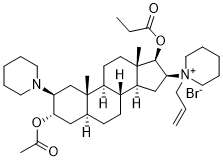
Physicochemical Properties
| Molecular Formula | C37H61BRN2O4 |
| Molecular Weight | 677.809 |
| Exact Mass | 676.381 |
| CAS # | 156137-99-4 |
| Related CAS # | 156137-99-4 (bromide);465499-11-0 (cation); |
| PubChem CID | 5311398 |
| Appearance | Light yellow to yellow solid powder |
| LogP | 3.812 |
| Hydrogen Bond Donor Count | 0 |
| Hydrogen Bond Acceptor Count | 6 |
| Rotatable Bond Count | 9 |
| Heavy Atom Count | 44 |
| Complexity | 1030 |
| Defined Atom Stereocenter Count | 10 |
| SMILES | CCC(=O)O[C@H]1[C@H](C[C@@H]2[C@@]1(CC[C@H]3[C@H]2CC[C@@H]4[C@@]3(C[C@@H]([C@H](C4)OC(=O)C)N5CCCCC5)C)C)[N+]6(CCCCC6)CC=C.[Br-] |
| InChi Key | LVQTUXZKLGXYIU-GWSNJHLMSA-M |
| InChi Code | InChI=1S/C37H61N2O4.BrH/c1-6-20-39(21-12-9-13-22-39)32-24-30-28-15-14-27-23-33(42-26(3)40)31(38-18-10-8-11-19-38)25-37(27,5)29(28)16-17-36(30,4)35(32)43-34(41)7-2;/h6,27-33,35H,1,7-25H2,2-5H3;1H/q+1;/p-1/t27-,28+,29-,30-,31-,32-,33-,35-,36-,37-;/m0./s1 |
| Chemical Name | [(2S,3S,5S,8R,9S,10S,13S,14S,16S,17R)-3-acetyloxy-10,13-dimethyl-2-piperidin-1-yl-16-(1-prop-2-enylpiperidin-1-ium-1-yl)-2,3,4,5,6,7,8,9,11,12,14,15,16,17-tetradecahydro-1H-cyclopenta[a]phenanthren-17-yl] propanoate;bromide |
| Synonyms | Org-9487; Rapacuronium Bromide; Org 9487; Org9487; brand name Raplon; |
| HS Tariff Code | 2934.99.9001 |
| Storage |
Powder-20°C 3 years 4°C 2 years In solvent -80°C 6 months -20°C 1 month Note: Please store this product in a sealed and protected environment, avoid exposure to moisture. |
| Shipping Condition | Room temperature (This product is stable at ambient temperature for a few days during ordinary shipping and time spent in Customs) |
Biological Activity
| ln Vitro | Rapacuronium has a micromolar affinity and a small degree of selectivity for the M2 receptor. It binds to all muscarinic receptor subtypes at physiologically relevant dosages. The kinetics of ACh binding and subsequent receptor activation, as measured by the stimulation of [35S]GTPγS binding, are intricately affected by rapacuronium. With an EC50 ranging from 28 μM for M2 receptors to 76 μM for M3 receptors, rapacuronium alone concentration-dependently lowers [35S]GTPγS binding to membranes, with a maximum impact of roughly 25% for odd isoforms and 15% for even isoforms. While there was a correlation (R2 = 0.76) between the EC50 values for rapacuronium's inhibition of [35S]GTPηS binding for each isoform and the affinities determined in [3H]ACh binding tests, these EC50 values were lower for all isoforms. minimal (4–12 times). Assessing the impact of 0.1, 1, and 10 μM rapacuronium on ACh-stimulated [35S]GTPγS binding revealed the compound's influence on the activation of distinct receptor subtypes by orthotopic agonists. distinct effects. Within the even subtype, rapacuronium at 1 μM and 10 μM considerably raised ACh EC50, although rapacuronium at 10 μM reduced EMAX. In this subtype, 0.1 and 1 μM rapacuronium caused an increase in EMAX of roughly 60% and 35%, respectively, and a significant 2-fold drop in ACh EC50. At 10 μM, rapacuronium bromide increased ACh EC50 by about three times without significantly altering EMAX. Rapacurium (0.1 - 10 μM) lowered the EC50 of ACh stimulation of [35S]GTPηS binding by 1.5 and 4 times at concentrations of 0.1 and 1 μM, respectively, but had no influence on the ACh effectiveness of M1 and M5 isoforms. At 10 μM rapacuronium, however, this impact was not noticeable [1]. |
| ln Vivo | After administering a dose of 2×ED90, the neuromuscular effects of rapacuronium were observed in rats and guinea pigs over a period of time. The corresponding ED90 values were 5953±199 and 187±16 µg/kg, respectively [2]. |
| References |
[1]. Divergence of allosteric effects of Rapacuronium on binding and function of muscarinic receptors. BMC Pharmacol. 2009 Dec 28;9:15. [2]. A new short-acting non-depolarizing muscle relaxant (SZ1677) without cardiovascular side-effects. Acta Anaesthesiol Scand. 2003 Mar;47(3):291-300. |
| Additional Infomation | See also: Rapacuronium (has active moiety). |
Solubility Data
| Solubility (In Vitro) | DMSO : ≥ 125 mg/mL (~184.42 mM) |
| Solubility (In Vivo) |
Solubility in Formulation 1: ≥ 2.08 mg/mL (3.07 mM) (saturation unknown) in 10% DMSO + 40% PEG300 + 5% Tween80 + 45% Saline (add these co-solvents sequentially from left to right, and one by one), clear solution. For example, if 1 mL of working solution is to be prepared, you can add 100 μL of 20.8 mg/mL clear DMSO stock solution to 400 μL PEG300 and mix evenly; then add 50 μL Tween-80 to the above solution and mix evenly; then add 450 μL normal saline to adjust the volume to 1 mL. Preparation of saline: Dissolve 0.9 g of sodium chloride in 100 mL ddH₂ O to obtain a clear solution. Solubility in Formulation 2: ≥ 2.08 mg/mL (3.07 mM) (saturation unknown) in 10% DMSO + 90% (20% SBE-β-CD in Saline) (add these co-solvents sequentially from left to right, and one by one), clear solution. For example, if 1 mL of working solution is to be prepared, you can add 100 μL of 20.8 mg/mL clear DMSO stock solution to 900 μL of 20% SBE-β-CD physiological saline solution and mix evenly. Preparation of 20% SBE-β-CD in Saline (4°C,1 week): Dissolve 2 g SBE-β-CD in 10 mL saline to obtain a clear solution. Solubility in Formulation 3: ≥ 2.08 mg/mL (3.07 mM) (saturation unknown) in 10% DMSO + 90% Corn Oil (add these co-solvents sequentially from left to right, and one by one), clear solution. For example, if 1 mL of working solution is to be prepared, you can add 100 μL of 20.8 mg/mL clear DMSO stock solution to 900 μL of corn oil and mix evenly. (Please use freshly prepared in vivo formulations for optimal results.) |
| Preparing Stock Solutions | 1 mg | 5 mg | 10 mg | |
| 1 mM | 1.4753 mL | 7.3767 mL | 14.7534 mL | |
| 5 mM | 0.2951 mL | 1.4753 mL | 2.9507 mL | |
| 10 mM | 0.1475 mL | 0.7377 mL | 1.4753 mL |