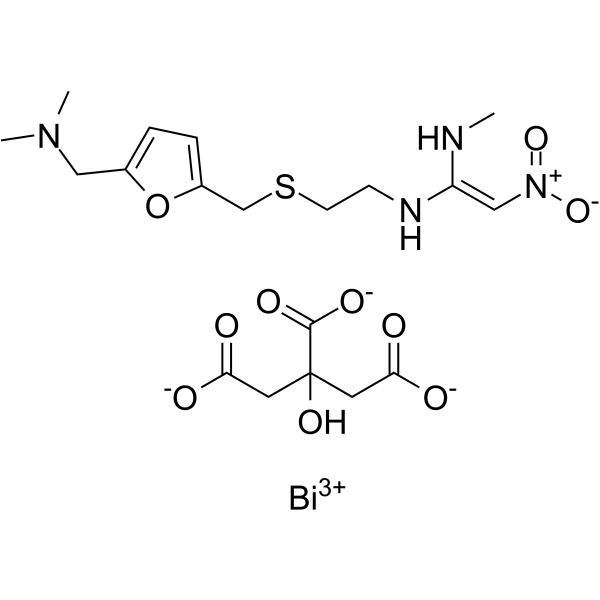
Physicochemical Properties
| Molecular Formula | C13H22N4O3S.C6H5O7-3.BI+3 |
| Molecular Weight | 712.48348 |
| Exact Mass | 712.125 |
| Elemental Analysis | C, 32.03; H, 3.82; Bi, 29.33; N, 7.86; O, 22.46; S, 4.50 |
| CAS # | 128345-62-0 |
| Related CAS # | Ranitidine hydrochloride;66357-59-3; Ranitidine-d6 hydrochloride; 1185238-09-8; Ranitidine; 66357-35-5; Ranitidine bismuth citrate; 128345-62-0; 71130-06-8 (HCl) |
| PubChem CID | 62984 |
| Appearance | Typically exists as solid at room temperature |
| Density | 1.184g/cm3 |
| Boiling Point | 437.1ºC at 760mmHg |
| Flash Point | 218.2ºC |
| Vapour Pressure | 7.66E-08mmHg at 25°C |
| Hydrogen Bond Donor Count | 3 |
| Hydrogen Bond Acceptor Count | 14 |
| Rotatable Bond Count | 11 |
| Heavy Atom Count | 35 |
| Complexity | 558 |
| Defined Atom Stereocenter Count | 0 |
| SMILES | [Bi+3].CN/C(/NCCSCC1=CC=C(CN(C)C)O1)=C\[N+]([O-])=O.O=C(CC(C([O-])=O)(O)CC([O-])=O)[O-] |
| InChi Key | XAUTYMZTJWXZHZ-UHFFFAOYSA-K |
| InChi Code | InChI=1S/C13H22N4O3S.C6H8O7.Bi/c1-14-13(9-17(18)19)15-6-7-21-10-12-5-4-11(20-12)8-16(2)3;7-3(8)1-6(13,5(11)12)2-4(9)10;/h4-5,9,14-15H,6-8,10H2,1-3H3;13H,1-2H2,(H,7,8)(H,9,10)(H,11,12);/q;;+3/p-3 |
| Chemical Name | bismuth;1-N'-[2-[[5-[(dimethylamino)methyl]furan-2-yl]methylsulfanyl]ethyl]-1-N-methyl-2-nitroethene-1,1-diamine;2-hydroxypropane-1,2,3-tricarboxylate |
| Synonyms | Ranitidine bismuth citrate; Tritec; 128345-62-0; GR 122311X; GR-122311X; Azamplus; Elicodil; Helirad; |
| HS Tariff Code | 2934.99.9001 |
| Storage |
Powder-20°C 3 years 4°C 2 years In solvent -80°C 6 months -20°C 1 month |
| Shipping Condition | Room temperature (This product is stable at ambient temperature for a few days during ordinary shipping and time spent in Customs) |
Biological Activity
| Targets | Histamine H2 receptor |
| ln Vitro | Ranitidine bismuth citrate (0.1–1 μM, 5 minutes) is a strong and irreversible inhibitor of DNA unwinding (IC50 = 0.74 μM, Ki = 0.39 μM) Agent-CoV-2 helicase and SARS ATPase (IC50 = 0.69 μM, Ki = 0.97 μM) [2]. With an EC50 value of 2.3 μM in Vero E6 cells, ranitidine bismuth citrate (24 hours) demonstrated strong efficacy against SARS-CoV-2 [2]. |
| ln Vivo | In the golden Syrian hamster model, ranitidine bismuth citrate (150 mg/kg; intranasally; thrice daily; 4 days) reduced SARS-CoV-2 replication and relieved virus-associated pneumonia [2]. Ranitidine bismuth citrate (48 mg/kg, intraperitoneally) is efficient in eliminating H. pylori in female ferrets and weasels, with MIC values of 8 ng/L and 1-2 ng/L, respectively [3] . Ranitidine bismuth citrate (0.1 mg/kg, 0.3 mg/kg; oral) significantly suppresses stomach acid secretion and (1.0 mM) inhibits human pepsin isoenzyme activity [4]. |
| Cell Assay |
Cytotoxicity assay[2] Cell Types: monkey kidney Vero E6 cells, human colorectal Caco-2 cells Tested Concentrations: 400-3,740 μM Incubation Duration: 48 hrs (hours) Experimental Results: demonstrated low cytotoxicity, 50% cytotoxic concentration (CC50) range 2.2 mM and 2.5 mm. |
| Animal Protocol |
Animal/Disease Models: Female Beagle dog (14-20 kg) [3] Doses: 0.1 mg/kg Route of Administration: Oral once hourly for 5 hrs (hrs (hours)) Experimental Results: Inhibition of gastric acid secretion. Animal/Disease Models: Female, randomly raised hooded rats (body weight range 90-120 g) [4] Doses: 0.5 mL/100 g Route of Administration: Pretreatment with indomethacin (5 mg/kg sc); oral Results of intragastric (po) (po) Route of Administration: Inhibition of gastric mucosal damage in rats. |
| ADME/Pharmacokinetics |
Metabolism / Metabolites Ranitidine has known human metabolites that include Desmethylranitidine. |
| Toxicity/Toxicokinetics |
Effects During Pregnancy and Lactation ◉ Summary of Use during Lactation Although interpatient variability exists, the dose of ranitidine in breastmilk is less than the dose used in newborn infants. However, the finding that ranitidine spontaneously breaks down to a cancer-causing chemical caused its removal from the market in the US and other countries. Other drugs are recommended. ◉ Effects in Breastfed Infants One 54-day-old breastfed infant had no observable adverse effects after maternal ingestion of ranitidine 150 mg every 12 hours for 2 days. ◉ Effects on Lactation and Breastmilk Histamine H2-receptor blockade is known to stimulate prolactin secretion. Ranitidine in intravenous doses over 100 mg or during long-term oral use have increased serum prolactin in some studies, and rare cases of gynecomastia have been reported. The prolactin level in a mother with established lactation may not affect her ability to breastfeed. Adverse Effects Occupational hepatotoxin - Secondary hepatotoxins: the potential for toxic effect in the occupational setting is based on cases of poisoning by human ingestion or animal experimentation. Skin Sensitizer - An agent that can induce an allergic reaction in the skin. |
| References |
[1]. Inhibition of 14C-aminopyrine accumulation in isolated rabbit gastric glands by the H2-receptor antagonist HOE 760 (TZU-0460). Agents Actions. 1987 Feb. 20(1-2):35-9. [2]. Metallodrug ranitidine bismuth citrate suppresses SARS-CoV-2 replication and relieves virus-associated pneumonia in Syrian hamsters. Nat Microbiol. 2020 Nov. 5(11):1439-1448. [3]. The actions of bismuth in the treatment of Helicobacter pylori infection. Aliment Pharmacol Ther. 1997 Apr. 11(Suppl 1):27-33. [4]. Gastric anti-secretory, mucosal protective, anti-pepsin and anti-Helicobacter properties of ranitidine bismuth citrate. Aliment Pharmacol Ther. 1993 Jun. 7(3):237-46. |
| Additional Infomation |
Ranitidine is a member of the class of furans used to treat peptic ulcer disease (PUD) and gastroesophageal reflux disease. It has a role as an anti-ulcer drug, a H2-receptor antagonist, an environmental contaminant, a xenobiotic and a drug allergen. It is a member of furans, a tertiary amino compound, a C-nitro compound and an organic sulfide. Ranitidine is a member of the class of histamine H2-receptor antagonists with antacid activity. Ranitidine is a competitive and reversible inhibitor of the action of histamine, released by enterochromaffin-like (ECL) cells, at the histamine H2-receptors on parietal cells in the stomach, thereby inhibiting the normal and meal-stimulated secretion of stomach acid. In addition, other substances that promote acid secretion have a reduced effect on parietal cells when the H2 receptors are blocked. Ranitidine Hydrochloride is a member of the class of histamine H2-receptor antagonists with antacid activity. Ranitidine is a competitive and reversible inhibitor of the action of histamine, released by enterochromaffin-like (ECL) cells, at the histamine H2-receptors on parietal cells in the stomach, thereby inhibiting the normal and meal-stimulated secretion of stomach acid. In addition, other substances that promote acid secretion have a reduced effect on parietal cells when the H2 receptors are blocked. A non-imidazole blocker of those histamine receptors that mediate gastric secretion (H2 receptors). It is used to treat gastrointestinal ulcers. See also: Ranitidine (annotation moved to). SARS-CoV-2 is causing a pandemic of COVID-19, with high infectivity and significant mortality1. Currently, therapeutic options for COVID-19 are limited. Historically, metal compounds have found use as antimicrobial agents, but their antiviral activities have rarely been explored. Here, we test a set of metallodrugs and related compounds, and identify ranitidine bismuth citrate, a commonly used drug for the treatment of Helicobacter pylori infection, as a potent anti-SARS-CoV-2 agent, both in vitro and in vivo. Ranitidine bismuth citrate exhibited low cytotoxicity and protected SARS-CoV-2-infected cells with a high selectivity index of 975. Importantly, ranitidine bismuth citrate suppressed SARS-CoV-2 replication, leading to decreased viral loads in both upper and lower respiratory tracts, and relieved virus-associated pneumonia in a golden Syrian hamster model. In vitro studies showed that ranitidine bismuth citrate and its related compounds exhibited inhibition towards both the ATPase (IC50 = 0.69 µM) and DNA-unwinding (IC50 = 0.70 µM) activities of the SARS-CoV-2 helicase via an irreversible displacement of zinc(II) ions from the enzyme by bismuth(III) ions. Our findings highlight viral helicase as a druggable target and the clinical potential of bismuth(III) drugs or other metallodrugs for the treatment of SARS-CoV-2 infection.[2] Ranitidine bismuth citrate is a novel compound formed from ranitidine and a bismuth citrate complex. In conscious dogs, ranitidine bismuth citrate had similar activity to ranitidine hydrochloride as an inhibitor of histamine-induced gastric acid secretion when oral doses containing equivalent amounts of ranitidine base (0.1 or 0.3 mg/kg) were compared. In the rat, ranitidine bismuth citrate (3-30 mg/kg p.o.) prevented gastric mucosal damage induced by ethanol (fundic damage) and indomethacin (antral damage). Ranitidine hydrochloride and tripotassium dicitrato bismuthate were also effective against indomethacin-induced damage, but were both significantly less potent than ranitidine bismuth citrate in this model. Ranitidine hydrochloride was inactive against ethanol-induced damage. In vitro, ranitidine bismuth citrate (1 mmol/L) inhibited human pepsin isoenzymes 1, 2, 3 and 5. Pepsin 1 was inhibited to a similar extent by ranitidine bismuth citrate, bismuth citrate and tripotassium dicitrato bismuthate at concentrations equivalent to 1 mmol/L bismuth, but ranitidine (1 mmol/L) was inactive. Ranitidine bismuth citrate was more potent than tripotassium dicitrato bismuthate as an inhibitor of pepsins 2, 3 and 5. Ranitidine bismuth citrate inhibited both Helicobacter pylori (effective concentration 4-32 micrograms bismuth/ml) and H. mustelae (1-4 micrograms bismuth/ml); similar results were obtained with tripotassium dicitrato bismuthate. Bismuth citrate was slightly less effective, and ranitidine hydrochloride was inactive (> 125 micrograms/ml). In ferrets naturally colonized with H. mustelae, oral treatment with ranitidine bismuth citrate, 12 or 24 mg/kg twice daily for 4 weeks, caused a dose related clearance of H. mustelae. Qualitatively similar results were obtained in a small study with tripotassium dicitrato bismuthate and bismuth citrate.[4] |
Solubility Data
| Solubility (In Vitro) | May dissolve in DMSO (in most cases), if not, try other solvents such as H2O, Ethanol, or DMF with a minute amount of products to avoid loss of samples |
| Solubility (In Vivo) |
Note: Listed below are some common formulations that may be used to formulate products with low water solubility (e.g. < 1 mg/mL), you may test these formulations using a minute amount of products to avoid loss of samples. Injection Formulations (e.g. IP/IV/IM/SC) Injection Formulation 1: DMSO : Tween 80: Saline = 10 : 5 : 85 (i.e. 100 μL DMSO stock solution → 50 μL Tween 80 → 850 μL Saline) *Preparation of saline: Dissolve 0.9 g of sodium chloride in 100 mL ddH ₂ O to obtain a clear solution. Injection Formulation 2: DMSO : PEG300 :Tween 80 : Saline = 10 : 40 : 5 : 45 (i.e. 100 μL DMSO → 400 μLPEG300 → 50 μL Tween 80 → 450 μL Saline) Injection Formulation 3: DMSO : Corn oil = 10 : 90 (i.e. 100 μL DMSO → 900 μL Corn oil) Example: Take the Injection Formulation 3 (DMSO : Corn oil = 10 : 90) as an example, if 1 mL of 2.5 mg/mL working solution is to be prepared, you can take 100 μL 25 mg/mL DMSO stock solution and add to 900 μL corn oil, mix well to obtain a clear or suspension solution (2.5 mg/mL, ready for use in animals). Injection Formulation 4: DMSO : 20% SBE-β-CD in saline = 10 : 90 [i.e. 100 μL DMSO → 900 μL (20% SBE-β-CD in saline)] *Preparation of 20% SBE-β-CD in Saline (4°C,1 week): Dissolve 2 g SBE-β-CD in 10 mL saline to obtain a clear solution. Injection Formulation 5: 2-Hydroxypropyl-β-cyclodextrin : Saline = 50 : 50 (i.e. 500 μL 2-Hydroxypropyl-β-cyclodextrin → 500 μL Saline) Injection Formulation 6: DMSO : PEG300 : castor oil : Saline = 5 : 10 : 20 : 65 (i.e. 50 μL DMSO → 100 μLPEG300 → 200 μL castor oil → 650 μL Saline) Injection Formulation 7: Ethanol : Cremophor : Saline = 10: 10 : 80 (i.e. 100 μL Ethanol → 100 μL Cremophor → 800 μL Saline) Injection Formulation 8: Dissolve in Cremophor/Ethanol (50 : 50), then diluted by Saline Injection Formulation 9: EtOH : Corn oil = 10 : 90 (i.e. 100 μL EtOH → 900 μL Corn oil) Injection Formulation 10: EtOH : PEG300:Tween 80 : Saline = 10 : 40 : 5 : 45 (i.e. 100 μL EtOH → 400 μLPEG300 → 50 μL Tween 80 → 450 μL Saline) Oral Formulations Oral Formulation 1: Suspend in 0.5% CMC Na (carboxymethylcellulose sodium) Oral Formulation 2: Suspend in 0.5% Carboxymethyl cellulose Example: Take the Oral Formulation 1 (Suspend in 0.5% CMC Na) as an example, if 100 mL of 2.5 mg/mL working solution is to be prepared, you can first prepare 0.5% CMC Na solution by measuring 0.5 g CMC Na and dissolve it in 100 mL ddH2O to obtain a clear solution; then add 250 mg of the product to 100 mL 0.5% CMC Na solution, to make the suspension solution (2.5 mg/mL, ready for use in animals). Oral Formulation 3: Dissolved in PEG400 Oral Formulation 4: Suspend in 0.2% Carboxymethyl cellulose Oral Formulation 5: Dissolve in 0.25% Tween 80 and 0.5% Carboxymethyl cellulose Oral Formulation 6: Mixing with food powders Note: Please be aware that the above formulations are for reference only. InvivoChem strongly recommends customers to read literature methods/protocols carefully before determining which formulation you should use for in vivo studies, as different compounds have different solubility properties and have to be formulated differently. (Please use freshly prepared in vivo formulations for optimal results.) |
| Preparing Stock Solutions | 1 mg | 5 mg | 10 mg | |
| 1 mM | 1.4035 mL | 7.0177 mL | 14.0355 mL | |
| 5 mM | 0.2807 mL | 1.4035 mL | 2.8071 mL | |
| 10 mM | 0.1404 mL | 0.7018 mL | 1.4035 mL |