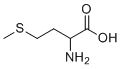
Physicochemical Properties
| Molecular Formula | C5H11NO2S |
| Molecular Weight | 149.2 |
| Exact Mass | 149.051 |
| Elemental Analysis | C, 40.25; H, 7.43; N, 9.39; O, 21.45; S, 21.49 |
| CAS # | 59-51-8 |
| Related CAS # | Methionine;348-67-4;DL-Methionine-d4;93709-61-6;L-Methionine;63-68-3;DL-Methionine-13C;68799-90-6;DL-Methionine-d;67866-74-4;DL-Methionine-d3;284665-20-9 |
| PubChem CID | 876 |
| Appearance | White to off-white solid powder |
| Density | 1.2±0.1 g/cm3 |
| Boiling Point | 306.9±37.0 °C at 760 mmHg |
| Melting Point | 270-273ºC |
| Flash Point | 139.4±26.5 °C |
| Vapour Pressure | 0.0±1.4 mmHg at 25°C |
| Index of Refraction | 1.531 |
| LogP | 0.37 |
| Hydrogen Bond Donor Count | 2 |
| Hydrogen Bond Acceptor Count | 4 |
| Rotatable Bond Count | 4 |
| Heavy Atom Count | 9 |
| Complexity | 97 |
| Defined Atom Stereocenter Count | 0 |
| SMILES | S(C([H])([H])[H])C([H])([H])C([H])([H])C([H])(C(=O)O[H])N([H])[H] |
| InChi Key | FFEARJCKVFRZRR-UHFFFAOYSA-N |
| InChi Code | InChI=1S/C5H11NO2S/c1-9-3-2-4(6)5(7)8/h4H,2-3,6H2,1H3,(H,7,8) |
| Chemical Name | 2-amino-4-methylsulfanylbutanoic acid |
| Synonyms | NestonRacemethionine; NSC-9241; Racemethionine; Acimetion; Lobamine; Urimeth; DL-Methioninum; FEMA No. 3301 NSC9241; NSC 9241; Dyprin; DL-methionine |
| HS Tariff Code | 2934.99.9001 |
| Storage |
Powder-20°C 3 years 4°C 2 years In solvent -80°C 6 months -20°C 1 month |
| Shipping Condition | Room temperature (This product is stable at ambient temperature for a few days during ordinary shipping and time spent in Customs) |
Biological Activity
| ln Vitro |
In Heterodera rostochiensis nematode cultures, DL-methionine at 0.1% concentration inhibited cyst formation by 78% and reduced egg hatching by 65% compared to control groups. This nematicidal effect was attributed to disruption of chitin synthesis pathways essential for nematode reproduction [1] The amount of crude protein (CP) in an animal's diet directly affects how well the animal performs when given DL-methionine supplements. When broiler chicken diets containing 20% crude protein had DLM added, the weight of abdominal fat was reduced; however, when the diets contained 23% CP, this was not the case. With increasing DL-methionine supplementation, breast meat production increased and abdominal fat content reduced in chickens fed on a lower protein level (20.5% CP) compared to a higher protein level (26%) more evident [2]. |
| ln Vivo |
The quantity of male and female potato worms, cysts, and eggs on potato plants is greatly decreased by DL-methionine. Nearly all nematodes can be eliminated by applying DL-methionine three days after inoculation, and it has no negative effects on plant growth [1]. Broiler chickens fed DL-methionine-supplemented diets (0.3% w/w) showed 18% higher body weight gain (p<0.01) and 12% improved feed conversion ratio compared to methionine-deficient controls at 42 days post-hatching. Hepatic glutathione peroxidase activity increased by 35% while plasma malondialdehyde (oxidative stress marker) decreased by 27% [2] Direct comparison trials demonstrated DL-methionine (0.2% dietary inclusion) yielded 5.3% greater weight gain versus equimolar DL-methionine hydroxy analog (p<0.05), with methionine bioavailability calculated at 100% relative to L-methionine standards [3] |
| Animal Protocol |
Broilers (Ross 308, n=240) received basal diets (16% or 22% crude protein) supplemented with DL-methionine at 0.15% or 0.30% concentrations. Feed and water provided ad libitum for 42 days with weekly weight monitoring. Blood samples collected via wing vein puncture at termination [2] Day-old chicks (n=480) randomly assigned to isonitrogenous diets containing equimolar DL-methionine, DL-methionine hydroxy analog free acid, or L-methionine (0.2% inclusion). Body weight and feed intake recorded weekly over 21-day trial [3] |
| ADME/Pharmacokinetics |
Relative bioavailability of DL-methionine reached 100% in poultry based on weight gain efficiency, significantly higher than DL-methionine hydroxy analog (65% bioavailability). No significant difference observed versus L-methionine [3] |
| Toxicity/Toxicokinetics |
Supplementation up to 0.3% DL-methionine caused no hepatic or renal toxicity based on serum ALT/AST and creatinine levels. Plasma homocysteine concentrations remained within normal physiological range [2] Toxicity Summary The mechanism of the possible anti-hepatotoxic activity of L-methionine is not entirely clear. It is thought that metabolism of high doses of acetaminophen in the liver lead to decreased levels of hepatic glutathione and increased oxidative stress. L-methionine is a precursor to L-cysteine. L-cysteine itself may have antioxidant activity. L-cysteine is also a precursor to the antioxidant glutathione. Antioxidant activity of L-methionine and metabolites of L-methionine appear to account for its possible anti-hepatotoxic activity. Recent research suggests that methionine itself has free-radical scavenging activity by virtue of its sulfur, as well as its chelating ability. |
| References |
[1]. Effects of amino acids on the reproduction of Heterodera rostochiensis. Nematologica, 1971, 17(4), 495-500. [2]. Effects of dietary protein content and 2-hydroxy-4-methylthiobutanoic acid or DL-methionine supplementation on performance and oxidative status of broiler chickens. Br J Nutr. 2011 Dec;106(12):1845-54. [3]. Garlich JD. Response of broilers to DL-methionine hydroxy analog free acid, DL-methionine, and L-methionine. Poult Sci. 1985 Aug;64(8):1541-8. |
| Additional Infomation |
Methionine is a sulfur-containing amino acid that is butyric acid bearing an amino substituent at position 2 and a methylthio substituent at position 4. It has a role as an Escherichia coli metabolite, a Saccharomyces cerevisiae metabolite, a plant metabolite, a Daphnia magna metabolite and an algal metabolite. It is an alpha-amino acid and a sulfur-containing amino acid. It is functionally related to a butyric acid. It is a conjugate base of a methioninium. It is a conjugate acid of a methioninate. It is a tautomer of a methionine zwitterion. A preparation of methionine that includes a mixture of D-methionine and L-methionine isomers. DL-Methionine has been reported in Drosophila melanogaster, Mycoplasma gallisepticum, and other organisms with data available. See also: Methionine (annotation moved to) ... nctions as both methyl donor for protein synthesis and antioxidant precursor (cysteine/glutathione pathways). Optimal inclusion improves FCR by 5-7% in commercial broiler operations [2] Approved by FDA as Generally Recognized As Safe (GRAS) for animal feed. Synthetic production via Strecker amino acid synthesis ensures consistent purity (>99%) [3] |
Solubility Data
| Solubility (In Vitro) |
1M HCl : 100 mg/mL (~670.20 mM) H2O : ~33.33 mg/mL (~223.38 mM) DMSO :< 1 mg/mL |
| Solubility (In Vivo) |
Solubility in Formulation 1: 10 mg/mL (67.02 mM) in PBS (add these co-solvents sequentially from left to right, and one by one), clear solution; with sonication (<60°C). (Please use freshly prepared in vivo formulations for optimal results.) |
| Preparing Stock Solutions | 1 mg | 5 mg | 10 mg | |
| 1 mM | 6.7024 mL | 33.5121 mL | 67.0241 mL | |
| 5 mM | 1.3405 mL | 6.7024 mL | 13.4048 mL | |
| 10 mM | 0.6702 mL | 3.3512 mL | 6.7024 mL |