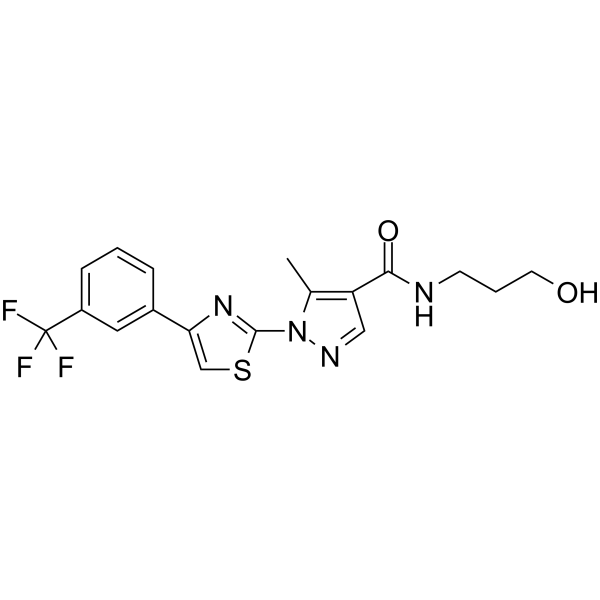
Physicochemical Properties
| Molecular Formula | C18H17F3N4O2S |
| Molecular Weight | 410.41338 |
| Exact Mass | 410.102 |
| CAS # | 162112-37-0 |
| PubChem CID | 9953357 |
| Appearance | White to off-white solid powder |
| LogP | 4.01 |
| Hydrogen Bond Donor Count | 2 |
| Hydrogen Bond Acceptor Count | 8 |
| Rotatable Bond Count | 6 |
| Heavy Atom Count | 28 |
| Complexity | 540 |
| Defined Atom Stereocenter Count | 0 |
| InChi Key | HOFGTYCLOKDAES-UHFFFAOYSA-N |
| InChi Code | InChI=1S/C18H17F3N4O2S/c1-11-14(16(27)22-6-3-7-26)9-23-25(11)17-24-15(10-28-17)12-4-2-5-13(8-12)18(19,20)21/h2,4-5,8-10,26H,3,6-7H2,1H3,(H,22,27) |
| Chemical Name | N-(3-hydroxypropyl)-5-methyl-1-[4-[3-(trifluoromethyl)phenyl]-1,3-thiazol-2-yl]pyrazole-4-carboxamide |
| HS Tariff Code | 2934.99.9001 |
| Storage |
Powder-20°C 3 years 4°C 2 years In solvent -80°C 6 months -20°C 1 month |
| Shipping Condition | Room temperature (This product is stable at ambient temperature for a few days during ordinary shipping and time spent in Customs) |
Biological Activity
| Targets | RWJ 50271 reduces the adherence of peripheral blood lymphocytes to plastic-fixed SICAM-1 [1]. In an LFA-1/ICAM-1-dependent natural killer [NK] cytotoxicity experiment, RWJ 50271 reduced human and mouse NK activity (IC50=5.0 μM) [1]. RWJ 50271 does not block Mac-1/ICAM-1, E-selectidialyl Lewis X or VLA-4/VCAM-1 mediated cell attachment at doses up to 20 μM [1]. RWJ 50271 does not modify LFA-1 expression levels on HL60 cells [1]. RWJ 50271 reduces the adherence of peripheral blood lymphocytes to plastic-fixed SICAM-1 [1]. RWJ 50271 does not display any harmful activity at doses up to 100 μM [1]. |
| ln Vitro |
RWJ 50271 reduces the adherence of peripheral blood lymphocytes to plastic-fixed SICAM-1 [1]. In an LFA-1/ICAM-1-dependent natural killer [NK] cytotoxicity experiment, RWJ 50271 reduced human and mouse NK activity (IC50=5.0 μM) [1]. RWJ 50271 does not block Mac-1/ICAM-1, E-selectidialyl Lewis X or VLA-4/VCAM-1 mediated cell attachment at doses up to 20 μM [1]. RWJ 50271 does not modify LFA-1 expression levels on HL60 cells [1]. RWJ 50271 reduces the adherence of peripheral blood lymphocytes to plastic-fixed SICAM-1 [1]. RWJ 50271 does not display any harmful activity at doses up to 100 μM [1]. RWJ 50271 (Compound 4) inhibits the adhesion of LFA-1 bearing HL60 cells to immobilized recombinant soluble ICAM-1 (sICAM-1) in a cell/protein adhesion assay with an IC50 of 5.0 µM. [1] RWJ 50271 also inhibits LFA-1/ICAM-1-mediated cell/cell adhesion between HL60 cells and U937 cells (which express ICAM-1) with an IC50 of 5 µM. [1] RWJ 50271 shows specificity for the LFA-1/ICAM-1 interaction. At concentrations up to 20 µM, it does not inhibit cell adhesion mediated by Mac-1/ICAM-1 (using fMLP-stimulated human neutrophils), E-selectin/sialyl Lewis X (using IL-1β-stimulated HUVECs and HL60 cells), or VLA-4/VCAM-1 (using IL-1β-stimulated HUVECs and Ramos cells). [1] Flow cytometry analysis indicates that RWJ 50271 does not alter the LFA-1 expression levels on HL60 cells. [1] RWJ 50271 inhibits the adhesion of peripheral blood lymphocytes to plastic-immobilized sICAM-1. [1] RWJ 50271 inhibits both human and murine natural killer (NK) cell cytotoxicity in an LFA-1/ICAM-1-dependent assay with an IC50 of 5.0 µM. [1] |
| ln Vivo |
RWJ 50271 (50 mg/kg; oral) works well in inflammatory animal models [1]. In a murine delayed-type hypersensitivity (DTH) reaction model, an oral dose of 50 mg/kg of RWJ 50271, administered 4 hours after the antigen challenge to previously immunized mice, significantly reduced foot pad swelling by >50% at 48 hours post-challenge. [1] |
| Cell Assay |
LFA-1/ICAM-1 Cell/Protein Adhesion Assay: Fluorochrome-labeled HL60 cells (expressing LFA-1) were allowed to adhere to recombinant soluble ICAM-1 (sICAM-1) that was immobilized onto plastic wells. After a 40-minute incubation period at 37 °C, nonadherent cells were washed away. Adherence levels were quantified using a fluorescence concentration analyzer. Test compounds like RWJ 50271 were added to the assay to monitor their inhibitory effect on adhesion. Blocking antibodies to either LFA-1 or ICAM-1 served as positive controls, exerting >90% inhibition. [1] Specificity Adhesion Assays: Additional adherence assays were used to test specificity. For Mac-1/ICAM-1, f-MetLeuPhe-stimulated human neutrophils were allowed to interact with immobilized ICAM-1 for 30 minutes at 37°C. For E-selectin/sialyl Lewis X, confluent monolayers of human umbilical vein endothelial cells (HUVECs) were treated with IL-1β for 4 hours to induce E-selectin expression, followed by a 20-minute incubation with HL60 cells at 4°C. For VLA-4/VCAM-1, Ramos cells (expressing VLA-4) were incubated with overnight IL-1β-stimulated HUVECs (expressing VCAM-1). Adherence was quantified using fluorescence technology, and specific antibodies were used as controls in each system. [1] NK Cell Cytotoxicity Assay: An LFA-1/ICAM-1-dependent natural killer (NK) cytotoxicity assay was performed. The detailed protocol is not provided in the main text, but the result states that RWJ 50271 inhibited both human and murine NK activity with an IC50 of 5.0 µM. [1] Membrane Integrity / Toxicity Assay: To monitor compound toxicity during NK cytolysis testing, target cells were exposed to varying doses of the test compounds for 4 hours. Lysis above the spontaneous level was attributed to compound toxicity. RWJ 50271 did not exhibit any cell lysis up to 100 µM concentrations. [1] Cell Viability Assay (Trypan Blue Exclusion): HL60 cells were treated with various doses of RWJ 50271 for 1 hour at 37°C before testing for viability by trypan blue exclusion. The compound did not exhibit any toxic activity up to 100 µM concentrations. [1] |
| Animal Protocol |
Animal/Disease Models: Mouse, delayed-type hypersensitivity [DTH] response model [1] Doses: 50 mg/kg Route of Administration: Oral Experimental Results: Footpad swelling was Dramatically diminished (>50%) 48 hrs (hrs (hours)) after challenge. Murine Delayed-Type Hypersensitivity (DTH) Model: Mice were first immunized (sensitization phase). Later, they were challenged with the antigen to induce a DTH reaction. RWJ 50271 was administered orally at a dose of 50 mg/kg, 4 hours after the antigen challenge. Foot pad swelling was measured 48 hours after the challenge. The specific vehicle or formulation for oral dosing is not detailed in the provided text. [1] |
| Toxicity/Toxicokinetics |
RWJ 50271 did not cause cell lysis up to a concentration of 100 µM in a membrane integrity assay using target cells in an NK cytotoxicity test setting. [1] RWJ 50271 did not exhibit any toxic activity (as measured by trypan blue exclusion) on HL60 cells up to a concentration of 100 µM after a 1-hour treatment at 37°C. [1] |
| References |
[1]. Novel thiazole based heterocycles as inhibitors of LFA-1/ICAM-1 mediated cell adhesion. J Med Chem. 1995 Mar 31;38(7):1057-9. |
| Additional Infomation |
RWJ 50271 (2-[4-(3-Hydroxypropylcarbamoyl)-5-methylpyrazol-1-yl]-4-[3-(trifluoromethyl)phenyl]thiazole) is a synthetic small molecule identified as an inhibitor of the LFA-1/ICAM-1 interaction. [1] The drug discovery program aimed to develop such inhibitors for the potential treatment of rheumatoid arthritis, organ transplantation, and other inflammatory disorders. [1] Preliminary structure-activity relationship (SAR) studies indicated that the 3-trifluoromethyl group on the phenyl ring, a methyl group on the pyrazole ring, and a terminal hydroxyl group on the side chain were important for optimal inhibitory activity in the cell/protein adhesion assay. [1] The study concludes that RWJ 50271 represents a novel series of adhesion molecule antagonists and that additional analogues were being evaluated in DTH and other animal models of inflammation. [1] |
Solubility Data
| Solubility (In Vitro) | DMSO : ~250 mg/mL (~609.15 mM) |
| Solubility (In Vivo) |
Solubility in Formulation 1: ≥ 2.08 mg/mL (5.07 mM) (saturation unknown) in 10% DMSO + 40% PEG300 + 5% Tween80 + 45% Saline (add these co-solvents sequentially from left to right, and one by one), clear solution. For example, if 1 mL of working solution is to be prepared, you can add 100 μL of 20.8 mg/mL clear DMSO stock solution to 400 μL PEG300 and mix evenly; then add 50 μL Tween-80 to the above solution and mix evenly; then add 450 μL normal saline to adjust the volume to 1 mL. Preparation of saline: Dissolve 0.9 g of sodium chloride in 100 mL ddH₂ O to obtain a clear solution. Solubility in Formulation 2: ≥ 2.08 mg/mL (5.07 mM) (saturation unknown) in 10% DMSO + 90% Corn Oil (add these co-solvents sequentially from left to right, and one by one), clear solution. For example, if 1 mL of working solution is to be prepared, you can add 100 μL of 20.8 mg/mL clear DMSO stock solution to 900 μL of corn oil and mix evenly. (Please use freshly prepared in vivo formulations for optimal results.) |
| Preparing Stock Solutions | 1 mg | 5 mg | 10 mg | |
| 1 mM | 2.4366 mL | 12.1829 mL | 24.3659 mL | |
| 5 mM | 0.4873 mL | 2.4366 mL | 4.8732 mL | |
| 10 mM | 0.2437 mL | 1.2183 mL | 2.4366 mL |