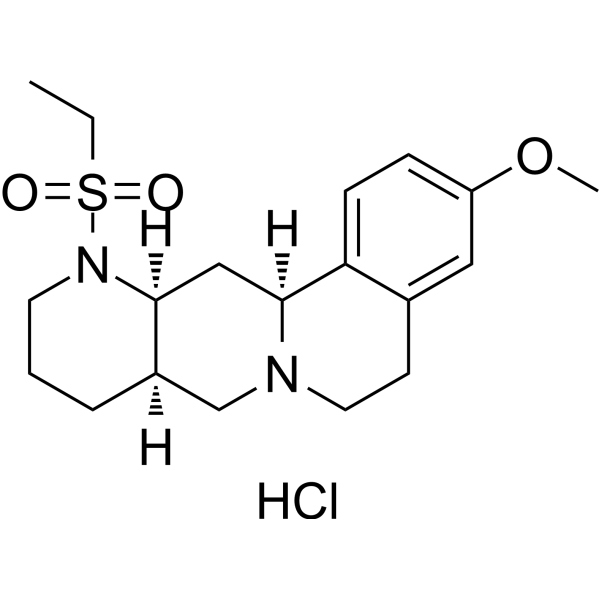
Physicochemical Properties
| Molecular Formula | C19H29CLN2O3S |
| Molecular Weight | 400.96 |
| Exact Mass | 400.159 |
| CAS # | 186002-54-0 |
| PubChem CID | 9908991 |
| Appearance | Typically exists as solid at room temperature |
| LogP | 4.187 |
| Hydrogen Bond Donor Count | 1 |
| Hydrogen Bond Acceptor Count | 5 |
| Rotatable Bond Count | 3 |
| Heavy Atom Count | 26 |
| Complexity | 576 |
| Defined Atom Stereocenter Count | 3 |
| SMILES | CCS(=O)(=O)N1CCC[C@H]2[C@@H]1C[C@H]3C4=C(CCN3C2)C=C(C=C4)OC.Cl |
| InChi Key | DZTZUOBWDBPPJQ-BQBHMPFISA-N |
| InChi Code | InChI=1S/C19H28N2O3S.ClH/c1-3-25(22,23)21-9-4-5-15-13-20-10-8-14-11-16(24-2)6-7-17(14)19(20)12-18(15)21;/h6-7,11,15,18-19H,3-5,8-10,12-13H2,1-2H3;1H/t15-,18+,19+;/m1./s1 |
| Chemical Name | (8aR,12aS,13aS)-12-ethylsulfonyl-3-methoxy-5,6,8,8a,9,10,11,12a,13,13a-decahydroisoquinolino[2,1-g][1,6]naphthyridine;hydrochloride |
| Synonyms | 186002-54-0; RS 79948 hydrochloride; RS 79948-197; RS-79948-197; DTXSID50432711; (8aR,12aS,13aS)-12-ethylsulfonyl-3-methoxy-5,6,8,8a,9,10,11,12a,13,13a-decahydroisoquinolino[2,1-g][1,6]naphthyridine;hydrochloride; (8aR,12aS,13aS)-5,8,8a,9,10,11,12,12a,13,13a-dechydro-3-methoxy-12-(ethylsulfonyl)-6H-isoquino[2,1-g][1,6]naphthyridine hydrochloride; RS 79948; |
| HS Tariff Code | 2934.99.9001 |
| Storage |
Powder-20°C 3 years 4°C 2 years In solvent -80°C 6 months -20°C 1 month |
| Shipping Condition | Room temperature (This product is stable at ambient temperature for a few days during ordinary shipping and time spent in Customs) |
Biological Activity
| Targets | rat α2A receptor 0.42 nM (Kd) rat α2B recepter 0.18 nM (Kd) rat α2C recepter 0.19 nM (Kd) human α2A-adrenoceptor 0.6 nM (Kd) human α2B-adrenoceptor 0.46 nM (Kd) human α2C-adrenoceptor 0.77 nM (Kd) |
| ln Vitro | Tritium-labelled RS-79948-197 {(8aR,12aS,13aS)-5, 8,8a,9,10,11,12,12a,13,13a-decahydro-3-methoxy-12-(ethylsulphon yl)-6H-iso- quino[2,1-g][1,6]naphthyridine} was evaluated in rat brain as an in vivo ligand for central alpha 2-adrenoceptors, as a preliminary step in the development of a radioligand for positron-emission tomography (PET) studies. The maximal receptor-specific signal was achieved within 90-120 min after i.v. injection of [ethyl-3H]RS-79948-197 and was selective for the alpha 2- compared with the alpha 1-adrenoceptor, with no detectable binding to the imidazoline-I2 site. Estimates for binding potential (approximating to Bmax/Kd) ranged between 3.4 in entorhinal cortex and 0.5 in medulla oblongata. The results, which indicate a similarly localised but 2-fold increase in specific binding compared with that previously demonstrated using [3H]RX 821002 (2-methoxy-idazoxan), are sufficiently encouraging as to support further investment in the development of 11C-labelled RS-79948-197, or a close structural analogue, as a ligand for clinical PET[2]. |
| Enzyme Assay | The Kd values of the recently introduced radioligand [3H]RS-79948-197 ((8a R,12aS,13a-S)-5,8,8a,9,10,11,12,12a,13,13a-decahydro-3-metho xy-12-(ethylsulphonyl)-6H-isoquino[2,1-g][1,6]naphthyridine) were determined for the recombinant human and rat alpha2A-, alpha2B- and alpha2C- as well as guinea pig alpha2B- and alpha2c-adrenoceptors expressed in COS (CV-1 Origin, SV40) cells. In addition, the Kd values were also determined for [3H]RS-79948-197 for the guinea pig spleen alpha2A-adrenoceptor and for pig alpha2A-, alpha2B- and alpha2C-adrenoceptors in membranes obtained from kidney and striatum. Available radioligands for alpha2-adrenoceptors, besides [3H]RS-79948-197 are the tritiated forms of MK912 ((2S,12bS)1',3'-dimethylspiro(1,3,4,5',6,6',7,12b-octa hydro-2H-benzo[b]furo[2,3-a]quinazoline)-2,4'-pyrimidin-2'-one), RX821002 (2-methoxy-idazoxan), rauwolscine and yohimbine. In the present article the binding constants of all these substances for the alpha2A-, alpha2B- and alpha2C-adrenoceptor subtypes in human, pig, rat and guinea pig are reviewed. In all species tested MK912 was alpha2C-selective, RX821002 showed a minor alpha2A-selectivity, whereas [3H]RS-79948-197 was non-selective among the alpha2-adrenoceptor subtypes, showing high affinity for all three subtypes. Rauwolscine and yohimbine showed relatively low affinities for nmost of the alpha2-adrenoceptor subtypes investigated, the exception being rauwolscine having high affinity for the human and porcine alpha2C-adrenoceptors[1]. |
| References |
[1].[3H]RS79948-197 binding to human, rat, guinea pig and pig alpha2A-, alpha2B- and alpha2C-adrenoceptors. Comparison with MK912, RX821002, rauwolscine and yohimbine. Eur J Pharmacol. 1998 Feb 5;343(1):93-101. [2].Evaluation in rat of RS-79948-197 as a potential PET ligand for central alpha 2-adrenoceptors. Eur J Pharmacol. 1996 Dec 12;317(1):67-73. |
Solubility Data
| Solubility (In Vitro) | Typically soluble in DMSO (e.g. 10 mM) |
| Solubility (In Vivo) |
Note: Listed below are some common formulations that may be used to formulate products with low water solubility (e.g. < 1 mg/mL), you may test these formulations using a minute amount of products to avoid loss of samples. Injection Formulations (e.g. IP/IV/IM/SC) Injection Formulation 1: DMSO : Tween 80: Saline = 10 : 5 : 85 (i.e. 100 μL DMSO stock solution → 50 μL Tween 80 → 850 μL Saline) *Preparation of saline: Dissolve 0.9 g of sodium chloride in 100 mL ddH ₂ O to obtain a clear solution. Injection Formulation 2: DMSO : PEG300 :Tween 80 : Saline = 10 : 40 : 5 : 45 (i.e. 100 μL DMSO → 400 μLPEG300 → 50 μL Tween 80 → 450 μL Saline) Injection Formulation 3: DMSO : Corn oil = 10 : 90 (i.e. 100 μL DMSO → 900 μL Corn oil) Example: Take the Injection Formulation 3 (DMSO : Corn oil = 10 : 90) as an example, if 1 mL of 2.5 mg/mL working solution is to be prepared, you can take 100 μL 25 mg/mL DMSO stock solution and add to 900 μL corn oil, mix well to obtain a clear or suspension solution (2.5 mg/mL, ready for use in animals). Injection Formulation 4: DMSO : 20% SBE-β-CD in saline = 10 : 90 [i.e. 100 μL DMSO → 900 μL (20% SBE-β-CD in saline)] *Preparation of 20% SBE-β-CD in Saline (4°C,1 week): Dissolve 2 g SBE-β-CD in 10 mL saline to obtain a clear solution. Injection Formulation 5: 2-Hydroxypropyl-β-cyclodextrin : Saline = 50 : 50 (i.e. 500 μL 2-Hydroxypropyl-β-cyclodextrin → 500 μL Saline) Injection Formulation 6: DMSO : PEG300 : castor oil : Saline = 5 : 10 : 20 : 65 (i.e. 50 μL DMSO → 100 μLPEG300 → 200 μL castor oil → 650 μL Saline) Injection Formulation 7: Ethanol : Cremophor : Saline = 10: 10 : 80 (i.e. 100 μL Ethanol → 100 μL Cremophor → 800 μL Saline) Injection Formulation 8: Dissolve in Cremophor/Ethanol (50 : 50), then diluted by Saline Injection Formulation 9: EtOH : Corn oil = 10 : 90 (i.e. 100 μL EtOH → 900 μL Corn oil) Injection Formulation 10: EtOH : PEG300:Tween 80 : Saline = 10 : 40 : 5 : 45 (i.e. 100 μL EtOH → 400 μLPEG300 → 50 μL Tween 80 → 450 μL Saline) Oral Formulations Oral Formulation 1: Suspend in 0.5% CMC Na (carboxymethylcellulose sodium) Oral Formulation 2: Suspend in 0.5% Carboxymethyl cellulose Example: Take the Oral Formulation 1 (Suspend in 0.5% CMC Na) as an example, if 100 mL of 2.5 mg/mL working solution is to be prepared, you can first prepare 0.5% CMC Na solution by measuring 0.5 g CMC Na and dissolve it in 100 mL ddH2O to obtain a clear solution; then add 250 mg of the product to 100 mL 0.5% CMC Na solution, to make the suspension solution (2.5 mg/mL, ready for use in animals). Oral Formulation 3: Dissolved in PEG400 Oral Formulation 4: Suspend in 0.2% Carboxymethyl cellulose Oral Formulation 5: Dissolve in 0.25% Tween 80 and 0.5% Carboxymethyl cellulose Oral Formulation 6: Mixing with food powders Note: Please be aware that the above formulations are for reference only. InvivoChem strongly recommends customers to read literature methods/protocols carefully before determining which formulation you should use for in vivo studies, as different compounds have different solubility properties and have to be formulated differently. (Please use freshly prepared in vivo formulations for optimal results.) |
| Preparing Stock Solutions | 1 mg | 5 mg | 10 mg | |
| 1 mM | 2.4940 mL | 12.4701 mL | 24.9401 mL | |
| 5 mM | 0.4988 mL | 2.4940 mL | 4.9880 mL | |
| 10 mM | 0.2494 mL | 1.2470 mL | 2.4940 mL |