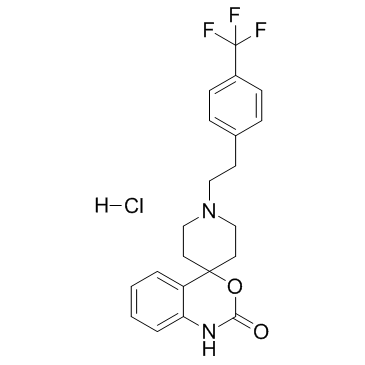
RS-102895 HCl (RS 102895), the hydrochloride salt of RS102895, is a novel and potent chemokine receptor CCR2 antagonist anticancer activity. It exhibits no effect on CCR1 but inhibits CCR2 with an IC50 of 360 nM. At IC50 values of 32 nM and 1.7 μM, respectively, RS-102895 HCl inhibits MCP-1-stimulated calcium influx and chemotaxis. Moreover, it blocks 5-HT1A, α1A, and α1D receptors.
Physicochemical Properties
| Molecular Formula | C21H22CLF3N2O2 |
| Molecular Weight | 426.8598 |
| Exact Mass | 426.13 |
| Elemental Analysis | C, 59.09; H, 5.20; Cl, 8.30; F, 13.35; N, 6.56; O, 7.50 |
| CAS # | 1173022-16-6 |
| Related CAS # | RS102895; 300815-41-2 |
| PubChem CID | 16759153 |
| Appearance | White to off-white solid powder |
| LogP | 4.188 |
| Hydrogen Bond Donor Count | 2 |
| Hydrogen Bond Acceptor Count | 6 |
| Rotatable Bond Count | 3 |
| Heavy Atom Count | 29 |
| Complexity | 552 |
| Defined Atom Stereocenter Count | 0 |
| SMILES | Cl[H].FC(C1C([H])=C([H])C(=C([H])C=1[H])C([H])([H])C([H])([H])N1C([H])([H])C([H])([H])C2(C3=C([H])C([H])=C([H])C([H])=C3N([H])C(=O)O2)C([H])([H])C1([H])[H])(F)F |
| InChi Key | KRRISOFSWVKYBF-UHFFFAOYSA-N |
| InChi Code | InChI=1S/C21H21F3N2O2.ClH/c22-21(23,24)16-7-5-15(6-8-16)9-12-26-13-10-20(11-14-26)17-3-1-2-4-18(17)25-19(27)28-20;/h1-8H,9-14H2,(H,25,27);1H |
| Chemical Name | 1'-[2-[4-(trifluoromethyl)phenyl]ethyl]spiro[1H-3,1-benzoxazine-4,4'-piperidine]-2-one;hydrochloride |
| Synonyms | RS-102895HCl; RS-102895; RS 102895; RS-102895 HCl; RS102895 |
| HS Tariff Code | 2934.99.9001 |
| Storage |
Powder-20°C 3 years 4°C 2 years In solvent -80°C 6 months -20°C 1 month Note: Please store this product in a sealed and protected environment, avoid exposure to moisture. |
| Shipping Condition | Room temperature (This product is stable at ambient temperature for a few days during ordinary shipping and time spent in Customs) |
Biological Activity
| Targets | CCR2 ( IC50 = 360 nM ); CCR1 ( IC50 = 17800 nM ); Human α1a receptor ( IC50 = 130 nM ); Human α1d receptor ( IC50 = 320 nM ); 5HT-1a receptor ( IC50 = 470 nM ) |
| ln Vitro | RS-102895's effect on leukocyte chemotaxis toward CCL2 is validated by an in vitro chemotaxis assay. Based on the data, it appears that elevated CCL2 in SS kidneys plays a significant role in the initial leukocyte recruitment. Blocking this recruitment with RS-102895 then reduces hypertension and renal damage.[2] |
| ln Vivo | The biological function of the CCL2/CCR2 pathway is tested by daily administration of CCR2 antagonist RS-102895. Assessments are made of blood pressure, renal damage, and renal leukocyte infiltration. The findings show that following a 21-day high-salt diet, RS-102895 treatment reduces hypertension and renal damage. It is found that by day three of the high-salt diet, renal leukocyte infiltration is blunted. [2] |
| Cell Assay | After being collected, peritoneal cells are centrifuged, filtered through a 40-μm strainer, and then resuspended in medium without serum. After using a hemocytometer to count the cells, the concentration was adjusted to 107 cells/mL. The cells are left untreated or incubated for 30 minutes with DMSO vehicle, urine from animals treated with CCR2 antagonists in vivo, or RS-102895 at different concentrations. |
| References |
[1]. J Biol Chem . 2000 Aug 18;275(33):25562-71. [2]. Am J Physiol Renal Physiol . 2020 Apr 1;318(4):F982-F993. |
Solubility Data
| Solubility (In Vitro) |
DMSO: 41.7~85 mg/mL (97.6~199.1 mM) Ethanol: 85 mg/mL |
| Solubility (In Vivo) |
Solubility in Formulation 1: ≥ 2.08 mg/mL (4.87 mM) (saturation unknown) in 10% DMSO + 40% PEG300 + 5% Tween80 + 45% Saline (add these co-solvents sequentially from left to right, and one by one), clear solution. For example, if 1 mL of working solution is to be prepared, you can add 100 μL of 20.8 mg/mL clear DMSO stock solution to 400 μL PEG300 and mix evenly; then add 50 μL Tween-80 to the above solution and mix evenly; then add 450 μL normal saline to adjust the volume to 1 mL. Preparation of saline: Dissolve 0.9 g of sodium chloride in 100 mL ddH₂ O to obtain a clear solution. Solubility in Formulation 2: ≥ 2.08 mg/mL (4.87 mM) (saturation unknown) in 10% DMSO + 90% (20% SBE-β-CD in Saline) (add these co-solvents sequentially from left to right, and one by one), clear solution. For example, if 1 mL of working solution is to be prepared, you can add 100 μL of 20.8 mg/mL clear DMSO stock solution to 900 μL of 20% SBE-β-CD physiological saline solution and mix evenly. Preparation of 20% SBE-β-CD in Saline (4°C,1 week): Dissolve 2 g SBE-β-CD in 10 mL saline to obtain a clear solution. Solubility in Formulation 3: ≥ 2.08 mg/mL (4.87 mM) (saturation unknown) in 10% DMSO + 90% Corn Oil (add these co-solvents sequentially from left to right, and one by one), clear solution. For example, if 1 mL of working solution is to be prepared, you can add 100 μL of 20.8 mg/mL clear DMSO stock solution to 900 μL of corn oil and mix evenly. Solubility in Formulation 4: 5%DMSO+ Corn oil: 4.5mg/ml (10.54mM) (Please use freshly prepared in vivo formulations for optimal results.) |
| Preparing Stock Solutions | 1 mg | 5 mg | 10 mg | |
| 1 mM | 2.3427 mL | 11.7134 mL | 23.4269 mL | |
| 5 mM | 0.4685 mL | 2.3427 mL | 4.6854 mL | |
| 10 mM | 0.2343 mL | 1.1713 mL | 2.3427 mL |