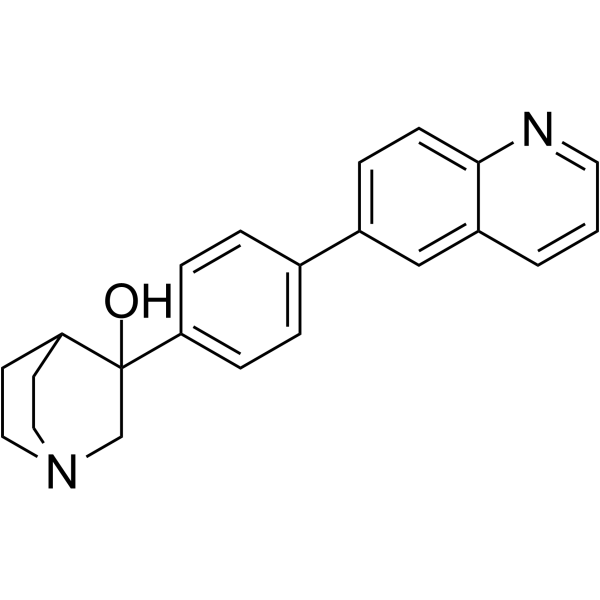
Physicochemical Properties
| Molecular Formula | C22H22N2O |
| Molecular Weight | 330.423 |
| Exact Mass | 330.173 |
| CAS # | 197576-78-6 |
| PubChem CID | 9883981 |
| Appearance | Typically exists as solid at room temperature |
| LogP | 3.3 |
| Hydrogen Bond Donor Count | 1 |
| Hydrogen Bond Acceptor Count | 3 |
| Rotatable Bond Count | 2 |
| Heavy Atom Count | 25 |
| Complexity | 467 |
| Defined Atom Stereocenter Count | 0 |
| InChi Key | JICDBMXIQNEXKV-UHFFFAOYSA-N |
| InChi Code | InChI=1S/C22H22N2O/c25-22(15-24-12-9-20(22)10-13-24)19-6-3-16(4-7-19)17-5-8-21-18(14-17)2-1-11-23-21/h1-8,11,14,20,25H,9-10,12-13,15H2 |
| Chemical Name | 3-(4-quinolin-6-ylphenyl)-1-azabicyclo[2.2.2]octan-3-ol |
| HS Tariff Code | 2934.99.9001 |
| Storage |
Powder-20°C 3 years 4°C 2 years In solvent -80°C 6 months -20°C 1 month |
| Shipping Condition | Room temperature (This product is stable at ambient temperature for a few days during ordinary shipping and time spent in Customs) |
Biological Activity
| Targets |
1. Squalene synthase (SQS, IC50=1.4 nM for human recombinant SQS; Ki=0.8 nM for rat liver microsomal SQS)[1] 2. No significant activity against HMG-CoA reductase (IC50>10000 nM, >7000-fold selectivity over SQS)[1] |
| ln Vitro |
RPR107393 is a selective squalene synthase inhibitor with subnanomolar potency. RPR107393 inhibits rat liver microsomal squalene synthase with an IC50 value of 0.8±0.2 nM (n=4)[1]. In time course investigations, cells were treated with ER-27856 (1 μM), RPR-107393 (10 μM), atorvastatin (1 μM), or NB-598 (1 μM) for 2-24 hours, followed by lipid Biosynthesis was evaluated during the last 2 h of incubation. RPR-107393 (10 μM) inhibits cholesterol biosynthesis and lowers triglyceride biosynthesis. Similarly, 1 μM RPR-107393 reduced cholesterol and triglyceride biosynthesis by 82.4% and 70.0% respectively[2]. 1. Enzyme activity inhibition: RPR107393 free base potently inhibited human recombinant SQS with IC50 of 1.4 nM and rat liver microsomal SQS with Ki of 0.8 nM; it showed negligible inhibition of HMG-CoA reductase (IC50>10 μM), demonstrating high target selectivity for SQS[1] 2. Cholesterol synthesis inhibition in liver preparations: In rat liver microsomes, the compound inhibited de novo cholesterol synthesis with IC50 of 2.1 nM; in primary rat hepatocytes, it reduced cholesterol biosynthesis by 82% at 10 nM and 95% at 100 nM[1] 3. Triglyceride biosynthesis suppression: In primary rat hepatocytes, RPR107393 free base (1-100 nM) dose-dependently suppressed triglyceride biosynthesis via the farnesol pathway; at 10 nM, triglyceride production was reduced by 38%, and at 100 nM, the reduction reached 65%; this effect was reversed by exogenous addition of squalene (1 μM) but not by mevalonate (10 μM)[2] |
| ln Vivo |
Cholesterol production is 92% reduced an hour after oral administration of 10 mg/kg of RPR107393, with an ED50 value of about 5 mg/kg. Six hours after delivery, RPR107393 (10 mg/kg po) decreases cholesterol production by 74% (it takes about 7 hours to reach 50% inhibition). After 10 hours, RPR107393 (25 mg/kg po) caused an 82% decrease of hepatic cholesterol biosynthesis; however, after 21 hours, the impact was no longer noticeable. Radiolabeled diacid product buildup in the liver is linked to zaragozic acid (RPR107393)-induced inhibition of cholesterol production. In rats, RPR107393 is a highly effective cholesterol-lowering drug. After two days of treatment and three days of treatment, RPR107393 (30 mg/kg pobid) decreased serum cholesterol by 35% and nearly 50%, respectively [1]. 1. Cholesterol-lowering efficacy in rodents: In normocholesterolemic rats, oral administration of RPR107393 free base (1, 3, 10 mg/kg/day for 7 days) dose-dependently reduced plasma total cholesterol by 12%, 27%, and 41% respectively; in hypercholesterolemic hamsters, the same doses led to total cholesterol reduction of 15%, 32%, and 48%, with low-density lipoprotein cholesterol (LDL-C) reduced by 18%, 36%, and 52% respectively; compared with HMG-CoA reductase inhibitor simvastatin (10 mg/kg/day), RPR107393 free base (10 mg/kg/day) showed comparable cholesterol-lowering efficacy but with a more pronounced reduction in hepatic triglyceride (42% vs 21% for simvastatin)[1] |
| Enzyme Assay |
1. Squalene synthase activity assay (recombinant enzyme): Prepare reaction mixtures containing human recombinant SQS, farnesyl pyrophosphate (FPP) substrate, NADPH-regenerating system, and serial concentrations of RPR107393 free base (0.1 nM–10 μM); incubate the mixtures at 37℃ for 30 min; terminate the reaction by adding organic solvent to extract squalene; quantify squalene production using high-performance liquid chromatography with ultraviolet detection; calculate residual enzyme activity by normalizing to vehicle control, then fit the dose-response curve to determine the IC50 value[1] 2. Squalene synthase activity assay (rat liver microsomes): Isolate microsomal fractions from rat liver and resuspend in appropriate buffer; set up reaction systems containing liver microsomes, FPP substrate, NADPH, and gradient concentrations of RPR107393 free base (0.1 nM–1 μM); incubate at 37℃ for 20 min; stop the reaction and extract squalene; quantify the product via gas chromatography-mass spectrometry; analyze enzyme kinetics using Lineweaver-Burk plots to obtain the Ki value for SQS inhibition[1] |
| Cell Assay | 1. Rat hepatocyte cholesterol and triglyceride synthesis assay: Isolate primary rat hepatocytes and seed them in culture plates with serum-containing medium for 24 h; switch to serum-free medium and treat cells with RPR107393 free base (0.1 nM–100 nM) for 2 h; add radiolabeled acetate (for cholesterol synthesis) or radiolabeled glycerol (for triglyceride synthesis) to the medium and incubate for another 6 h; harvest cells and extract lipids via organic solvent extraction; separate lipid fractions using thin-layer chromatography; quantify radiolabel incorporation into cholesterol or triglyceride fractions with a scintillation counter to evaluate synthesis inhibition[1][2] |
| Animal Protocol |
1. Rodent cholesterol-lowering experiment (rat): Use male Sprague-Dawley rats (150-180 g) and randomly divide into control, low-dose (1 mg/kg), medium-dose (3 mg/kg), and high-dose (10 mg/kg) RPR107393 free base groups; dissolve the compound in a vehicle containing carboxymethylcellulose and a small amount of solubilizer, and administer via oral gavage once daily for 7 consecutive days; collect tail vein blood samples at day 0 (baseline) and day 7 (endpoint) to measure plasma total cholesterol, LDL-C, high-density lipoprotein cholesterol (HDL-C), and triglyceride levels using automated biochemical analyzer; at the endpoint, sacrifice rats and harvest liver tissue to quantify hepatic cholesterol and triglyceride content[1] 2. Hypercholesterolemic hamster experiment: Use male Golden Syrian hamsters (80-100 g) fed a high-cholesterol diet for 2 weeks to induce hypercholesterolemia; assign hamsters to control, RPR107393 free base (1, 3, 10 mg/kg/day), or simvastatin (10 mg/kg/day) groups; administer drugs via oral gavage daily for 14 days while maintaining the high-cholesterol diet; collect blood samples at baseline and endpoint to measure lipid profiles, and compare cholesterol-lowering efficacy between RPR107393 free base and simvastatin[1] |
| ADME/Pharmacokinetics |
1. Oral bioavailability: RPR107393 free base had an oral bioavailability of 62% in rats and 58% in hamsters after oral administration of 10 mg/kg[1] 2. Plasma half-life: The compound exhibited a plasma half-life (t1/2) of 4.2 h in rats and 5.1 h in hamsters[1] 3. Tissue distribution: It accumulated preferentially in the liver (liver/plasma concentration ratio of 8.7 at 2 h post-administration in rats), the primary target organ for cholesterol synthesis inhibition[1] 4. Excretion: Within 72 h of oral administration in rats, 58% of the dose was excreted in feces (mainly as metabolites) and 27% in urine (12% as unchanged drug, 15% as glucuronide conjugates)[1] |
| Toxicity/Toxicokinetics |
1. Plasma protein binding: RPR107393 free base had a plasma protein binding rate of 92% in human plasma and 89% in rat plasma[1] 2. Acute and subchronic toxicity: In rats, the maximum tolerated dose (MTD) of oral RPR107393 free base was >50 mg/kg; subchronic administration (10 mg/kg/day for 28 days) caused no significant histopathological changes in liver, kidney, or heart tissues; serum levels of liver enzymes (ALT, AST) and renal function markers (BUN, creatinine) remained within normal ranges, with no evidence of organ toxicity[1] |
| References |
[1]. RPR107393, a potent squalene synthase inhibitor and orally effective Cholesterol-lowering agent: comparison with inhibitors of HMG-CoA reductase. J Pharmacol Exp Ther. 1997 May;281(2):746-52. [2]. Squalene synthase inhibitors suppress triglyceride biosynthesis through the farnesol pathway in rat hepatocytes. J Lipid Res. 2003 Jan;44(1):128-35. |
| Additional Infomation |
1. RPR107393 free base is a potent, selective squalene synthase inhibitor (SSI) developed for hypercholesterolemia treatment, with a distinct mechanism from HMG-CoA reductase inhibitors (statins)[1] 2. Its cholesterol-lowering mechanism involves blocking squalene synthase, the rate-limiting enzyme in the cholesterol biosynthetic pathway downstream of mevalonate, which reduces de novo cholesterol synthesis in the liver[1] 3. The compound also suppresses triglyceride biosynthesis in hepatocytes via the farnesol pathway, a mevalonate-derived intermediate pathway, which contributes to its dual lipid-modulating effects[2] 4. Compared with statins, RPR107393 free base does not interfere with the production of mevalonate-derived isoprenoids (e.g., ubiquinone, geranylgeranyl pyrophosphate) that are essential for cellular function, suggesting a lower risk of statin-associated side effects (e.g., myopathy)[1] |
Solubility Data
| Solubility (In Vitro) | May dissolve in DMSO (in most cases), if not, try other solvents such as H2O, Ethanol, or DMF with a minute amount of products to avoid loss of samples |
| Solubility (In Vivo) |
Note: Listed below are some common formulations that may be used to formulate products with low water solubility (e.g. < 1 mg/mL), you may test these formulations using a minute amount of products to avoid loss of samples. Injection Formulations (e.g. IP/IV/IM/SC) Injection Formulation 1: DMSO : Tween 80: Saline = 10 : 5 : 85 (i.e. 100 μL DMSO stock solution → 50 μL Tween 80 → 850 μL Saline) *Preparation of saline: Dissolve 0.9 g of sodium chloride in 100 mL ddH ₂ O to obtain a clear solution. Injection Formulation 2: DMSO : PEG300 :Tween 80 : Saline = 10 : 40 : 5 : 45 (i.e. 100 μL DMSO → 400 μLPEG300 → 50 μL Tween 80 → 450 μL Saline) Injection Formulation 3: DMSO : Corn oil = 10 : 90 (i.e. 100 μL DMSO → 900 μL Corn oil) Example: Take the Injection Formulation 3 (DMSO : Corn oil = 10 : 90) as an example, if 1 mL of 2.5 mg/mL working solution is to be prepared, you can take 100 μL 25 mg/mL DMSO stock solution and add to 900 μL corn oil, mix well to obtain a clear or suspension solution (2.5 mg/mL, ready for use in animals). Injection Formulation 4: DMSO : 20% SBE-β-CD in saline = 10 : 90 [i.e. 100 μL DMSO → 900 μL (20% SBE-β-CD in saline)] *Preparation of 20% SBE-β-CD in Saline (4°C,1 week): Dissolve 2 g SBE-β-CD in 10 mL saline to obtain a clear solution. Injection Formulation 5: 2-Hydroxypropyl-β-cyclodextrin : Saline = 50 : 50 (i.e. 500 μL 2-Hydroxypropyl-β-cyclodextrin → 500 μL Saline) Injection Formulation 6: DMSO : PEG300 : castor oil : Saline = 5 : 10 : 20 : 65 (i.e. 50 μL DMSO → 100 μLPEG300 → 200 μL castor oil → 650 μL Saline) Injection Formulation 7: Ethanol : Cremophor : Saline = 10: 10 : 80 (i.e. 100 μL Ethanol → 100 μL Cremophor → 800 μL Saline) Injection Formulation 8: Dissolve in Cremophor/Ethanol (50 : 50), then diluted by Saline Injection Formulation 9: EtOH : Corn oil = 10 : 90 (i.e. 100 μL EtOH → 900 μL Corn oil) Injection Formulation 10: EtOH : PEG300:Tween 80 : Saline = 10 : 40 : 5 : 45 (i.e. 100 μL EtOH → 400 μLPEG300 → 50 μL Tween 80 → 450 μL Saline) Oral Formulations Oral Formulation 1: Suspend in 0.5% CMC Na (carboxymethylcellulose sodium) Oral Formulation 2: Suspend in 0.5% Carboxymethyl cellulose Example: Take the Oral Formulation 1 (Suspend in 0.5% CMC Na) as an example, if 100 mL of 2.5 mg/mL working solution is to be prepared, you can first prepare 0.5% CMC Na solution by measuring 0.5 g CMC Na and dissolve it in 100 mL ddH2O to obtain a clear solution; then add 250 mg of the product to 100 mL 0.5% CMC Na solution, to make the suspension solution (2.5 mg/mL, ready for use in animals). Oral Formulation 3: Dissolved in PEG400 Oral Formulation 4: Suspend in 0.2% Carboxymethyl cellulose Oral Formulation 5: Dissolve in 0.25% Tween 80 and 0.5% Carboxymethyl cellulose Oral Formulation 6: Mixing with food powders Note: Please be aware that the above formulations are for reference only. InvivoChem strongly recommends customers to read literature methods/protocols carefully before determining which formulation you should use for in vivo studies, as different compounds have different solubility properties and have to be formulated differently. (Please use freshly prepared in vivo formulations for optimal results.) |
| Preparing Stock Solutions | 1 mg | 5 mg | 10 mg | |
| 1 mM | 3.0265 mL | 15.1323 mL | 30.2645 mL | |
| 5 mM | 0.6053 mL | 3.0265 mL | 6.0529 mL | |
| 10 mM | 0.3026 mL | 1.5132 mL | 3.0265 mL |