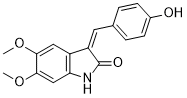
RPI-1 is an ATP-dependent RET kinase inhibitor. RPI-1, which is orally bioavailable, effectively treated 81% of treated tumors by causing growth arrest or regression. After treatment was halted, tumor inhibition remained (51%, P<0.05, 100 days) and 2/11 mice were cured. RPI-1 treatment of TT cells in vitro led to the in vivo effects of BAD activation, caspase cleavage, fragmentation of apoptotic DNA, and inhibition of VEGF production.
Physicochemical Properties
| Molecular Formula | C17H15NO4 |
| Molecular Weight | 297.31 |
| Exact Mass | 297.1 |
| Elemental Analysis | C, 68.68; H, 5.09; N, 4.71; O, 21.53 |
| CAS # | 269730-03-2 |
| Related CAS # | 269730-03-2 |
| PubChem CID | 1749978 |
| Appearance | Yellow to brown solid powder |
| Density | 1.3±0.1 g/cm3 |
| Boiling Point | 533.6±50.0 °C at 760 mmHg |
| Flash Point | 276.5±30.1 °C |
| Vapour Pressure | 0.0±1.5 mmHg at 25°C |
| Index of Refraction | 1.660 |
| LogP | 3.08 |
| Hydrogen Bond Donor Count | 2 |
| Hydrogen Bond Acceptor Count | 4 |
| Rotatable Bond Count | 3 |
| Heavy Atom Count | 22 |
| Complexity | 442 |
| Defined Atom Stereocenter Count | 0 |
| SMILES | OC1C=CC(/C=C2/C3C(=CC(OC)=C(OC)C=3)NC/2=O)=CC=1 |
| InChi Key | JGSMCYNBVCGIHC-QPEQYQDCSA-N |
| InChi Code | InChI=1S/C17H15NO4/c1-21-15-8-12-13(7-10-3-5-11(19)6-4-10)17(20)18-14(12)9-16(15)22-2/h3-9,19H,1-2H3,(H,18,20)/b13-7- |
| Chemical Name | (3Z)-3-[(4-hydroxyphenyl)methylidene]-5,6-dimethoxy-1H-indol-2-one |
| Synonyms | RPI1; RPI 1; RPI-1 |
| HS Tariff Code | 2934.99.9001 |
| Storage |
Powder-20°C 3 years 4°C 2 years In solvent -80°C 6 months -20°C 1 month |
| Shipping Condition | Room temperature (This product is stable at ambient temperature for a few days during ordinary shipping and time spent in Customs) |
Biological Activity
| Targets | JNK2; Akt |
| ln Vitro |
Following 72 hours of treatment, RPI-1's growth-inhibitory effect on TPC-1 cells is susceptible, with an IC50 of 5.1 μM. In TPC-1 cells, RPI-1 (7.5–60 μM) prevents Ret/Ptc1 autophosphorylation. In TPC-1 cell culture conditions, RPI-1 inhibitory effects result in the inhibition of pathways involving JNK2 and AKT[1]. In NIH3T3 cells expressing the Ret mutant, the RPI-1 IC50 value is 3.6 µM compared to 16 µM in non-transfected NIH3T3 cells, and in RET mutant-transfected and H-RAS-transfected NIH3T3 cells, it was 2.4 µM and 26 µM, respectively, for colony formation in soft agar. After 24 hours of RPI-1 treatment, Ret protein and tyrosine phosphorylation in NIH3T3 cells expressing the Ret mutant were undetectable. RPI-1 inhibits TT cell proliferation, Ret tyrosine phosphorylation, Ret protein expression, and PLCgamma, ERKs, and AKT activation[2]. |
| ln Vivo | RPI-1 (50, 100 mg/kg; p.o.; twice a day for 10 days) inhibits TT xenograft tumor growth by 81%[2]. |
| Animal Protocol |
8- to 11-week-old female athymic nude CD-1 mice (bearing TT cells)[2] 50, 100 mg/kg P.o.; twice a day for 10 days |
| References |
[1]. Inactivation of Ret/Ptc1 oncoprotein and inhibition of papillary thyroid carcinoma cell proliferation by indolinone RPI-1. Cell Mol Life Sci. 2003;60(7):1449-1459. [2]. Cellular effects and antitumor activity of RET inhibitor RPI-1 on MEN2A-associated medullary thyroid carcinoma. J Natl Cancer Inst. 2004;96(13):1006-1014. |
Solubility Data
| Solubility (In Vitro) |
DMSO: 59~125 mg/mL (198.5~420.4 mM) Ethanol: ~2 mg/mL (~6.7 mM) |
| Solubility (In Vivo) |
Solubility in Formulation 1: 2.08 mg/mL (7.00 mM) in 10% DMSO + 90% (20% SBE-β-CD in Saline) (add these co-solvents sequentially from left to right, and one by one), suspension solution; with sonication. For example, if 1 mL of working solution is to be prepared, you can add 100 μL of 20.8 mg/mL clear DMSO stock solution to 900 μL of 20% SBE-β-CD physiological saline solution and mix evenly. Preparation of 20% SBE-β-CD in Saline (4°C,1 week): Dissolve 2 g SBE-β-CD in 10 mL saline to obtain a clear solution. (Please use freshly prepared in vivo formulations for optimal results.) |
| Preparing Stock Solutions | 1 mg | 5 mg | 10 mg | |
| 1 mM | 3.3635 mL | 16.8175 mL | 33.6349 mL | |
| 5 mM | 0.6727 mL | 3.3635 mL | 6.7270 mL | |
| 10 mM | 0.3363 mL | 1.6817 mL | 3.3635 mL |