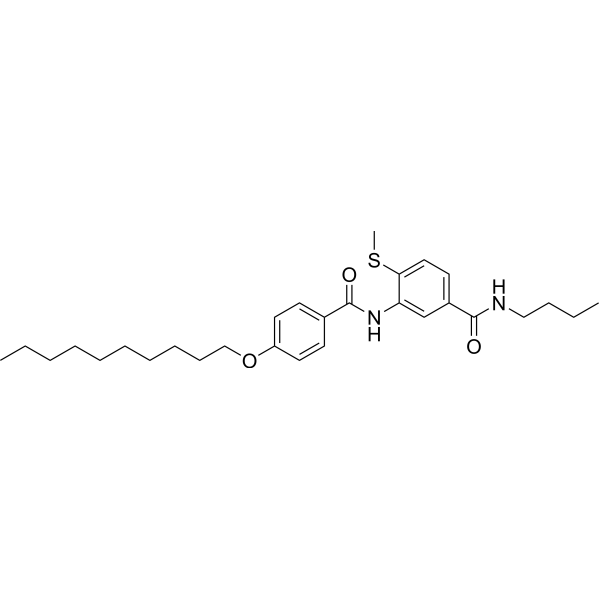
Physicochemical Properties
| Molecular Formula | C29H42N2O3S |
| Molecular Weight | 498.720386981964 |
| Exact Mass | 498.291 |
| CAS # | 135239-65-5 |
| PubChem CID | 9870538 |
| Appearance | White to off-white solid powder |
| Density | 1.1±0.1 g/cm3 |
| Boiling Point | 580.4±50.0 °C at 760 mmHg |
| Flash Point | 304.8±30.1 °C |
| Vapour Pressure | 0.0±1.6 mmHg at 25°C |
| Index of Refraction | 1.563 |
| LogP | 8.73 |
| Hydrogen Bond Donor Count | 2 |
| Hydrogen Bond Acceptor Count | 4 |
| Rotatable Bond Count | 17 |
| Heavy Atom Count | 35 |
| Complexity | 580 |
| Defined Atom Stereocenter Count | 0 |
| InChi Key | OZMWNRSILHTVFV-UHFFFAOYSA-N |
| InChi Code | InChI=1S/C29H42N2O3S/c1-4-6-8-9-10-11-12-13-21-34-25-17-14-23(15-18-25)29(33)31-26-22-24(16-19-27(26)35-3)28(32)30-20-7-5-2/h14-19,22H,4-13,20-21H2,1-3H3,(H,30,32)(H,31,33) |
| Chemical Name | N-butyl-3-[(4-decoxybenzoyl)amino]-4-methylsulfanylbenzamide |
| HS Tariff Code | 2934.99.9001 |
| Storage |
Powder-20°C 3 years 4°C 2 years In solvent -80°C 6 months -20°C 1 month |
| Shipping Condition | Room temperature (This product is stable at ambient temperature for a few days during ordinary shipping and time spent in Customs) |
Biological Activity
| Targets |
Acyl-coenzyme A:cholesterol O-acyltransferase (ACAT) (IC₅₀ values: 14–283 nM in animal tissue preparations; 113 nM in human intestinal CaCo-2 cells; 503 nM in human hepatic HepG2 cells; 180 nM in human monocytic THP-1 cells). No inhibitory activity against pancreatic cholesterol ester hydrolase (PCEH) or lecithin:cholesterol acyltransferase (LCAT) at tested concentrations up to 200 µM and 20 µM, respectively. [1] |
| ln Vitro |
The cholesterol esterification enzyme acyl-CoA:cholesterol O-acyltransferase (ACAT) is strongly inhibited by RP-64477. RP-64477 was found to have in vitro inhibitory potency in tissue preparations derived from human cell cultures and a variety of animal species. There were no discernible species or tissue differences in the recorded IC50 values for animal tissues, which ranged from 6 to 283 nM. With IC50s of 503, 113, and 180 nM, respectively, RP-64477 demonstrates strong inhibitory activity in human hepatocyte (HepGZ), intestinal (CaCo-2), and monocyte (THP-1) cell lines. Up to 200 μM and 20 μM, respectively, of test concentrations showed no inhibitory activity against rat PCEH or LCAT [1]. RP-64477 is a potent inhibitor of ACAT in microsomal preparations from intestinal, hepatic, adrenal, and arterial tissues of rats, rabbits, hamsters, pigs, and marmosets, with IC₅₀ values ranging from 6 to 283 nM. In rabbit enterocyte homogenates, inhibition was non-competitive with respect to oleoyl-CoA. In human cell lines, RP-64477 inhibited ACAT activity with IC₅₀ values of 113 nM in intestinal CaCo-2 cells, 503 nM in hepatic HepG2 cells, and 180 nM in monocytic THP-1 cells. [1] |
| ln Vivo |
In rats fed cholesterol/cholic acid, the administration of RP-64477 (0.01% and 0.03% w/w in the diet) markedly decreased plasma cholesterol levels by 29% and 61%, respectively. Incorporating RP-64477 into the diet has no effect on food intake. During this time, animals given RP-64477 (10 and 30 mg/kg bid) showed noticeably decreased plasma cholesterol levels on days 4 and 7 when compared to animals given a diet high in cholesterol that were given a vehicle treatment. in contrast to the documented value. Following a 7-day dosage period, animals given 10 mg/kg of RP-64477 twice a day and 30 mg/kg of RP-64477 daily showed a 35% decrease in plasma cholesterol levels as compared to the cholesterol-fed controls. % and 53% [1]. In cholesterol/cholic acid-fed rats, dietary RP-64477 (0.03% w/w) significantly reduced cholesterol absorption from 94 ± 8% to 65 ± 4%. In cholesterol-fed rabbits, RP-64477 (10 and 30 mg/kg b.i.d.) reduced cholesterol absorption from 72 ± 5% to 50 ± 5% and 44 ± 5%, respectively. Plasma cholesterol levels were dose-dependently reduced in both cholesterol-fed rats and rabbits. No significant effect on cholesterol absorption or plasma cholesterol was observed in animals fed standard diets. [1] |
| Enzyme Assay |
ACAT activity was measured in microsomal preparations using [¹⁴C]oleoyl-CoA and endogenous cholesterol as substrates. Approximately 60 µg of protein was incubated in sodium phosphate buffer with bovine serum albumin and dithiothreitol. The reaction was started by adding [¹⁴C]oleoyl-CoA and stopped after 5 minutes with dichloromethane:methanol. Cholesterol esters were extracted and quantified by TLC and scintillation counting. Inhibition was tested in quadruplicate at five concentrations, and IC₅₀ values were derived from the line of best fit. [1] |
| Cell Assay |
ACAT activity in CaCo-2 cells was assessed by preincubating cells with cholesterol-rich micelles and RP-64477 for 2 hours, followed by incubation with [¹⁴C]oleic acid/albumin complex for another 2 hours. Cells were then washed, dried, dissolved in SDS, and cholesterol esters extracted for measurement. In HepG2 cells, ACAT activity was measured after a 22-hour incubation with LDL and RP-64477, with [¹⁴C]oleic acid added for the final 2 hours. In THP-1 cells, differentiated with phorbol ester, ACAT activity was measured after a 24-hour incubation with acetylated LDL and RP-64477, with [¹⁴C]oleic acid added for the final 5 hours. [1] |
| Animal Protocol |
Hypocholesterolaemic activity in rats was tested by feeding a diet supplemented with 0.5% cholesterol/0.25% cholic acid and RP-64477 (0.001%–0.03% w/w) for 3 days. Plasma cholesterol was measured enzymatically. In rabbits, RP-64477 (1, 3, 10, 30 mg/kg b.i.d.) was administered orally as a suspension in 1% sodium carboxymethylcellulose/0.5% Tween 80 for 7 days to cholesterol-fed animals. Blood was collected on days 0, 4, and 7 for cholesterol analysis. Cholesterol absorption was measured in rats and rabbits using a dual-isotope method with intravenous [³H]cholesterol and oral [¹⁴C]cholesterol. [1] |
| ADME/Pharmacokinetics |
Following oral administration of RP-64477 (2000 mg/kg) to rats, plasma levels were below the detection limit (<2 ng/mL), indicating very poor absorption. After oral administration of [¹⁴C]RP-64477 (100 mg/kg) to rats, 96.4% of radioactivity was excreted in feces within 1 week, with only 0.6% in urine and 0.05% in bile over 24 hours. Tissue distribution was low, with highest levels in gastrointestinal tract walls and minimal systemic exposure. [1] |
| References |
[1]. RP 64477: a potent inhibitor of acyl-coenzyme A:cholesterol O-acyltransferase with low systemic bioavailability. Biochem Pharmacol. 1996 Feb 23;51(4):413-21. |
| Additional Infomation |
RP-64477 is proposed to inhibit cholesterol absorption by blocking intestinal ACAT, particularly under high-cholesterol dietary conditions. Despite potent ACAT inhibition and hypocholesterolaemic effects in animal models, the drug did not show significant cholesterol-lowering effects in human clinical trials, possibly due to insufficient intestinal ACAT inhibition or poor systemic bioavailability. [1] |
Solubility Data
| Solubility (In Vitro) | DMSO : ~8.33 mg/mL (~16.70 mM) |
| Solubility (In Vivo) |
Note: Listed below are some common formulations that may be used to formulate products with low water solubility (e.g. < 1 mg/mL), you may test these formulations using a minute amount of products to avoid loss of samples. Injection Formulations (e.g. IP/IV/IM/SC) Injection Formulation 1: DMSO : Tween 80: Saline = 10 : 5 : 85 (i.e. 100 μL DMSO stock solution → 50 μL Tween 80 → 850 μL Saline) *Preparation of saline: Dissolve 0.9 g of sodium chloride in 100 mL ddH ₂ O to obtain a clear solution. Injection Formulation 2: DMSO : PEG300 :Tween 80 : Saline = 10 : 40 : 5 : 45 (i.e. 100 μL DMSO → 400 μLPEG300 → 50 μL Tween 80 → 450 μL Saline) Injection Formulation 3: DMSO : Corn oil = 10 : 90 (i.e. 100 μL DMSO → 900 μL Corn oil) Example: Take the Injection Formulation 3 (DMSO : Corn oil = 10 : 90) as an example, if 1 mL of 2.5 mg/mL working solution is to be prepared, you can take 100 μL 25 mg/mL DMSO stock solution and add to 900 μL corn oil, mix well to obtain a clear or suspension solution (2.5 mg/mL, ready for use in animals). Injection Formulation 4: DMSO : 20% SBE-β-CD in saline = 10 : 90 [i.e. 100 μL DMSO → 900 μL (20% SBE-β-CD in saline)] *Preparation of 20% SBE-β-CD in Saline (4°C,1 week): Dissolve 2 g SBE-β-CD in 10 mL saline to obtain a clear solution. Injection Formulation 5: 2-Hydroxypropyl-β-cyclodextrin : Saline = 50 : 50 (i.e. 500 μL 2-Hydroxypropyl-β-cyclodextrin → 500 μL Saline) Injection Formulation 6: DMSO : PEG300 : castor oil : Saline = 5 : 10 : 20 : 65 (i.e. 50 μL DMSO → 100 μLPEG300 → 200 μL castor oil → 650 μL Saline) Injection Formulation 7: Ethanol : Cremophor : Saline = 10: 10 : 80 (i.e. 100 μL Ethanol → 100 μL Cremophor → 800 μL Saline) Injection Formulation 8: Dissolve in Cremophor/Ethanol (50 : 50), then diluted by Saline Injection Formulation 9: EtOH : Corn oil = 10 : 90 (i.e. 100 μL EtOH → 900 μL Corn oil) Injection Formulation 10: EtOH : PEG300:Tween 80 : Saline = 10 : 40 : 5 : 45 (i.e. 100 μL EtOH → 400 μLPEG300 → 50 μL Tween 80 → 450 μL Saline) Oral Formulations Oral Formulation 1: Suspend in 0.5% CMC Na (carboxymethylcellulose sodium) Oral Formulation 2: Suspend in 0.5% Carboxymethyl cellulose Example: Take the Oral Formulation 1 (Suspend in 0.5% CMC Na) as an example, if 100 mL of 2.5 mg/mL working solution is to be prepared, you can first prepare 0.5% CMC Na solution by measuring 0.5 g CMC Na and dissolve it in 100 mL ddH2O to obtain a clear solution; then add 250 mg of the product to 100 mL 0.5% CMC Na solution, to make the suspension solution (2.5 mg/mL, ready for use in animals). Oral Formulation 3: Dissolved in PEG400 Oral Formulation 4: Suspend in 0.2% Carboxymethyl cellulose Oral Formulation 5: Dissolve in 0.25% Tween 80 and 0.5% Carboxymethyl cellulose Oral Formulation 6: Mixing with food powders Note: Please be aware that the above formulations are for reference only. InvivoChem strongly recommends customers to read literature methods/protocols carefully before determining which formulation you should use for in vivo studies, as different compounds have different solubility properties and have to be formulated differently. (Please use freshly prepared in vivo formulations for optimal results.) |
| Preparing Stock Solutions | 1 mg | 5 mg | 10 mg | |
| 1 mM | 2.0051 mL | 10.0257 mL | 20.0513 mL | |
| 5 mM | 0.4010 mL | 2.0051 mL | 4.0103 mL | |
| 10 mM | 0.2005 mL | 1.0026 mL | 2.0051 mL |