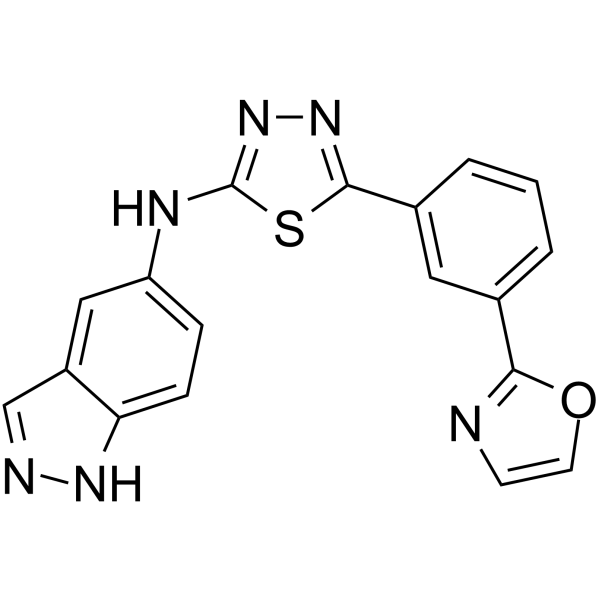
Physicochemical Properties
| Molecular Formula | C18H12N6OS |
| Molecular Weight | 360.39 |
| Exact Mass | 360.079 |
| CAS # | 1995065-79-6 |
| PubChem CID | 122507549 |
| Appearance | Light yellow to green yellow solid powder |
| LogP | 3.6 |
| Hydrogen Bond Donor Count | 2 |
| Hydrogen Bond Acceptor Count | 7 |
| Rotatable Bond Count | 4 |
| Heavy Atom Count | 26 |
| Complexity | 485 |
| Defined Atom Stereocenter Count | 0 |
| SMILES | C1(OC=CN=1)C1C=C(C=CC=1)C1=NN=C(S1)NC1C=CC2NN=CC=2C=1 |
| InChi Key | WFSHRQCWPPIEIB-UHFFFAOYSA-N |
| InChi Code | InChI=1S/C18H12N6OS/c1-2-11(16-19-6-7-25-16)8-12(3-1)17-23-24-18(26-17)21-14-4-5-15-13(9-14)10-20-22-15/h1-10H,(H,20,22)(H,21,24) |
| Chemical Name | N-(1H-indazol-5-yl)-5-[3-(1,3-oxazol-2-yl)phenyl]-1,3,4-thiadiazol-2-amine |
| HS Tariff Code | 2934.99.9001 |
| Storage |
Powder-20°C 3 years 4°C 2 years In solvent -80°C 6 months -20°C 1 month |
| Shipping Condition | Room temperature (This product is stable at ambient temperature for a few days during ordinary shipping and time spent in Customs) |
Biological Activity
| Targets |
Rho-associated protein kinase 2 (ROCK2) (IC₅₀ = 0.04 μM in kinase activity assay) [1] Rho-associated protein kinase 1 (ROCK1) (IC₅₀ = 0.87 μM in kinase activity assay; selectivity >21-fold vs ROCK2) [1] Other kinases (PKA, PKCα, CDK2, ERK2, JNK1) (IC₅₀ > 10 μM, selectivity >250-fold vs ROCK2) [1] |
| ln Vitro |
Rho-related protein kinase (ROCK) belongs to the serine-threonine protein kinases family. ROCK exists in two subtypes: ROCK1 and ROCK2, both of which are RhoA effector molecules. The RhoA/ROCK signaling system is involved in a variety of cellular processes, such as actin organization, cell adhesion, migration, and cytokinesis. In addition, the RhoA/ROCK signaling system regulates smooth muscle contraction. ROCK inhibitors have been shown to be effective in the therapy of a variety of medical conditions, including fibrosis, inflammatory illnesses, autoimmune disorders, and cardiovascular disease [1]. ROCK2-IN-2 is an indazolyl thiadiazolamine-derived selective inhibitor of Rho-associated protein kinase 2 (ROCK2), with potent enzymatic and cellular activity. [1] In recombinant ROCK kinase activity assays, ROCK2-IN-2 dose-dependently inhibits ROCK2 with an IC₅₀ of 0.04 μM, and exhibits moderate inhibition of ROCK1 (IC₅₀ = 0.87 μM), resulting in a selectivity ratio of >21-fold for ROCK2 over ROCK1. [1] It shows high specificity against other kinases: IC₅₀ values for PKA, PKCα, CDK2, ERK2, and JNK1 are all >10 μM, representing a selectivity of >250-fold compared to ROCK2. [1] In human aortic smooth muscle cells (HASMCs), ROCK2-IN-2 dose-dependently inhibits thrombin-induced cell contraction: At 1 μM, it reduces cell contraction by 68% compared to the vehicle control; at 0.1 μM, the inhibition rate is 42%. [1] It suppresses HASMC migration: Transwell migration assays show that ROCK2-IN-2 (0.01-1 μM) inhibits thrombin-induced migration of HASMCs with an IC₅₀ of 0.08 μM; 1 μM treatment reduces migration by 75% relative to control. [1] ROCK2-IN-2 inhibits ROCK-mediated phosphorylation of myosin light chain 2 (MLC2) in HASMCs: Western blot analysis confirms that 0.1-1 μM ROCK2-IN-2 dose-dependently reduces the phosphorylation level of MLC2 (p-MLC2) without affecting total MLC2 protein expression. [1] |
| Enzyme Assay |
Recombinant ROCK kinase activity assay: Recombinant human ROCK2 or ROCK1 protein was incubated with a fluorescently labeled peptide substrate (containing the ROCK phosphorylation site) and ATP in a reaction buffer. Serial dilutions of ROCK2-IN-2 (0.001 μM-10 μM) were added to the reaction mixture, which was incubated at 37°C for 60 minutes. The reaction was terminated by adding a stop solution, and the fluorescence intensity (corresponding to the amount of phosphorylated substrate) was measured. The IC₅₀ value was calculated by plotting the percentage of kinase activity inhibition against the logarithm of compound concentration. [1] Kinase selectivity assay: Using the same protocol as the ROCK kinase activity assay, ROCK2-IN-2 (up to 10 μM) was tested against a panel of recombinant kinases (PKA, PKCα, CDK2, ERK2, JNK1) to evaluate cross-reactivity and selectivity. [1] |
| Cell Assay |
Human aortic smooth muscle cell (HASMC) contraction assay: HASMCs were seeded on collagen-coated wells and cultured to confluence. Cells were serum-starved for 24 hours, then treated with serial dilutions of ROCK2-IN-2 (0.01 μM-1 μM) for 30 minutes. Thrombin was added to induce cell contraction, and the change in cell area was measured using a phase-contrast microscope. The inhibition rate of contraction was calculated by comparing with the vehicle control group. [1] HASMC migration assay (Transwell): HASMCs were serum-starved for 24 hours, trypsinized, and resuspended in serum-free medium containing ROCK2-IN-2 (0.001 μM-1 μM). The cell suspension was added to the upper chamber of Transwell inserts, and medium containing thrombin was added to the lower chamber. After incubation at 37°C for 4 hours, cells that migrated to the lower chamber were fixed, stained, and counted. The migration inhibition rate was calculated to determine the IC₅₀ value. [1] Western blot assay for p-MLC2: HASMCs were treated with ROCK2-IN-2 (0.01 μM-1 μM) for 30 minutes, then stimulated with thrombin for 15 minutes. Cells were lysed, total proteins were extracted, separated by SDS-PAGE, transferred to membranes, and probed with antibodies against phosphorylated MLC2 (p-MLC2) and total MLC2. The intensity of protein bands was quantified, and the ratio of p-MLC2 to total MLC2 was calculated to assess ROCK pathway inhibition. [1] |
| References |
[1]. INDAZOLYL THIADIAZOLAMINES AND RELATED COMPOUNDS FOR INHIBITION OF RHO-ASSOCIATED PROTEIN KINASE AND THE TREATMENT OF DISEASE. US20180093978A1. |
| Additional Infomation |
ROCK2-IN-2 belongs to the indazolyl thiadiazolamine chemical class, developed as a selective ROCK2 inhibitor for the treatment of ROCK2-mediated diseases. [1] Rho-associated protein kinases (ROCK1 and ROCK2) are serine/threonine kinases that regulate cytoskeletal rearrangement, cell contraction, migration, proliferation, and survival; ROCK2 overactivation is associated with diseases such as hypertension, atherosclerosis, fibrosis, and cancer. [1] The mechanism of action of ROCK2-IN-2 involves competitive binding to the ATP-binding pocket of ROCK2, inhibiting its kinase activity and blocking downstream signaling pathways (e.g., MLC2 phosphorylation), thereby suppressing smooth muscle cell contraction and migration—key pathological processes in cardiovascular diseases. [1] The patent US20180093978A1 discloses ROCK2-IN-2 as a potential therapeutic agent for diseases mediated by ROCK2 overactivity, including but not limited to cardiovascular diseases (hypertension, restenosis), fibrotic diseases (pulmonary fibrosis, liver fibrosis), and neurological disorders. [1] |
Solubility Data
| Solubility (In Vitro) | DMSO : ~100 mg/mL (~277.48 mM) |
| Solubility (In Vivo) |
Solubility in Formulation 1: ≥ 2.5 mg/mL (6.94 mM) (saturation unknown) in 10% DMSO + 90% Corn Oil (add these co-solvents sequentially from left to right, and one by one), clear solution. For example, if 1 mL of working solution is to be prepared, you can add 100 μL of 25.0 mg/mL clear DMSO stock solution to 900 μL of corn oil and mix evenly. (Please use freshly prepared in vivo formulations for optimal results.) |
| Preparing Stock Solutions | 1 mg | 5 mg | 10 mg | |
| 1 mM | 2.7748 mL | 13.8739 mL | 27.7477 mL | |
| 5 mM | 0.5550 mL | 2.7748 mL | 5.5495 mL | |
| 10 mM | 0.2775 mL | 1.3874 mL | 2.7748 mL |