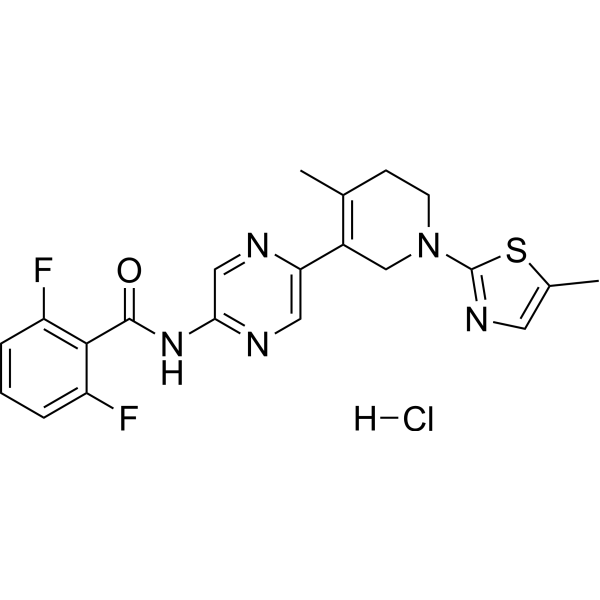
Physicochemical Properties
| Molecular Formula | C21H20CLF2N5OS |
| Molecular Weight | 463.931208610535 |
| Exact Mass | 463.104 |
| CAS # | 2309172-44-7 |
| Related CAS # | RO2959 hydrochloride;1219927-22-6 |
| PubChem CID | 45274292 |
| Appearance | Light brown to brown solid powder |
| Hydrogen Bond Donor Count | 2 |
| Hydrogen Bond Acceptor Count | 8 |
| Rotatable Bond Count | 4 |
| Heavy Atom Count | 31 |
| Complexity | 655 |
| Defined Atom Stereocenter Count | 0 |
| SMILES | Cl.S1C(C)=CN=C1N1CC(C2C=NC(=CN=2)NC(C2C(=CC=CC=2F)F)=O)=C(C)CC1 |
| InChi Key | GMLSDODALBRLPE-UHFFFAOYSA-N |
| InChi Code | InChI=1S/C21H19F2N5OS.ClH/c1-12-6-7-28(21-26-8-13(2)30-21)11-14(12)17-9-25-18(10-24-17)27-20(29)19-15(22)4-3-5-16(19)23;/h3-5,8-10H,6-7,11H2,1-2H3,(H,25,27,29);1H |
| Chemical Name | 2,6-difluoro-N-[5-[4-methyl-1-(5-methyl-1,3-thiazol-2-yl)-3,6-dihydro-2H-pyridin-5-yl]pyrazin-2-yl]benzamide;hydrochloride |
| HS Tariff Code | 2934.99.9001 |
| Storage |
Powder-20°C 3 years 4°C 2 years In solvent -80°C 6 months -20°C 1 month Note: Please store this product in a sealed and protected environment, avoid exposure to moisture. |
| Shipping Condition | Room temperature (This product is stable at ambient temperature for a few days during ordinary shipping and time spent in Customs) |
Biological Activity
| Targets | CRAC channel 402 nM (IC50) Orai1/Stim1 channels 25 nM (IC50) IL-2 |
| ln Vitro | RO2959 has an IC50 of 25 nM for Orai1 and 530 nM for Orai3 inhibition. With an IC50 value of 265 nM, RO2959 inhibits store operated calcium entry (SOCE) in activated CD4+T lymphocytes[1]. Strong SOCE inhibitor RO2959 inhibits both IP3-dependent current in CRAC-expressing RBL-2H3 cells and CHO cells that exhibit stable human Orai1 and Stim1 expression, as well as SOCE in human primary CD4+ T cells stimulated by TCR activation or thapsigargin therapy. When TCR stimulation or mixed lymphocyte reaction (MLR) is used to stimulate T cells, RO2959 totally blocks both cytokine generation and T cell proliferation[1]. |
| References |
[1]. Characterization of a Novel CRAC Inhibitor That Potently Blocks Human T Cell Activation and Effector Functions. Mol Immunol. 2013 Jul;54(3-4):355-67. [2]. Gastrodin Inhibits Store-Operated Ca 2+ Entry and Alleviates Cardiac Hypertrophy. Front Pharmacol. 2017 Apr 25;8:222. |
Solubility Data
| Solubility (In Vitro) |
DMSO: 25 mg/mL (53.89 mM) H2O: < 0.1 mg/mL |
| Solubility (In Vivo) |
Solubility in Formulation 1: 2.08 mg/mL (4.48 mM) in 10% DMSO + 40% PEG300 + 5% Tween80 + 45% Saline (add these co-solvents sequentially from left to right, and one by one), suspension solution; with sonication. For example, if 1 mL of working solution is to be prepared, you can add 100 μL of 20.8 mg/mL clear DMSO stock solution to 400 μL PEG300 and mix evenly; then add 50 μL Tween-80 to the above solution and mix evenly; then add 450 μL normal saline to adjust the volume to 1 mL. Preparation of saline: Dissolve 0.9 g of sodium chloride in 100 mL ddH₂ O to obtain a clear solution. Solubility in Formulation 2: ≥ 2.08 mg/mL (4.48 mM) (saturation unknown) in 10% DMSO + 90% (20% SBE-β-CD in Saline) (add these co-solvents sequentially from left to right, and one by one), clear solution. For example, if 1 mL of working solution is to be prepared, you can add 100 μL of 20.8 mg/mL clear DMSO stock solution to 900 μL of 20% SBE-β-CD physiological saline solution and mix evenly. Preparation of 20% SBE-β-CD in Saline (4°C,1 week): Dissolve 2 g SBE-β-CD in 10 mL saline to obtain a clear solution. Solubility in Formulation 3: ≥ 2.08 mg/mL (4.48 mM) (saturation unknown) in 10% DMSO + 90% Corn Oil (add these co-solvents sequentially from left to right, and one by one), clear solution. For example, if 1 mL of working solution is to be prepared, you can add 100 μL of 20.8 mg/mL clear DMSO stock solution to 900 μL of corn oil and mix evenly. (Please use freshly prepared in vivo formulations for optimal results.) |
| Preparing Stock Solutions | 1 mg | 5 mg | 10 mg | |
| 1 mM | 2.1555 mL | 10.7775 mL | 21.5550 mL | |
| 5 mM | 0.4311 mL | 2.1555 mL | 4.3110 mL | |
| 10 mM | 0.2155 mL | 1.0777 mL | 2.1555 mL |