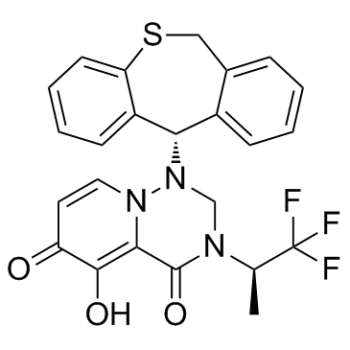
RO-7 is a novel, potent and next-generation PA (polymerase) endonuclease inhibitor of influenza A and B viruses, but its drug resistance potential is unknown. The effectiveness of antiviral drugs can be severely compromised by the emergence of resistant viruses. Therefore, determination of the mechanisms by which viruses become resistant is critical for drug development and clinical use. RO-7 is a compound that potently inhibits influenza virus replication and belongs to a new class of drugs in late-stage clinical trials for treatment of influenza virus infection. Here we demonstrate that a single amino acid change acquired under prolonged virus exposure to RO-7 renders influenza viruses significantly less susceptible to its inhibitory effects. We have discovered how the mutation can simultaneously interfere with drug activity and still maintain efficient virus replication. These findings have important implications for the development of more effective derivatives of RO-7-like drugs and provide guidance for how to monitor the emergence of resistance.
Physicochemical Properties
| Molecular Weight | 0 |
| Exact Mass | 487.117 |
| CAS # | 1370241-45-4 |
| PubChem CID | 68097023 |
| Appearance | Typically exists as solid at room temperature |
| LogP | 5.3 |
| Hydrogen Bond Donor Count | 1 |
| Hydrogen Bond Acceptor Count | 9 |
| Rotatable Bond Count | 2 |
| Heavy Atom Count | 34 |
| Complexity | 908 |
| Defined Atom Stereocenter Count | 2 |
| SMILES | C[C@H](C(F)(F)F)N1CN(N2C=CC(=O)C(=C2C1=O)O)[C@H]3C4=CC=CC=C4CSC5=CC=CC=C35 |
| InChi Key | XEOTUHPFOHTFEX-VLIAUNLRSA-N |
| InChi Code | InChI=1S/C24H20F3N3O3S/c1-14(24(25,26)27)28-13-30(29-11-10-18(31)22(32)21(29)23(28)33)20-16-7-3-2-6-15(16)12-34-19-9-5-4-8-17(19)20/h2-11,14,20,32H,12-13H2,1H3/t14-,20+/m1/s1 |
| Chemical Name | 1-[(11S)-6,11-dihydrobenzo[c][1]benzothiepin-11-yl]-5-hydroxy-3-[(2R)-1,1,1-trifluoropropan-2-yl]-2H-pyrido[2,1-f][1,2,4]triazine-4,6-dione |
| HS Tariff Code | 2934.99.9001 |
| Storage |
Powder-20°C 3 years 4°C 2 years In solvent -80°C 6 months -20°C 1 month |
| Shipping Condition | Room temperature (This product is stable at ambient temperature for a few days during ordinary shipping and time spent in Customs) |
Biological Activity
| ln Vitro | In late-stage clinical studies, a novel family of medications called RO-7 is being tested to treat influenza virus infections. It successfully suppresses the replication of the influenza virus. Mice are shielded from a potentially fatal influenza A and B virus challenge by RO-7, which demonstrates broad-spectrum anti-influenza action in vitro]1. |
| ln Vivo | Mice are shielded by RO-7 from the deadly influenza A and B viruses [1]. |
| References |
[1]. Identification of the I38T PA Substitution as a Resistance Marker for Next-Generation InfluenzaVirus Endonuclease Inhibitors. MBio. 2018 Apr 24;9(2). pii: e00430-18. |
Solubility Data
| Solubility (In Vitro) | May dissolve in DMSO (in most cases), if not, try other solvents such as H2O, Ethanol, or DMF with a minute amount of products to avoid loss of samples |
| Solubility (In Vivo) |
Note: Listed below are some common formulations that may be used to formulate products with low water solubility (e.g. < 1 mg/mL), you may test these formulations using a minute amount of products to avoid loss of samples. Injection Formulations (e.g. IP/IV/IM/SC) Injection Formulation 1: DMSO : Tween 80: Saline = 10 : 5 : 85 (i.e. 100 μL DMSO stock solution → 50 μL Tween 80 → 850 μL Saline) *Preparation of saline: Dissolve 0.9 g of sodium chloride in 100 mL ddH ₂ O to obtain a clear solution. Injection Formulation 2: DMSO : PEG300 :Tween 80 : Saline = 10 : 40 : 5 : 45 (i.e. 100 μL DMSO → 400 μLPEG300 → 50 μL Tween 80 → 450 μL Saline) Injection Formulation 3: DMSO : Corn oil = 10 : 90 (i.e. 100 μL DMSO → 900 μL Corn oil) Example: Take the Injection Formulation 3 (DMSO : Corn oil = 10 : 90) as an example, if 1 mL of 2.5 mg/mL working solution is to be prepared, you can take 100 μL 25 mg/mL DMSO stock solution and add to 900 μL corn oil, mix well to obtain a clear or suspension solution (2.5 mg/mL, ready for use in animals). Injection Formulation 4: DMSO : 20% SBE-β-CD in saline = 10 : 90 [i.e. 100 μL DMSO → 900 μL (20% SBE-β-CD in saline)] *Preparation of 20% SBE-β-CD in Saline (4°C,1 week): Dissolve 2 g SBE-β-CD in 10 mL saline to obtain a clear solution. Injection Formulation 5: 2-Hydroxypropyl-β-cyclodextrin : Saline = 50 : 50 (i.e. 500 μL 2-Hydroxypropyl-β-cyclodextrin → 500 μL Saline) Injection Formulation 6: DMSO : PEG300 : castor oil : Saline = 5 : 10 : 20 : 65 (i.e. 50 μL DMSO → 100 μLPEG300 → 200 μL castor oil → 650 μL Saline) Injection Formulation 7: Ethanol : Cremophor : Saline = 10: 10 : 80 (i.e. 100 μL Ethanol → 100 μL Cremophor → 800 μL Saline) Injection Formulation 8: Dissolve in Cremophor/Ethanol (50 : 50), then diluted by Saline Injection Formulation 9: EtOH : Corn oil = 10 : 90 (i.e. 100 μL EtOH → 900 μL Corn oil) Injection Formulation 10: EtOH : PEG300:Tween 80 : Saline = 10 : 40 : 5 : 45 (i.e. 100 μL EtOH → 400 μLPEG300 → 50 μL Tween 80 → 450 μL Saline) Oral Formulations Oral Formulation 1: Suspend in 0.5% CMC Na (carboxymethylcellulose sodium) Oral Formulation 2: Suspend in 0.5% Carboxymethyl cellulose Example: Take the Oral Formulation 1 (Suspend in 0.5% CMC Na) as an example, if 100 mL of 2.5 mg/mL working solution is to be prepared, you can first prepare 0.5% CMC Na solution by measuring 0.5 g CMC Na and dissolve it in 100 mL ddH2O to obtain a clear solution; then add 250 mg of the product to 100 mL 0.5% CMC Na solution, to make the suspension solution (2.5 mg/mL, ready for use in animals). Oral Formulation 3: Dissolved in PEG400 Oral Formulation 4: Suspend in 0.2% Carboxymethyl cellulose Oral Formulation 5: Dissolve in 0.25% Tween 80 and 0.5% Carboxymethyl cellulose Oral Formulation 6: Mixing with food powders Note: Please be aware that the above formulations are for reference only. InvivoChem strongly recommends customers to read literature methods/protocols carefully before determining which formulation you should use for in vivo studies, as different compounds have different solubility properties and have to be formulated differently. (Please use freshly prepared in vivo formulations for optimal results.) |