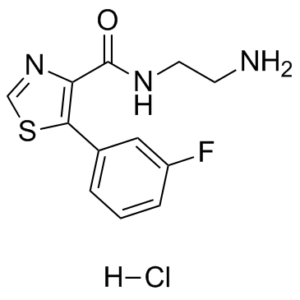
Ro 41-1049 hydrochloride, the hydrochloride salt of Ro 41-1049, is a novel, potent, selective, reversible and orally bioavailable inhibitor of MAO-A (Monoamine oxidase).
Physicochemical Properties
| Molecular Formula | C12H13CLFN3OS |
| Molecular Weight | 301.767523527145 |
| Exact Mass | 301.045 |
| CAS # | 127917-66-2 |
| Related CAS # | 127500-84-9; 127917-66-2 (HCl) |
| PubChem CID | 5311308 |
| Appearance | White to off-white solid powder |
| LogP | 3.714 |
| Hydrogen Bond Donor Count | 3 |
| Hydrogen Bond Acceptor Count | 5 |
| Rotatable Bond Count | 4 |
| Heavy Atom Count | 19 |
| Complexity | 293 |
| Defined Atom Stereocenter Count | 0 |
| InChi Key | RRNSPXUFTKJIEZ-UHFFFAOYSA-N |
| InChi Code | InChI=1S/C12H12FN3OS.ClH/c13-9-3-1-2-8(6-9)11-10(16-7-18-11)12(17)15-5-4-14;/h1-3,6-7H,4-5,14H2,(H,15,17);1H |
| Chemical Name | 4-Thiazolecarboxamide, N-(2-aminoethyl)-5-(3-fluorophenyl)-, hydrochloride (1:1) |
| Synonyms | RO-41-1049 hydrochloride; RO 41-1049 hydrochloride; RO-41-1049 HCl. |
| HS Tariff Code | 2934.99.9001 |
| Storage |
Powder-20°C 3 years 4°C 2 years In solvent -80°C 6 months -20°C 1 month Note: Please store this product in a sealed and protected environment, avoid exposure to moisture. |
| Shipping Condition | Room temperature (This product is stable at ambient temperature for a few days during ordinary shipping and time spent in Customs) |
Biological Activity
| Targets |
Human monoamine oxidase-A (MAO-A) (Ki = 0.9 nM, determined by radioligand binding assay) [1] - Human monoamine oxidase-B (MAO-B) (Ki > 1000 nM, no significant binding) [1] |
| ln Vitro |
Acts as a selective and competitive inhibitor of human MAO-A, with high affinity (Ki = 0.9 nM) and negligible activity against MAO-B (Ki > 1000 nM) [1] - Displaced [3H]Ro 41-1049 binding to human MAO-A in a concentration-dependent manner, showing specific and saturable binding with a Bmax of 1.2 pmol/mg protein [1] - Inhibited MAO-A-mediated oxidation of serotonin (5-HT) in human liver microsomes, reducing 5-HT metabolite formation by ~90% at 10 nM RO-41-1049 hydrochloride [1] |
| ln Vivo |
Dopamine levels are dose-dependently increased and dopamine metabolite production is inhibited in Sprague-Dawley rats treated with Ro 41-1049 (1-50 mg/kg; i.p.; 3 hours). Pretreatment with Ro 41-1049 (20 mg/kg) reduced the synthesis of 3,4-dihydroxyphenylacetic acid (DOPAC) and homovanillic acid (HVA) and considerably boosted the generation of dopamine following levodopa delivery (100 mg/kg IP)[2]. In male Wistar rats, oral administration of RO-41-1049 hydrochloride (10 mg/kg) significantly increased striatal dopamine (DA) concentration by ~65% compared to vehicle control [2] - Reduced striatal levels of dopamine metabolites 3,4-dihydroxyphenylacetic acid (DOPAC) and homovanillic acid (HVA) by ~40% and ~35%, respectively, due to inhibited MAO-A-mediated DA degradation [2] - Enhanced the accumulation of exogenously administered L-dopa in striatal tissue, with L-dopa levels increasing by ~50% at 2 hours post-administration of RO-41-1049 hydrochloride [2] |
| Enzyme Assay |
Radioligand binding assay for MAO-A: Membrane preparations from human MAO-A-expressing cells were incubated with [3H]Ro 41-1049 and various concentrations of unlabeled RO-41-1049 hydrochloride in binding buffer. After incubation at 25°C for 60 minutes, unbound ligand was removed by filtration through glass fiber filters. Radioactivity of the bound fraction was measured, and Ki value was calculated using saturation and competition binding analysis [1] - MAO-A enzyme activity assay: Human liver microsomes were mixed with serotonin (5-HT) as substrate and RO-41-1049 hydrochloride (0.1-100 nM) in reaction buffer. The mixture was incubated at 37°C for 30 minutes, and the reaction was stopped by adding perchloric acid. The formation of 5-HT metabolite (5-hydroxyindoleacetic acid, 5-HIAA) was quantified by high-performance liquid chromatography (HPLC) with electrochemical detection, and the inhibition rate was determined [1] |
| Animal Protocol |
Animal/Disease Models: SD (SD (Sprague-Dawley)) rat (200-240 g) [2] Doses: 1 mg/kg, 5 mg/kg, 10 mg/kg, 20 mg/kg or 50 mg/kg Route of Administration: intraperitoneal (ip) injection; 3 hour Experimental Results: Inhibits dopamine metabolite formation and increases dopamine levels in a dose-dependent manner. Pretreatment at a concentration of 20 mg/kg Dramatically increased dopamine formation after levodopa administration while reducing DOPAC and HVA formation. Male Wistar rats (200-250 g) were fasted overnight before administration. RO-41-1049 hydrochloride was suspended in 0.5% carboxymethylcellulose sodium and administered by oral gavage at a dosage of 10 mg/kg. For L-dopa interaction studies, L-dopa was co-administered with RO-41-1049 hydrochloride at a dosage of 25 mg/kg. Rats were euthanized at 2 hours post-administration, striatal tissues were dissected and homogenized in ice-cold perchloric acid. DA, DOPAC, HVA, and L-dopa concentrations were quantified by HPLC with electrochemical detection [2] |
| References |
[1]. Characterization of the binding of [3H]Ro 41-1049 to the active site of human monoamine oxidase-A. Mol Pharmacol. 1990 Mar;37(3):358-66. [2]. Effect of a selective MAO-A inhibitor (Ro 41-1049) on striatal L-dopa and dopamine metabolism: an in vivo study. J Neural Transm Park Dis Dement Sect. 1994;8(1-2):99-105. |
| Additional Infomation |
RO-41-1049 hydrochloride is a potent and selective reversible inhibitor of MAO-A, with minimal cross-reactivity with MAO-B [1, 2] - Its mechanism of action involves competitive binding to the active site of MAO-A, blocking the oxidative deamination of monoamine neurotransmitters (dopamine, serotonin, norepinephrine) [1] - The in vivo enhancement of striatal dopamine and L-dopa levels suggests potential therapeutic applications in neurological disorders associated with reduced monoamine neurotransmission, such as Parkinson's disease and depression [2] - The selective inhibition of MAO-A avoids the adverse effects associated with non-selective MAO inhibitors (e.g., tyramine-induced hypertensive crisis) [1] |
Solubility Data
| Solubility (In Vitro) |
DMSO : ≥ 32 mg/mL (~106.04 mM) H2O : ~25 mg/mL (~82.84 mM) |
| Solubility (In Vivo) |
Solubility in Formulation 1: ≥ 2.5 mg/mL (8.28 mM) (saturation unknown) in 10% DMSO + 40% PEG300 + 5% Tween80 + 45% Saline (add these co-solvents sequentially from left to right, and one by one), clear solution. For example, if 1 mL of working solution is to be prepared, you can add 100 μL of 25.0 mg/mL clear DMSO stock solution to 400 μL PEG300 and mix evenly; then add 50 μL Tween-80 to the above solution and mix evenly; then add 450 μL normal saline to adjust the volume to 1 mL. Preparation of saline: Dissolve 0.9 g of sodium chloride in 100 mL ddH₂ O to obtain a clear solution. Solubility in Formulation 2: ≥ 2.5 mg/mL (8.28 mM) (saturation unknown) in 10% DMSO + 90% (20% SBE-β-CD in Saline) (add these co-solvents sequentially from left to right, and one by one), clear solution. For example, if 1 mL of working solution is to be prepared, you can add 100 μL of 25.0 mg/mL clear DMSO stock solution to 900 μL of 20% SBE-β-CD physiological saline solution and mix evenly. Preparation of 20% SBE-β-CD in Saline (4°C,1 week): Dissolve 2 g SBE-β-CD in 10 mL saline to obtain a clear solution. Solubility in Formulation 3: ≥ 2.5 mg/mL (8.28 mM) (saturation unknown) in 10% DMSO + 90% Corn Oil (add these co-solvents sequentially from left to right, and one by one), clear solution. For example, if 1 mL of working solution is to be prepared, you can add 100 μL of 25.0 mg/mL clear DMSO stock solution to 900 μL of corn oil and mix evenly. Solubility in Formulation 4: 20 mg/mL (66.28 mM) in PBS (add these co-solvents sequentially from left to right, and one by one), clear solution; with ultrasonication (<60°C). (Please use freshly prepared in vivo formulations for optimal results.) |
| Preparing Stock Solutions | 1 mg | 5 mg | 10 mg | |
| 1 mM | 3.3138 mL | 16.5689 mL | 33.1378 mL | |
| 5 mM | 0.6628 mL | 3.3138 mL | 6.6276 mL | |
| 10 mM | 0.3314 mL | 1.6569 mL | 3.3138 mL |