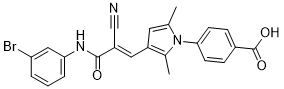
RNPA1000 is a novel and potent inhibitor of growth of Staphylococcus aureus. It is a antimicrobial agent acting as a RNase inhibitor.
Physicochemical Properties
| Molecular Formula | C23H18BRN3O3 |
| Molecular Weight | 464.311324596405 |
| Exact Mass | 463.053 |
| CAS # | 359600-10-5 |
| Related CAS # | 359600-10-5; |
| PubChem CID | 1268985 |
| Appearance | Light yellow to khaki solid powder |
| LogP | 5.1 |
| Hydrogen Bond Donor Count | 2 |
| Hydrogen Bond Acceptor Count | 4 |
| Rotatable Bond Count | 5 |
| Heavy Atom Count | 30 |
| Complexity | 723 |
| Defined Atom Stereocenter Count | 0 |
| SMILES | CC1=CC(=C(N1C2=CC=C(C=C2)C(=O)O)C)/C=C(\C#N)/C(=O)NC3=CC(=CC=C3)Br |
| InChi Key | WQCMDUBFZYCGMI-WOJGMQOQSA-N |
| InChi Code | InChI=1S/C23H18BrN3O3/c1-14-10-17(15(2)27(14)21-8-6-16(7-9-21)23(29)30)11-18(13-25)22(28)26-20-5-3-4-19(24)12-20/h3-12H,1-2H3,(H,26,28)(H,29,30)/b18-11+ SMILES |
| Chemical Name | 4-[3-[3-[(3-Bromophenyl)amino]-2-cyano-3-oxo-1-propen-1-yl]-2,5-dimethyl-1H-pyrrol-1-yl]-benzoic acid InChi Key |
| Synonyms | RNPA1000 RNPA-1000 RNPA 1000 |
| HS Tariff Code | 2934.99.9001 |
| Storage |
Powder-20°C 3 years 4°C 2 years In solvent -80°C 6 months -20°C 1 month |
| Shipping Condition | Room temperature (This product is stable at ambient temperature for a few days during ordinary shipping and time spent in Customs) |
Biological Activity
| ln Vitro | RNPA1000 exhibits minimal toxicity to human cells and antibacterial efficacy against Gram-positive bacteria [2]. Staphylococcus aureus mRNA growth and turnover are restricted by RNPA1000. Along with its antimicrobial activity against biofilm-associated Staphylococcus aureus, RNPA1000 also inhibits the growth of other significant Gram-positive bacterial pathogens and guards against S. aureus pathology in animal infection models [3]. Commercially available E. Coli RNase HI, RNase A, RNase I, and in-house purified S. aureus RNase J1 are not affected by RNPA1000 (IC50= 100-125 µM) at any tested concentration (0-750 µM). However, E. Coli RNase III activity (IC50= 500-750 µM) is modestly inhibited[3]. |
| References |
[1]. Eidem TM, et al. Drug-eluting cements for hard tissue repair: a comparative study using vancomycin and RNPA1000 to inhibit growth of Staphylococcus aureus. J Biomater Appl. 2014 Apr;28(8):1235-46. [2]. Eidem TM, et al. Small-molecule inhibitors of Staphylococcus aureus RnpA-mediated RNA turnover and tRNA processing. Antimicrob Agents Chemother. 2015 Apr;59(4):2016-28. [3]. Patrick D Olson, et al. Small molecule inhibitors of Staphylococcus aureus RnpA alter cellular mRNA turnover, exhibit antimicrobial activity, and attenuate pathogenesis. PLoS Pathog. 2011 Feb 10;7(2):e1001287. |
Solubility Data
| Solubility (In Vitro) | DMSO : ~50 mg/mL (~107.69 mM) |
| Solubility (In Vivo) |
Solubility in Formulation 1: ≥ 2.5 mg/mL (5.38 mM) (saturation unknown) in 10% DMSO + 40% PEG300 + 5% Tween80 + 45% Saline (add these co-solvents sequentially from left to right, and one by one), clear solution. For example, if 1 mL of working solution is to be prepared, you can add 100 μL of 25.0 mg/mL clear DMSO stock solution to 400 μL PEG300 and mix evenly; then add 50 μL Tween-80 to the above solution and mix evenly; then add 450 μL normal saline to adjust the volume to 1 mL. Preparation of saline: Dissolve 0.9 g of sodium chloride in 100 mL ddH₂ O to obtain a clear solution. Solubility in Formulation 2: ≥ 2.5 mg/mL (5.38 mM) (saturation unknown) in 10% DMSO + 90% (20% SBE-β-CD in Saline) (add these co-solvents sequentially from left to right, and one by one), clear solution. For example, if 1 mL of working solution is to be prepared, you can add 100 μL of 25.0 mg/mL clear DMSO stock solution to 900 μL of 20% SBE-β-CD physiological saline solution and mix evenly. Preparation of 20% SBE-β-CD in Saline (4°C,1 week): Dissolve 2 g SBE-β-CD in 10 mL saline to obtain a clear solution. Solubility in Formulation 3: ≥ 2.5 mg/mL (5.38 mM) (saturation unknown) in 10% DMSO + 90% Corn Oil (add these co-solvents sequentially from left to right, and one by one), clear solution. For example, if 1 mL of working solution is to be prepared, you can add 100 μL of 25.0 mg/mL clear DMSO stock solution to 900 μL of corn oil and mix evenly. (Please use freshly prepared in vivo formulations for optimal results.) |
| Preparing Stock Solutions | 1 mg | 5 mg | 10 mg | |
| 1 mM | 2.1537 mL | 10.7687 mL | 21.5373 mL | |
| 5 mM | 0.4307 mL | 2.1537 mL | 4.3075 mL | |
| 10 mM | 0.2154 mL | 1.0769 mL | 2.1537 mL |