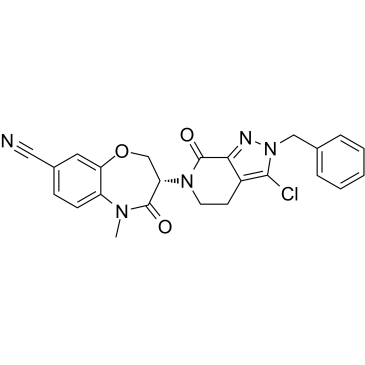
RIP1 kinase inhibitor 1 (compound 22) is a novel, oral and brain-penetrating receptor interacting protein 1 (RIP1) kinase inhibitor with pKi of 9.04 and excellent PK profiles. Compound 22 significantly suppressed necroptotic cell death both in mouse and human cells. Oral administration of 22 (10 mg/kg, bid) attenuated disease progression in the mouse experimental autoimmune encephalomyelitis (EAE) model of multiple sclerosis (MS).
Physicochemical Properties
| Molecular Formula | C24H20CLN5O3 |
| Molecular Weight | 461.9003 |
| Exact Mass | 461.125 |
| CAS # | 2095515-38-9 |
| Related CAS # | 2095515-38-9; |
| PubChem CID | 132471860 |
| Appearance | White to yellow solid powder |
| LogP | 3.2 |
| Hydrogen Bond Donor Count | 0 |
| Hydrogen Bond Acceptor Count | 5 |
| Rotatable Bond Count | 3 |
| Heavy Atom Count | 33 |
| Complexity | 811 |
| Defined Atom Stereocenter Count | 1 |
| SMILES | ClC1=C2C(C(N(C([H])([H])C2([H])[H])[C@]2([H])C(N(C([H])([H])[H])C3C([H])=C([H])C(C#N)=C([H])C=3OC2([H])[H])=O)=O)=NN1C([H])([H])C1C([H])=C([H])C([H])=C([H])C=1[H] |
| InChi Key | JWKONLKXWPCOJF-IBGZPJMESA-N |
| InChi Code | InChI=1S/C24H20ClN5O3/c1-28-18-8-7-16(12-26)11-20(18)33-14-19(23(28)31)29-10-9-17-21(24(29)32)27-30(22(17)25)13-15-5-3-2-4-6-15/h2-8,11,19H,9-10,13-14H2,1H3/t19-/m0/s1 |
| Chemical Name | (3S)-3-(2-benzyl-3-chloro-7-oxo-4,5-dihydropyrazolo[3,4-c]pyridin-6-yl)-5-methyl-4-oxo-2,3-dihydro-1,5-benzoxazepine-8-carbonitrile |
| HS Tariff Code | 2934.99.9001 |
| Storage |
Powder-20°C 3 years 4°C 2 years In solvent -80°C 6 months -20°C 1 month Note: Please store this product in a sealed and protected environment (e.g. under nitrogen), avoid exposure to moisture and light. |
| Shipping Condition | Room temperature (This product is stable at ambient temperature for a few days during ordinary shipping and time spent in Customs) |
Biological Activity
| ln Vitro | Human colorectal adenocarcinoma HT-29 cells (necroptosis, IC50=2 nM; pMLKL, IC50=1.3 nM) and mouse L cells and MLKL (pMLKL) phosphorylate NCTC 929 (necroptosis, IC50=15 nM; pMLKL, IC50=2.7 nM) are both significantly inhibited by RIP1 kinase inhibitor 1 (compound 22). |
| References |
[1]. Discovery of 7-Oxo-2,4,5,7-tetrahydro-6 H-pyrazolo[3,4- c]pyridine Derivatives as Potent, OrallyAvailable, and Brain-Penetrating Receptor Interacting Protein 1 (RIP1) Kinase Inhibitors: Analysis of Structure-Kinetic Relationships. J Me. |
Solubility Data
| Solubility (In Vitro) | DMSO : ~200 mg/mL (~432.99 mM) |
| Solubility (In Vivo) |
Solubility in Formulation 1: 5 mg/mL (10.82 mM) in 10% DMSO + 40% PEG300 + 5% Tween80 + 45% Saline (add these co-solvents sequentially from left to right, and one by one), suspension solution; with sonication. For example, if 1 mL of working solution is to be prepared, you can add 100 μL of 50.0 mg/mL clear DMSO stock solution to 400 μL PEG300 and mix evenly; then add 50 μL Tween-80 to the above solution and mix evenly; then add 450 μL normal saline to adjust the volume to 1 mL. Preparation of saline: Dissolve 0.9 g of sodium chloride in 100 mL ddH₂ O to obtain a clear solution. Solubility in Formulation 2: ≥ 5 mg/mL (10.82 mM) (saturation unknown) in 10% DMSO + 90% Corn Oil (add these co-solvents sequentially from left to right, and one by one), clear solution. For example, if 1 mL of working solution is to be prepared, you can add 100 μL of 50.0 mg/mL clear DMSO stock solution to 900 μL of corn oil and mix evenly. (Please use freshly prepared in vivo formulations for optimal results.) |
| Preparing Stock Solutions | 1 mg | 5 mg | 10 mg | |
| 1 mM | 2.1650 mL | 10.8249 mL | 21.6497 mL | |
| 5 mM | 0.4330 mL | 2.1650 mL | 4.3299 mL | |
| 10 mM | 0.2165 mL | 1.0825 mL | 2.1650 mL |