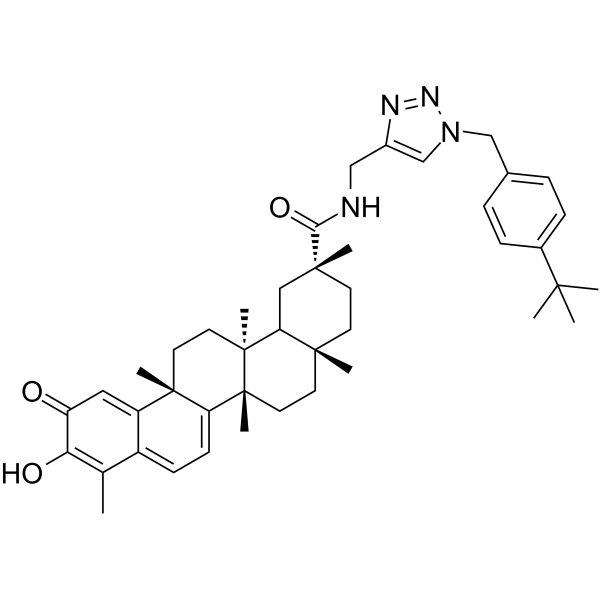
RIP1/RIP3/MLKL activator 1 (Compound 6i) is a novel and potent anti-glioma agent acting as an agpnist of RIP1/RIP3/MLKL pathway. It induces necroptosis through activating RIP1/RIP3/MLKL pathway.
Physicochemical Properties
| Molecular Formula | C43H56N4O3 |
| Molecular Weight | 676.929751396179 |
| Exact Mass | 676.435 |
| CAS # | 2682850-41-3 |
| PubChem CID | 163322291 |
| Appearance | Orange to red solid powder |
| Density | 1.19±0.1 g/cm3(Predicted) |
| LogP | 8.3 |
| Hydrogen Bond Donor Count | 2 |
| Hydrogen Bond Acceptor Count | 5 |
| Rotatable Bond Count | 6 |
| Heavy Atom Count | 50 |
| Complexity | 1560 |
| Defined Atom Stereocenter Count | 5 |
| SMILES | CC1=C(C(=O)C=C2C1=CC=C3[C@]2(CC[C@@]4([C@@]3(CC[C@@]5(C4C[C@](CC5)(C)C(=O)NCC6=CN(N=N6)CC7=CC=C(C=C7)C(C)(C)C)C)C)C)C)O |
| InChi Key | QLFCJGYFBTYJGC-RSWNTZNOSA-N |
| InChi Code | InChI=1S/C43H56N4O3/c1-27-31-14-15-34-41(7,32(31)22-33(48)36(27)49)19-21-43(9)35-23-40(6,17-16-39(35,5)18-20-42(34,43)8)37(50)44-24-30-26-47(46-45-30)25-28-10-12-29(13-11-28)38(2,3)4/h10-15,22,26,35,49H,16-21,23-25H2,1-9H3,(H,44,50)/t35?,39-,40-,41+,42-,43+/m1/s1 |
| Chemical Name | (2R,4aS,6aR,6aS,14aS)-N-[[1-[(4-tert-butylphenyl)methyl]triazol-4-yl]methyl]-10-hydroxy-2,4a,6a,6a,9,14a-hexamethyl-11-oxo-1,3,4,5,6,13,14,14b-octahydropicene-2-carboxamide |
| HS Tariff Code | 2934.99.9001 |
| Storage |
Powder-20°C 3 years 4°C 2 years In solvent -80°C 6 months -20°C 1 month Note: Please store this product in a sealed and protected environment (e.g. under nitrogen), avoid exposure to moisture. |
| Shipping Condition | Room temperature (This product is stable at ambient temperature for a few days during ordinary shipping and time spent in Customs) |
Biological Activity
| ln Vitro | In human glioma cell lines, RIP1/RIP3/MLKL activator 1 (compound 6i) (96 hours) demonstrated antiproliferative action [1]. On U251 cells, RIP1/RIP3/MLKL activator 1 (0–4 µM, 0-72 hours) demonstrates strong anti-proliferative activity in a concentration- and time-dependent way [1]. Acceptable stability is demonstrated by RIP1/RIP3/MLKL activator 1 (10 µM, 0-72 hours) [1]. It has been observed that RIP1/RIP3/MLKL activator 1 (0–2 µM, 24 hours) efficiently prevents U251 cell migration [1]. In U251 cells, RIP1/RIP3/MLKL activator 1 causes mitochondrial depolarization and necroptosis via the RIP1/RIP3/MLKL pathway [1]. In U251 cells, RIP1/RIP3/MLKL activator 1 is unable to cause apoptosis [1]. |
| ln Vivo | Compound 6i, RIP1/RIP3/MLKL activator 1 (2.50 ng/tail; intravenous injection; 48 hours), exhibits acceptable BBB permeability while inhibiting U251 cell proliferation in vivo [1]. |
| Cell Assay |
Cell proliferation assay[1] Cell Types: A172, LN229, U87, U251 and L02 Cell lines Tested Concentrations: 0-4 µM for U251 cells Incubation Duration: 96 hrs (hours); 24, 48 and 72 hrs (hours) for U251 cells Experimental Results: For A172, LN229, U87, U251 and L02 demonstrated antiproliferative activity with IC50 values of 3.03 ± 0.70, 1.78 ± 0.79, 1.22 ± 0.89, 0.94 ± 0.45 and 0.99 ± 0.46 µM cells, respectively. Inhibits the growth of U251 cells in a time- and concentration-dependent manner. Western Blot Analysis[1] Cell Types: U251 Tested Concentrations: 0, 0.5, 1, 2 and 4 µM Incubation Duration: 24 or 48 hrs (hours) Experimental Results: Concentration-dependent upregulation of the expression of p-RIP1, RIP1, p-RIP3, RIP3, p -MLKL and MLKL at 24 or 48 hrs (hours). |
| Animal Protocol |
Animal/Disease Models: Zebrafish broad AB strain; 200 CM-DiI labeled U251 cells were transplanted into the yolk sac of each wild-type zebrafish embryo at 2 dpf (2 days after fertilization) [1] Doses: 2.50 ng/tail Route of Administration: microinjection; 48-hour Experimental Results: The fluorescence intensity of U251 xenografts was Dramatically diminished. |
| References |
[1]. Synthesis and biological evaluation of celastrol derivatives as potential anti-glioma agents by activating RIP1/RIP3/MLKL pathway to induce necroptosis. Eur J Med Chem. 2022 Feb 5;229:114070. |
Solubility Data
| Solubility (In Vitro) | DMSO : ~100 mg/mL (~147.73 mM) |
| Solubility (In Vivo) |
Solubility in Formulation 1: ≥ 2.5 mg/mL (3.69 mM) (saturation unknown) in 10% DMSO + 90% (20% SBE-β-CD in Saline) (add these co-solvents sequentially from left to right, and one by one), suspension solution. For example, if 1 mL of working solution is to be prepared, you can add 100 μL of 25.0 mg/mL clear DMSO stock solution to 900 μL of 20% SBE-β-CD physiological saline solution and mix evenly. Preparation of 20% SBE-β-CD in Saline (4°C,1 week): Dissolve 2 g SBE-β-CD in 10 mL saline to obtain a clear solution. Solubility in Formulation 2: 2.5 mg/mL (3.69 mM) in 10% DMSO + 90% Corn Oil (add these co-solvents sequentially from left to right, and one by one), suspension solution; with ultrasonication. For example, if 1 mL of working solution is to be prepared, you can add 100 μL of 25.0 mg/mL clear DMSO stock solution to 900 μL of corn oil and mix evenly. (Please use freshly prepared in vivo formulations for optimal results.) |
| Preparing Stock Solutions | 1 mg | 5 mg | 10 mg | |
| 1 mM | 1.4773 mL | 7.3863 mL | 14.7726 mL | |
| 5 mM | 0.2955 mL | 1.4773 mL | 2.9545 mL | |
| 10 mM | 0.1477 mL | 0.7386 mL | 1.4773 mL |