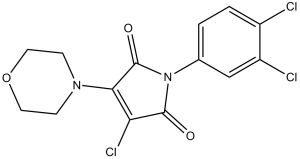
RI-1 (also known as RAD51 inhibitor 1) is an irreversible small molecule inhibitor of RAD51 with IC50 ranging from 5 to 30 μM. Through direct and specific disruption of HsRAD51 and inhibition of RAD51's ability to form filaments on ssDNA, RI-1 sensitizes cells to DNA damage. Furthermore, all three cancer cell lines (HeLa, MCF-7, and U2OS) exhibit single-agent toxicity when exposed to RI-1 alone, with LD50 values in the 20–40 µM range. In G2 phase cells, RI-1 inhibits the rejoining of γ-H2AX foci, leading to an increased amount of unrepaired double-strand breaks six hours post-irradiation.
Physicochemical Properties
| Molecular Formula | C14H11CL3N2O3 | |
| Molecular Weight | 361.61 | |
| Exact Mass | 359.983 | |
| Elemental Analysis | C, 46.50; H, 3.07; Cl, 29.41; N, 7.75; O, 13.27 | |
| CAS # | 415713-60-9 | |
| Related CAS # |
|
|
| PubChem CID | 1074953 | |
| Appearance | Yellow to orange solid powder | |
| Density | 1.6±0.1 g/cm3 | |
| Boiling Point | 483.0±45.0 °C at 760 mmHg | |
| Flash Point | 245.9±28.7 °C | |
| Vapour Pressure | 0.0±1.2 mmHg at 25°C | |
| Index of Refraction | 1.669 | |
| LogP | 3.04 | |
| Hydrogen Bond Donor Count | 0 | |
| Hydrogen Bond Acceptor Count | 4 | |
| Rotatable Bond Count | 2 | |
| Heavy Atom Count | 22 | |
| Complexity | 520 | |
| Defined Atom Stereocenter Count | 0 | |
| SMILES | ClC1C(N(C2C([H])=C([H])C(=C(C=2[H])Cl)Cl)C(C=1N1C([H])([H])C([H])([H])OC([H])([H])C1([H])[H])=O)=O |
|
| InChi Key | MWSUIZKGNWELRF-UHFFFAOYSA-N | |
| InChi Code | InChI=1S/C14H11Cl3N2O3/c15-9-2-1-8(7-10(9)16)19-13(20)11(17)12(14(19)21)18-3-5-22-6-4-18/h1-2,7H,3-6H2 | |
| Chemical Name | 3-chloro-1-(3,4-dichlorophenyl)-4-morpholin-4-ylpyrrole-2,5-dione | |
| Synonyms |
|
|
| HS Tariff Code | 2934.99.9001 | |
| Storage |
Powder-20°C 3 years 4°C 2 years In solvent -80°C 6 months -20°C 1 month |
|
| Shipping Condition | Room temperature (This product is stable at ambient temperature for a few days during ordinary shipping and time spent in Customs) |
Biological Activity
| Targets | RAD51 ( IC50 = 5-30 μM ) | |
| ln Vitro |
|
|
| ln Vivo |
|
|
| Enzyme Assay | Reaction volumes range from 30 to 100 μL, and all reactions are carried out in 384-well black non-binding polystyrene plates. Purified chemical compounds and DNA strand exchange proteins are first incubated for five minutes at room temperature. They are then incubated for a further thirty minutes at 37°C with 100 nM of ssDNA substrate, which is a 45-mer poly-dT tagged with Alexa 488 at the 5' terminus (purified and synthesized by Integrated DNA Technologies). 20 mM HEPES pH 7.5, 10 mM MgCl2, 0.25 μM BSA, 2% glycerol, 30 mM NaCl, 4% DMSO, and 2 mM ATP are used for the reactions. DTT or TCEP (tris(2-carboxyethyl)phosphine) were among the conditions mentioned. The Safire2 plate reader is used to measure DNA binding as a function of fluorescence polarization (FP). The following settings are used: excitation 470±5 nm, emission 530±5 nm, 10 reads/well, Z height, and G factor auto-calibrated from control wells. Error bars that are displayed stand for standard deviation. Data are fitted to an equation that takes into account the cooperative nature of recombinase protein DNA binding in experiments involving the titration of protein concentrations. Protein concentrations are chosen for RI-1 titration experiments such that the FP signal reaches approximately 80% saturation when RI-1 is not present. | |
| Cell Assay | The ability to form colonies is the key indicator of cytotoxicity. Three duplicates of each experiment are run. NIH Image software is utilized to count colonies that have been stained with crystal violet and imaged using a CCD camera. Normal error is indicated by error bars. | |
| Animal Protocol |
Female BALB/c nude mice (6 weeks) bearing TNBC tumor 50 mg/kg I.p. every 3 days for 30 days |
|
| References |
[1]. RI-1: a chemical inhibitor of RAD51 that disrupts homologous recombination in human cells. Nucleic Acids Res. 2012 Aug;40(15):7347-57. [2]. DAXX, as a Tumor Suppressor, Impacts DNA Damage Repair and Sensitizes BRCA-Proficient TNBC Cells to PARP Inhibitors. Neoplasia. 2019 Jun;21(6):533-544. |
Solubility Data
| Solubility (In Vitro) |
|
|||
| Solubility (In Vivo) |
Solubility in Formulation 1: ≥ 2.5 mg/mL (6.91 mM) (saturation unknown) in 10% DMSO + 90% Corn Oil (add these co-solvents sequentially from left to right, and one by one), clear solution. For example, if 1 mL of working solution is to be prepared, you can add 100 μL of 25.0 mg/mL clear DMSO stock solution to 900 μL of corn oil and mix evenly. (Please use freshly prepared in vivo formulations for optimal results.) |
| Preparing Stock Solutions | 1 mg | 5 mg | 10 mg | |
| 1 mM | 2.7654 mL | 13.8271 mL | 27.6541 mL | |
| 5 mM | 0.5531 mL | 2.7654 mL | 5.5308 mL | |
| 10 mM | 0.2765 mL | 1.3827 mL | 2.7654 mL |