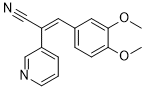
Physicochemical Properties
| Molecular Formula | C16H14N2O2 |
| Molecular Weight | 266.3 |
| Exact Mass | 266.106 |
| Elemental Analysis | C, 72.17; H, 5.30; N, 10.52; O, 12.02 |
| CAS # | 136831-48-6 |
| Related CAS # | 136831-48-6 |
| PubChem CID | 5468216 |
| Appearance | White to off-white solid powder |
| Density | 1.172g/cm3 |
| Boiling Point | 423.8ºC at 760mmHg |
| Melting Point | 118 °C |
| Flash Point | 210.1ºC |
| Vapour Pressure | 2.18E-07mmHg at 25°C |
| Index of Refraction | 1.605 |
| LogP | 3.162 |
| Hydrogen Bond Donor Count | 0 |
| Hydrogen Bond Acceptor Count | 4 |
| Rotatable Bond Count | 4 |
| Heavy Atom Count | 20 |
| Complexity | 385 |
| Defined Atom Stereocenter Count | 0 |
| SMILES | N#C/C(C1=CC=CN=C1)=C/C2=CC=C(OC)C(OC)=C2 |
| InChi Key | DBGZNJVTHYFQJI-ZSOIEALJSA-N |
| InChi Code | InChI=1S/C16H14N2O2/c1-19-15-6-5-12(9-16(15)20-2)8-14(10-17)13-4-3-7-18-11-13/h3-9,11H,1-2H3/b14-8- |
| Chemical Name | (E)-3-(3,4-dimethoxyphenyl)-2-pyridin-3-ylprop-2-enenitrile |
| Synonyms | RG13022; RG-13022; RG 13022; Tyrphostin; RG 13022 |
| HS Tariff Code | 2934.99.9001 |
| Storage |
Powder-20°C 3 years 4°C 2 years In solvent -80°C 6 months -20°C 1 month |
| Shipping Condition | Room temperature (This product is stable at ambient temperature for a few days during ordinary shipping and time spent in Customs) |
Biological Activity
| Targets | EGF receptor autophosphorylation (IC50 = 4 μM) |
| ln Vitro | G-13022 prevents the EGF-receptor in HER 14 cells from becoming autophosphorylated after an overnight incubation. RG-13022 has an IC50 of 5 μM. When HER 14 cells are stimulated by 50 ng/mL EGF, RG-13022 inhibits colony formation and DNA synthesis in a dose-dependent manner. For HER 14 colony formation, RG-13022's IC50 is 1 μM, while for HER 14 DNA synthesis, it is 3 μM. Additionally, EGF-stimulated MH-85 cells' colony formation and DNA synthesis are suppressed by RG-13022 in a dose-dependent manner. For MH-85 cells, the IC50 values of RG-13022 are 7 μM for colony formation and 1.5 μM for DNA synthesis.[1] |
| ln Vivo | RG-13022, at 400 μg/mouse/day, considerably suppresses the growth of MH-85 tumors. In comparison to untreated MH-85 tumor-bearing animals, animals receiving injections of RG-13022 exhibit less cachexia and hypercalcemia, eat more food, and exhibit greater levels of activity due to slower tumor growth. RG-13022 extends the life span of MH-85 tumor-bearing animals by inhibiting the growth of tumors. Significant inhibition of MH-85 growth in nude mice is observed upon administration of mAb108 i.p. (1 mg/mouse/day) at 1, 5, and 10 days following RG-13022 (400 μg/mouse/day) for 14 days as an MH-85 inoculation.[1] |
| Cell Assay | The following cell types are plated in complete medium: alpha MEM (100/well; 24-well plate) or HER 14 cells (200/dish; 10-cm dish), with 10% FCS added. The culture medium is changed to either DMEM supplemented with 0.5% PCS and 50 ng/mL EGF (HER14) or alpha MEM supplemented with 0.2% PCS and 50 ng/mL EGF (MH-85) after the overnight culture. For ten days, the cells are cultivated in this medium with or without increasing concentrations of RG-13022. After the culture is complete, the cells are fixed for 15 minutes at room temperature using 4% (v/v) formaldehyde in phosphate-buffered saline that is free of calcium and magnesium, and then they are stained with hematoxylin. Under a microscope, the number of colonies—which contain more than 20 cells in each well—is counted. |
| Animal Protocol | Mice: MH-85 tumors 5 mm in diameter are injected subcutaneously (s.c.) into the right dorsal region of male BALB/c nu/nu mice that are 4–6 weeks old. I.p. injections of RG-13022 or RG-14620 in 0.1 ml 100% DMSO are given twice a day starting one day following the inoculation of the MH-85 tumor. The vehicle is given to control animals. Under nembutal anesthesia (0.05 mg/g body weight, i.p.), tumor sizes are measured once a week and computed. |
| References |
[1]. The antiproliferative effects of tyrosine kinase inhibitors tyrphostins on a human squamous cell carcinoma in vitro and in nude mice. Cancer Res. 1991 Aug 15;51(16):4430-5. [2]. Inhibition of breast cancer cell growth in vitro by a tyrosine kinase inhibitor. Cancer Res. 1992 Jul 1;52(13):3636-41. |
| Additional Infomation |
3-(3,4-dimethoxyphenyl)-2-(3-pyridinyl)-2-propenenitrile is a dimethoxybenzene. RG 13022 is a tyrosine kinase inhibitor that selectively inhibits epidermal growth factor receptor, epidermal factor-stimulated HER14 cell proliferation, and tumor growth in vivo. (NCI) |
Solubility Data
| Solubility (In Vitro) |
DMSO: ~100 mg/mL (~375.5 mM) Ethanol: ~5 mg/mL (~18.8 mM) |
| Solubility (In Vivo) |
Solubility in Formulation 1: ≥ 2.5 mg/mL (9.39 mM) (saturation unknown) in 10% DMSO + 40% PEG300 + 5% Tween80 + 45% Saline (add these co-solvents sequentially from left to right, and one by one), clear solution. For example, if 1 mL of working solution is to be prepared, you can add 100 μL of 25.0 mg/mL clear DMSO stock solution to 400 μL PEG300 and mix evenly; then add 50 μL Tween-80 to the above solution and mix evenly; then add 450 μL normal saline to adjust the volume to 1 mL. Preparation of saline: Dissolve 0.9 g of sodium chloride in 100 mL ddH₂ O to obtain a clear solution. Solubility in Formulation 2: ≥ 2.5 mg/mL (9.39 mM) (saturation unknown) in 10% DMSO + 90% (20% SBE-β-CD in Saline) (add these co-solvents sequentially from left to right, and one by one), clear solution. For example, if 1 mL of working solution is to be prepared, you can add 100 μL of 25.0 mg/mL clear DMSO stock solution to 900 μL of 20% SBE-β-CD physiological saline solution and mix evenly. Preparation of 20% SBE-β-CD in Saline (4°C,1 week): Dissolve 2 g SBE-β-CD in 10 mL saline to obtain a clear solution. Solubility in Formulation 3: ≥ 2.5 mg/mL (9.39 mM) (saturation unknown) in 10% DMSO + 90% Corn Oil (add these co-solvents sequentially from left to right, and one by one), clear solution. For example, if 1 mL of working solution is to be prepared, you can add 100 μL of 25.0 mg/mL clear DMSO stock solution to 900 μL of corn oil and mix evenly. (Please use freshly prepared in vivo formulations for optimal results.) |
| Preparing Stock Solutions | 1 mg | 5 mg | 10 mg | |
| 1 mM | 3.7552 mL | 18.7758 mL | 37.5516 mL | |
| 5 mM | 0.7510 mL | 3.7552 mL | 7.5103 mL | |
| 10 mM | 0.3755 mL | 1.8776 mL | 3.7552 mL |