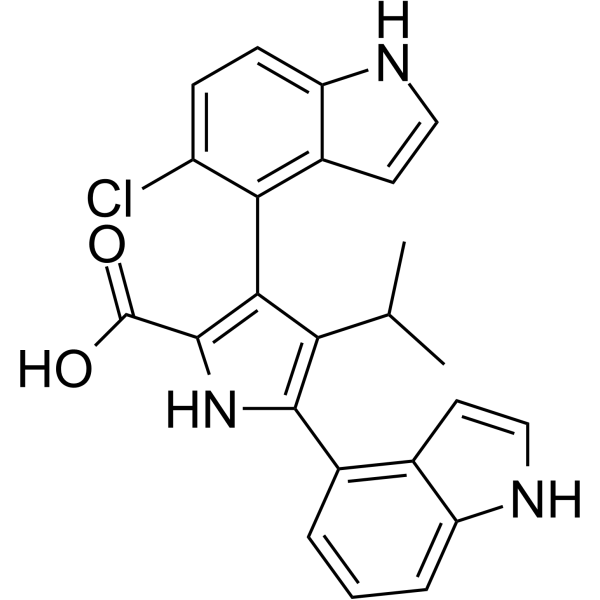
Physicochemical Properties
| Molecular Formula | C24H20CLN3O2 |
| Molecular Weight | 417.89 |
| Exact Mass | 417.124 |
| CAS # | 2396639-11-3 |
| PubChem CID | 146315785 |
| Appearance | White to light yellow solid powder |
| LogP | 5.9 |
| Hydrogen Bond Donor Count | 4 |
| Hydrogen Bond Acceptor Count | 2 |
| Rotatable Bond Count | 4 |
| Heavy Atom Count | 30 |
| Complexity | 646 |
| Defined Atom Stereocenter Count | 0 |
| SMILES | N1C(C2=CC=CC3=C2C=CN3)=C(C(C)C)C(C2=C(Cl)C=CC3=C2C=CN3)=C1C(O)=O |
| InChi Key | IUEFQUANJWCUNT-UHFFFAOYSA-N |
| InChi Code | InChI=1S/C24H20ClN3O2/c1-12(2)19-21(20-15-9-11-27-18(15)7-6-16(20)25)23(24(29)30)28-22(19)14-4-3-5-17-13(14)8-10-26-17/h3-12,26-28H,1-2H3,(H,29,30) |
| Chemical Name | 3-(5-chloro-1H-indol-4-yl)-5-(1H-indol-4-yl)-4-propan-2-yl-1H-pyrrole-2-carboxylic acid |
| HS Tariff Code | 2934.99.9001 |
| Storage |
Powder-20°C 3 years 4°C 2 years In solvent -80°C 6 months -20°C 1 month Note: Please store this product in a sealed and protected environment (e.g. under nitrogen), avoid exposure to moisture and light. |
| Shipping Condition | Room temperature (This product is stable at ambient temperature for a few days during ordinary shipping and time spent in Customs) |
Biological Activity
| Targets | Kd: 2.8 μM (RING1B-BMI1f)[1]. |
| ln Vitro | Leukemia cell lines and primary acute myeloid leukemia (AML) samples undergo differentiation in response to RB-3, which also lowers the global level of H2A ubiquitination[1]. H2A ubiquitination is inhibited by RB-3, with an IC50 of 1.6 μM[1]. PRC1 and interferes with nucleosome interaction[1]. In a mixed lineage leukemia (MLL)-eleven nineteen leukemia (ENL) model, RB-3 inhibits colony formation[1]. |
| Cell Assay |
Western Blot Analysis[1] Cell Types: TEX cells. Tested Concentrations: 6, 12, 25 μM. Incubation Duration: 8d. Experimental Results: Dose-dependently increased C/EBPα-p42 protein levels. |
| References |
[1]. Small-molecule inhibitors targeting Polycomb repressive complex 1 RING domain. Nat Chem Biol. 2021 Jul;17(7):784-793. |
Solubility Data
| Solubility (In Vitro) | DMSO: 100 mg/mL (239.30 mM) |
| Solubility (In Vivo) |
Solubility in Formulation 1: ≥ 3.25 mg/mL (7.78 mM) (saturation unknown) in 10% DMSO + 40% PEG300 + 5% Tween80 + 45% Saline (add these co-solvents sequentially from left to right, and one by one), clear solution. For example, if 1 mL of working solution is to be prepared, you can add 100 μL of 32.5 mg/mL clear DMSO stock solution to 400 μL of PEG300 and mix evenly; then add 50 μL of Tween-80 to the above solution and mix evenly; then add 450 μL of normal saline to adjust the volume to 1 mL. Preparation of saline: Dissolve 0.9 g of sodium chloride in 100 mL ddH₂ O to obtain a clear solution. Solubility in Formulation 2: ≥ 3.25 mg/mL (7.78 mM) (saturation unknown) in 10% DMSO + 90% Corn Oil (add these co-solvents sequentially from left to right, and one by one), clear solution. For example, if 1 mL of working solution is to be prepared, you can add 100 μL of 32.5 mg/mL clear DMSO stock solution to 900 μL of corn oil and mix evenly. (Please use freshly prepared in vivo formulations for optimal results.) |
| Preparing Stock Solutions | 1 mg | 5 mg | 10 mg | |
| 1 mM | 2.3930 mL | 11.9649 mL | 23.9297 mL | |
| 5 mM | 0.4786 mL | 2.3930 mL | 4.7859 mL | |
| 10 mM | 0.2393 mL | 1.1965 mL | 2.3930 mL |