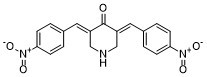
RA-9 is a cell permeable and potent inhibitor of the ubiquitin-proteasome system (UPS). RA-9 Inhibits Proteasome-Associated DUBs and Ovarian Cancer in Vitro and in Vivo via Exacerbating Unfolded Protein Responses. Treatment with RA-9 selectively induces onset of apoptosis in ovarian cancer cell lines and primary cultures derived from donors. Loss of cell viability following RA-9 exposure is associated with an unfolded protein response as mechanism to compensate for unsustainable levels of proteotoxic stress. In vivo treatment with RA-9 retards tumor growth, increases overall survival, and was well tolerated by the host.
Physicochemical Properties
| Molecular Formula | C19H15N3O5 |
| Molecular Weight | 365.345 |
| Exact Mass | 365.101 |
| Elemental Analysis | C, 62.46; H, 4.14; N, 11.50; O, 21.90 |
| CAS # | 919091-63-7 |
| Related CAS # | 919091-63-7 |
| PubChem CID | 5469266 |
| Appearance | Light yellow to yellow solid powder |
| LogP | 4.517 |
| Hydrogen Bond Donor Count | 1 |
| Hydrogen Bond Acceptor Count | 6 |
| Rotatable Bond Count | 2 |
| Heavy Atom Count | 27 |
| Complexity | 591 |
| Defined Atom Stereocenter Count | 0 |
| SMILES | C(/C1C=CC([N+](=O)[O-])=CC=1)=C1/CNC/C(=C\C2C=CC([N+](=O)[O-])=CC=2)/C/1=O |
| InChi Key | YUYPWAMLWZVHAE-KAVGSWPWSA-N |
| InChi Code | InChI=1S/C19H15N3O5/c23-19-15(9-13-1-5-17(6-2-13)21(24)25)11-20-12-16(19)10-14-3-7-18(8-4-14)22(26)27/h1-10,20H,11-12H2/b15-9+,16-10+ |
| Chemical Name | (3E,5E)-3,5-Bis[(4-nitrophenyl)methylene]-4-piperidinone |
| Synonyms | RA-9; RA 9; RA9; RA-9 UPS inhibitor |
| HS Tariff Code | 2934.99.9001 |
| Storage |
Powder-20°C 3 years 4°C 2 years In solvent -80°C 6 months -20°C 1 month |
| Shipping Condition | Room temperature (This product is stable at ambient temperature for a few days during ordinary shipping and time spent in Customs) |
Biological Activity
| Targets |
RA-9 targets proteasome-associated deubiquitinating enzymes (DUBs), including UCHL5 (IC50 = 0.8 μM) and USP14 (IC50 = 1.2 μM); it does not inhibit the 20S proteasome core activity at concentrations up to 10 μM [1] |
| ln Vitro |
The growth of primary cultures and cell lines of ovarian cancer is inhibited by RA-9 (10-30 μM; 48 hours) [1].
In ovarian cancer cells, RA-9 (1.25-5 μM; 18 hours) induces cell cycle arrest and caspase-mediated apoptosis [1].
Inducing ER-stress responses in ovarian cancer cells, RA-9 (5 μM; 0-24 hours) [1].
RA-9 (5 μM; more than a day) treatment outcomes, with as early as eight hours of time-dependent accumulation of the cleaved form of PARP [1]. Against human ovarian cancer cell lines (SKOV3, OVCAR3, A2780), RA-9 exhibited potent antiproliferative activity with IC50 values of 1.5 μM, 2.3 μM, and 1.8 μM, respectively, after 72 hours of treatment [1] - RA-9 (2 μM, 24 h) induced unfolded protein response (UPR) in SKOV3 cells, as evidenced by upregulated expression of GRP78, CHOP, and XBP1s (spliced XBP1) detected via western blot and RT-PCR [1] - Flow cytometry analysis showed that RA-9 (3 μM, 48 h) induced apoptosis in SKOV3 cells, with the apoptotic rate increasing from ~5% (control) to ~45% [1] - Western blot analysis revealed that RA-9 (2 μM, 24 h) increased polyubiquitinated protein accumulation, activated caspase-3/7 and PARP cleavage, and downregulated anti-apoptotic protein Bcl-2 in ovarian cancer cells [1] - RA-9 (1 μM, 7 days) significantly inhibited colony formation of SKOV3 cells, reducing the number of colonies by ~70% compared to the control group [1] |
| ln Vivo |
In a mouse model of ovarian cancer, RA-9 (5 mg/kg; i.p.; one day on, two days off) prolongs survival by inhibiting the growth of human ovarian cancer cells in vivo [1]. In the SKOV3 ovarian cancer xenograft model in nude mice, intraperitoneal administration of RA-9 at 10 mg/kg and 20 mg/kg twice weekly for 4 weeks resulted in tumor growth inhibition (TGI) rates of 58% and 76%, respectively [1] - RA-9 treatment (20 mg/kg) significantly reduced tumor weight from ~1.2 g (vehicle control) to ~0.3 g, without causing significant body weight loss (≤4% weight change) or obvious toxicity signs [1] - Immunohistochemical staining of tumor tissues showed that RA-9 (20 mg/kg) increased polyubiquitinated protein levels, upregulated GRP78 and CHOP expression, and enhanced caspase-3 activation (TUNEL-positive cells increased by ~3-fold) [1] |
| Enzyme Assay |
DUB activity assay was performed using a fluorogenic substrate-based method. The reaction mixture contained recombinant UCHL5 or USP14 enzyme, fluorogenic ubiquitin-AMC substrate, buffer, and serial dilutions of RA-9. After incubation at 37°C for 60 minutes, the release of AMC (7-amino-4-methylcoumarin) was measured by fluorescence spectroscopy (excitation 380 nm, emission 460 nm). IC50 values were calculated by fitting the dose-response curves [1] - 20S proteasome core activity assay: The reaction mixture included 20S proteasome, fluorogenic peptide substrate (Suc-LLVY-AMC), buffer, and RA-9 (up to 10 μM). Fluorescence intensity was measured after 1 hour of incubation at 37°C to evaluate potential inhibition of the 20S proteasome [1] |
| Cell Assay |
Antiproliferative assay: Ovarian cancer cells (SKOV3, OVCAR3, A2780) were seeded in 96-well plates at 3×10³ cells/well and incubated overnight. Serial dilutions of RA-9 were added, and cells were cultured for 72 hours. Cell viability was assessed using a tetrazolium salt-based colorimetric assay, and IC50 values were calculated [1] - UPR activation assay: SKOV3 cells were seeded in 6-well plates and treated with RA-9 (2 μM) for 24 hours. Total RNA was extracted for RT-PCR to detect XBP1s mRNA expression; total proteins were extracted for western blot to analyze GRP78 and CHOP protein levels [1] - Apoptosis assay: SKOV3 cells were treated with RA-9 (3 μM) for 48 hours, harvested, and stained with Annexin V-FITC and propidium iodide (PI). Apoptotic cells were detected and quantified using flow cytometry [1] - Colony formation assay: SKOV3 cells were seeded in 6-well plates at 500 cells/well and treated with RA-9 (1 μM) for 7 days. Colonies were fixed, stained with crystal violet, and counted to calculate the colony formation inhibition rate [1] |
| Animal Protocol |
Six-week-old female immunodeficient (NCr nu/nu) mice [1]. 5 mg/kg Female nude mice (6-7 weeks old) were subcutaneously inoculated with 5×10⁶ SKOV3 cells into the right flank. When tumors reached an average volume of 100 mm3, mice were randomly divided into three groups (n=8 per group): vehicle control, RA-9 10 mg/kg, and RA-9 20 mg/kg. RA-9 was formulated in a mixture of DMSO, Cremophor EL, and normal saline (volume ratio 1:1:8) and administered via intraperitoneal injection twice weekly for 4 weeks. Tumor volume (length × width2 / 2) and body weight were recorded every 3 days. At the end of the study, mice were euthanized, tumors were excised and weighed, and tumor tissues were collected for immunohistochemical staining [1] |
| Toxicity/Toxicokinetics |
In the 4-week in vivo efficacy study, RA-9 at doses up to 20 mg/kg (intraperitoneal) did not cause significant body weight loss, mortality, or histopathological abnormalities in major organs (liver, kidney, heart, lung, spleen) [1] - Plasma protein binding of RA-9 was determined to be 89% in mouse plasma and 91% in human plasma [1] |
| References |
[1]. Small-molecule RA-9 inhibits proteasome-associated DUBs and ovarian cancer in vitro and in vivo via exacerbating unfolded protein responses. Clin Cancer Res. 2014;20(12):3174-3186. |
| Additional Infomation |
RA-9 is a small-molecule inhibitor of proteasome-associated DUBs (UCHL5, USP14) with potential therapeutic effects on ovarian cancer [1] - Its mechanism of action involves inhibiting DUB-mediated deubiquitination, leading to accumulation of polyubiquitinated proteins, exacerbation of the unfolded protein response (UPR), and ultimately induction of ovarian cancer cell apoptosis [1] - RA-9 shows selectivity for cancer cells over normal cells: it did not inhibit the proliferation of normal human ovarian epithelial cells (HOSEpiC) at concentrations up to 5 μM [1] |
Solubility Data
| Solubility (In Vitro) | DMSO :4.17~8 mg/mL ( 11.41~21.89 mM ) |
| Solubility (In Vivo) |
Note: Listed below are some common formulations that may be used to formulate products with low water solubility (e.g. < 1 mg/mL), you may test these formulations using a minute amount of products to avoid loss of samples. Injection Formulations (e.g. IP/IV/IM/SC) Injection Formulation 1: DMSO : Tween 80: Saline = 10 : 5 : 85 (i.e. 100 μL DMSO stock solution → 50 μL Tween 80 → 850 μL Saline) *Preparation of saline: Dissolve 0.9 g of sodium chloride in 100 mL ddH ₂ O to obtain a clear solution. Injection Formulation 2: DMSO : PEG300 :Tween 80 : Saline = 10 : 40 : 5 : 45 (i.e. 100 μL DMSO → 400 μLPEG300 → 50 μL Tween 80 → 450 μL Saline) Injection Formulation 3: DMSO : Corn oil = 10 : 90 (i.e. 100 μL DMSO → 900 μL Corn oil) Example: Take the Injection Formulation 3 (DMSO : Corn oil = 10 : 90) as an example, if 1 mL of 2.5 mg/mL working solution is to be prepared, you can take 100 μL 25 mg/mL DMSO stock solution and add to 900 μL corn oil, mix well to obtain a clear or suspension solution (2.5 mg/mL, ready for use in animals). Injection Formulation 4: DMSO : 20% SBE-β-CD in saline = 10 : 90 [i.e. 100 μL DMSO → 900 μL (20% SBE-β-CD in saline)] *Preparation of 20% SBE-β-CD in Saline (4°C,1 week): Dissolve 2 g SBE-β-CD in 10 mL saline to obtain a clear solution. Injection Formulation 5: 2-Hydroxypropyl-β-cyclodextrin : Saline = 50 : 50 (i.e. 500 μL 2-Hydroxypropyl-β-cyclodextrin → 500 μL Saline) Injection Formulation 6: DMSO : PEG300 : castor oil : Saline = 5 : 10 : 20 : 65 (i.e. 50 μL DMSO → 100 μLPEG300 → 200 μL castor oil → 650 μL Saline) Injection Formulation 7: Ethanol : Cremophor : Saline = 10: 10 : 80 (i.e. 100 μL Ethanol → 100 μL Cremophor → 800 μL Saline) Injection Formulation 8: Dissolve in Cremophor/Ethanol (50 : 50), then diluted by Saline Injection Formulation 9: EtOH : Corn oil = 10 : 90 (i.e. 100 μL EtOH → 900 μL Corn oil) Injection Formulation 10: EtOH : PEG300:Tween 80 : Saline = 10 : 40 : 5 : 45 (i.e. 100 μL EtOH → 400 μLPEG300 → 50 μL Tween 80 → 450 μL Saline) Oral Formulations Oral Formulation 1: Suspend in 0.5% CMC Na (carboxymethylcellulose sodium) Oral Formulation 2: Suspend in 0.5% Carboxymethyl cellulose Example: Take the Oral Formulation 1 (Suspend in 0.5% CMC Na) as an example, if 100 mL of 2.5 mg/mL working solution is to be prepared, you can first prepare 0.5% CMC Na solution by measuring 0.5 g CMC Na and dissolve it in 100 mL ddH2O to obtain a clear solution; then add 250 mg of the product to 100 mL 0.5% CMC Na solution, to make the suspension solution (2.5 mg/mL, ready for use in animals). Oral Formulation 3: Dissolved in PEG400 Oral Formulation 4: Suspend in 0.2% Carboxymethyl cellulose Oral Formulation 5: Dissolve in 0.25% Tween 80 and 0.5% Carboxymethyl cellulose Oral Formulation 6: Mixing with food powders Note: Please be aware that the above formulations are for reference only. InvivoChem strongly recommends customers to read literature methods/protocols carefully before determining which formulation you should use for in vivo studies, as different compounds have different solubility properties and have to be formulated differently. (Please use freshly prepared in vivo formulations for optimal results.) |
| Preparing Stock Solutions | 1 mg | 5 mg | 10 mg | |
| 1 mM | 2.7371 mL | 13.6855 mL | 27.3710 mL | |
| 5 mM | 0.5474 mL | 2.7371 mL | 5.4742 mL | |
| 10 mM | 0.2737 mL | 1.3686 mL | 2.7371 mL |