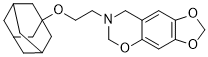
R243 (R-243) is a novel and potent inhibitor of CCR8 signaling with antinociceptive and anti-inflammatory activity. It inhibits CCR8 signaling and chemotaxis, inhibits CCL1-induced Ca2+ flux and CCL1-driven peritoneal macrophages aggregation. It also reduced secretion of cytokines such as TNF-α, IL-6, and most strikingly IL-10 from WT PMφ (peritoneal macrophages), but not BMMφ (bone marrow-derived macrophages).
Physicochemical Properties
| Molecular Formula | C21H27NO4 |
| Molecular Weight | 357.443386316299 |
| Exact Mass | 357.194 |
| Elemental Analysis | C, 70.56; H, 7.61; N, 3.92; O, 17.90 |
| CAS # | 688352-84-3 |
| PubChem CID | 2962888 |
| Appearance | White to off-white solid powder |
| LogP | 3.9 |
| Hydrogen Bond Donor Count | 0 |
| Hydrogen Bond Acceptor Count | 5 |
| Rotatable Bond Count | 4 |
| Heavy Atom Count | 26 |
| Complexity | 499 |
| Defined Atom Stereocenter Count | 0 |
| InChi Key | JJMLDSFDOODCIR-UHFFFAOYSA-N |
| InChi Code | InChI=1S/C21H27NO4/c1(2-26-21-8-14-3-15(9-21)5-16(4-14)10-21)22-11-17-6-19-20(25-13-24-19)7-18(17)23-12-22/h6-7,14-16H,1-5,8-13H2 |
| Chemical Name | 7,8-Dihydro-7-[2-(tricyclo[3.3.1.1(3,7)]dec-1-yloxy)ethyl]-6H-1,3-dioxolo[4,5-g][1,3]benzoxazine |
| Synonyms | R-243 R243 R 243 |
| HS Tariff Code | 2934.99.9001 |
| Storage |
Powder-20°C 3 years 4°C 2 years In solvent -80°C 6 months -20°C 1 month |
| Shipping Condition | Room temperature (This product is stable at ambient temperature for a few days during ordinary shipping and time spent in Customs) |
Biological Activity
| ln Vitro | CCL1-induced Ca2+ flow and CCL1-driven peritoneal macrophage accumulation are antagonistic to CCR8 in R243 [1]. R243 reduces the amount of TNF-α, IL-6, and IL-10 that wild-type peritoneal macrophages (WT PMφ) secrete [1]. After lipopolysaccharide (LPS) treatment, R243-treated WT PMφ demonstrated reduction of NF-κB signaling and c-jun N-terminal kinase activity compared to WT PMφ [1]. |
| ln Vivo | R243 (0.1-1 mg/kg; intraperitoneal injection; once; male Swiss mice) therapy decreased CCL1-induced analgesia in a dose-dependent manner [2]. |
| Animal Protocol |
Animal/Disease Models: Male Swiss mice (7-9 weeks old) were injected with CCL1[2] Doses: 0.1 mg/kg, 0.3mg/kg, 1 mg/kg Route of Administration: intraperitoneal (ip) injection; Experimental Results:CCL1 (10 μg/kg ; 1 h; sc)-induced analgesia was dose-dependently inhibited. |
| References |
[1]. Chemokine Receptor CCR8 Is Required for Lipopolysaccharide-Triggered Cytokine Production in Mouse Peritoneal Macrophages. PLoS One. 2014 Apr 8;9(4):e94445. [2]. The Systemic Administration of the Chemokine CCL1 Evokes Thermal Analgesia in Mice Through the Activation of the Endocannabinoid System. Cell Mol Neurobiol. 2019 Nov;39(8):1115-1124. |
Solubility Data
| Solubility (In Vitro) | DMSO : ~125 mg/mL (~349.71 mM) |
| Solubility (In Vivo) |
Solubility in Formulation 1: ≥ 2.08 mg/mL (5.82 mM) (saturation unknown) in 10% DMSO + 90% (20% SBE-β-CD in Saline) (add these co-solvents sequentially from left to right, and one by one), clear solution. For example, if 1 mL of working solution is to be prepared, you can add 100 μL of 20.8 mg/mL clear DMSO stock solution to 900 μL of 20% SBE-β-CD physiological saline solution and mix evenly. Preparation of 20% SBE-β-CD in Saline (4°C,1 week): Dissolve 2 g SBE-β-CD in 10 mL saline to obtain a clear solution. Solubility in Formulation 2: ≥ 2.08 mg/mL (5.82 mM) (saturation unknown) in 10% DMSO + 90% Corn Oil (add these co-solvents sequentially from left to right, and one by one), clear solution. For example, if 1 mL of working solution is to be prepared, you can add 100 μL of 20.8 mg/mL clear DMSO stock solution to 900 μL of corn oil and mix evenly. (Please use freshly prepared in vivo formulations for optimal results.) |
| Preparing Stock Solutions | 1 mg | 5 mg | 10 mg | |
| 1 mM | 2.7977 mL | 13.9884 mL | 27.9767 mL | |
| 5 mM | 0.5595 mL | 2.7977 mL | 5.5953 mL | |
| 10 mM | 0.2798 mL | 1.3988 mL | 2.7977 mL |