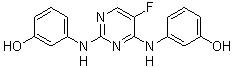
R112 is a novel, potent and ATP-competitive inhibitor of Syk kinase with a Ki of 96 nM. R112 prevented degranulation brought on by allergen (dust mite) in basophils (histamine release, EC(50) = 490 nmol/L), anti-IgE cross-linking in mast cells (tryptase release, effective concentration for 50% inhibition [EC(50)] = 353 nmol/L), or both. R112 also inhibited the production of leukotriene C4 and every proinflammatory cytokine that was examined. R112 was found to be an ATP-competitive spleen tyrosine kinase (Syk) inhibitor by subsequent molecular characterization (inhibitory constant [K(i)] = 96 nmol/L). It had a rapid onset of action and reversible inhibition. Mast cells incubated with R112 demonstrated that prolonged activation of the FcvarepsilonRI-Lyn-spleen tyrosine kinase pathway was necessary for mast cell cytokine production. R112 was able to totally inhibit the three IgE-induced mast cell functions of degranulation, lipid mediator production, and cytokine production, in contrast to other mast cell inhibitors. IgE receptor cross-linking-induced mast cell activation cascades were all potently, totally, and quickly abrogated by R112. R112 and its derivatives present a novel approach to the management of allergic rhinorrhea.
Physicochemical Properties
| Molecular Formula | C16H13FN4O2 |
| Molecular Weight | 312.2984 |
| Exact Mass | 312.102 |
| Elemental Analysis | C, 61.53; H, 4.20; F, 6.08; N, 17.94; O, 10.25 |
| CAS # | 575474-82-7 |
| Related CAS # | 575474-82-7 |
| PubChem CID | 9904854 |
| Appearance | White to off white solid powder |
| LogP | 3.009 |
| Hydrogen Bond Donor Count | 4 |
| Hydrogen Bond Acceptor Count | 7 |
| Rotatable Bond Count | 4 |
| Heavy Atom Count | 23 |
| Complexity | 376 |
| Defined Atom Stereocenter Count | 0 |
| SMILES | FC1=C([H])N=C(N=C1N([H])C1C([H])=C([H])C([H])=C(C=1[H])O[H])N([H])C1C([H])=C([H])C([H])=C(C=1[H])O[H] |
| InChi Key | TVKGTSHBQZEFEE-UHFFFAOYSA-N |
| InChi Code | InChI=1S/C16H13FN4O2/c17-14-9-18-16(20-11-4-2-6-13(23)8-11)21-15(14)19-10-3-1-5-12(22)7-10/h1-9,22-23H,(H2,18,19,20,21) |
| Chemical Name | 3-[[5-fluoro-2-(3-hydroxyanilino)pyrimidin-4-yl]amino]phenol |
| Synonyms | R 112; R112; R112 |
| HS Tariff Code | 2934.99.9001 |
| Storage |
Powder-20°C 3 years 4°C 2 years In solvent -80°C 6 months -20°C 1 month |
| Shipping Condition | Room temperature (This product is stable at ambient temperature for a few days during ordinary shipping and time spent in Customs) |
Biological Activity
| Targets | Syk (Ki = 96 nM); c-Met (IC50 = 32 nM) |
| ln Vitro |
R112 (0.001-10 μM; 1 h) prevents the release of histamine and anti-IgE-mediated tryptase with EC50s of 0.353 and 0.28 μM, the release of histamine when basophils are stimulated with an EC50 value of 0.49 μM, and the release of LTC4, TNF-α, GM-CSF, and IL-8 with EC50s of 0.115, 2.01, 1.58, and 1.75 μM, respectively[1]. R112 (0-10 μM; 40 min) reduces the phosphorylation of the Syk target LAT (Y191)[1]. |
| Cell Assay |
Cell Line: Human mast cells Concentration: 0.4, 2 and 10 μM Incubation Time: 40 min Result: Inhibited phosphorylation of the Syk target LAT (Y191) and also inhibited phosphorylation of Syk downstream events. |
| References |
[1]. Identification of the Syk kinase inhibitor R112 by a human mast cell screen. J Allergy Clin Immunol. 2006 Sep;118(3):749-755. |
Solubility Data
| Solubility (In Vitro) | DMSO: 55~62 mg/mL (176.1~198.5 mM) |
| Solubility (In Vivo) |
Solubility in Formulation 1: ≥ 2.75 mg/mL (8.81 mM) (saturation unknown) in 10% DMSO + 40% PEG300 + 5% Tween80 + 45% Saline (add these co-solvents sequentially from left to right, and one by one), clear solution. For example, if 1 mL of working solution is to be prepared, you can add 100 μL of 27.5 mg/mL clear DMSO stock solution to 400 μL PEG300 and mix evenly; then add 50 μL Tween-80 to the above solution and mix evenly; then add 450 μL normal saline to adjust the volume to 1 mL. Preparation of saline: Dissolve 0.9 g of sodium chloride in 100 mL ddH₂ O to obtain a clear solution. Solubility in Formulation 2: ≥ 2.75 mg/mL (8.81 mM) (saturation unknown) in 10% DMSO + 90% (20% SBE-β-CD in Saline) (add these co-solvents sequentially from left to right, and one by one), clear solution. For example, if 1 mL of working solution is to be prepared, you can add 100 μL of 27.5 mg/mL clear DMSO stock solution to 900 μL of 20% SBE-β-CD physiological saline solution and mix evenly. Preparation of 20% SBE-β-CD in Saline (4°C,1 week): Dissolve 2 g SBE-β-CD in 10 mL saline to obtain a clear solution. Solubility in Formulation 3: ≥ 2.75 mg/mL (8.81 mM) (saturation unknown) in 10% DMSO + 90% Corn Oil (add these co-solvents sequentially from left to right, and one by one), clear solution. For example, if 1 mL of working solution is to be prepared, you can add 100 μL of 27.5 mg/mL clear DMSO stock solution to 900 μL of corn oil and mix evenly. (Please use freshly prepared in vivo formulations for optimal results.) |
| Preparing Stock Solutions | 1 mg | 5 mg | 10 mg | |
| 1 mM | 3.2020 mL | 16.0102 mL | 32.0205 mL | |
| 5 mM | 0.6404 mL | 3.2020 mL | 6.4041 mL | |
| 10 mM | 0.3202 mL | 1.6010 mL | 3.2020 mL |