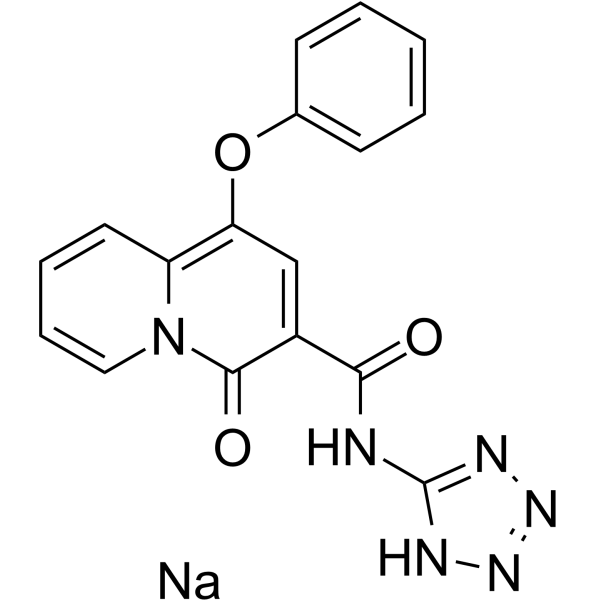
Physicochemical Properties
| Molecular Formula | C17H11N6NAO3 |
| Molecular Weight | 370.297413110733 |
| Exact Mass | 371.087 |
| CAS # | 101193-62-8 |
| PubChem CID | 14600474 |
| Appearance | Light yellow to yellow solid powder |
| LogP | 1.93 |
| Hydrogen Bond Donor Count | 1 |
| Hydrogen Bond Acceptor Count | 7 |
| Rotatable Bond Count | 4 |
| Heavy Atom Count | 27 |
| Complexity | 726 |
| Defined Atom Stereocenter Count | 0 |
| InChi Key | CDPWRMHFRRXOQH-UHFFFAOYSA-M |
| InChi Code | InChI=1S/C17H12N6O3.Na/c24-15(18-17-19-21-22-20-17)12-10-14(26-11-6-2-1-3-7-11)13-8-4-5-9-23(13)16(12)25;/h1-10H,(H2,18,19,20,21,22,24);/q;+1/p-1 |
| Chemical Name | sodium;4-oxo-1-phenoxy-N-(1,2,3-triaza-4-azanidacyclopenta-2,5-dien-5-yl)quinolizine-3-carboxamide |
| HS Tariff Code | 2934.99.9001 |
| Storage |
Powder-20°C 3 years 4°C 2 years In solvent -80°C 6 months -20°C 1 month Note: Please store this product in a sealed and protected environment, avoid exposure to moisture. |
| Shipping Condition | Room temperature (This product is stable at ambient temperature for a few days during ordinary shipping and time spent in Customs) |
Biological Activity
| ln Vitro | In dispersed human lung cells, quinotolast inhibits the release of histamine as well as the production of prostaglandin D2 and leukotriene (LT) C4. Quinotolast (100 μg/mL) markedly reduced PGD2 and LTC4 release. Quinotolast inhibits PGD2 release by 100% and LTC4 release by 54%. The inhibitory effect of quinotolast on histamine release from dispersed lung cells was largely independent of the preincubation period, and no tachyphylaxis was observed. Quinotolast has a significant inhibitory effect on inflammatory mediators in human dispersed lung cells [1]. Quinotolast also showed strong inhibitory effects on histamine and the peptide leukotrienes released from guinea pig lung fragments or mouse cultured mast cells. Quinotolast concentration-dependently inhibits pLT release from cultured mast cells. The IC50 value of Quinotolast is 0.72 μg/mL[2]. |
| ln Vivo | Quinotolast can effectively suppress type I allergic reactions, including allergic bronchoconstriction and passive cutaneous anaphylaxis (PCA), in rats when administered intravenously and orally. When given intravenously to rats, quinotolast inhibits PCA in a dose-dependent manner. 0.0063 mg/kg of quinolast is the dose needed to suppress the response by 50% (ED50). When taken orally, quinotolast suppresses this reaction. Quinlilast's ED50 value is 0.0081 mg/kg. At a dose of 0.32 mg/kg, Quinotolast almost completely inhibited, but at a dose of 1 mg/kg, its effect was somewhat diminished [2]. |
| References |
[1]. Inhibition of histamine and eicosanoid release from dispersed human lung cells in vitro byquinotolast. Jpn J Pharmacol. 1995 Dec;69(4):375-80. [2]. Effects of quinotolast, a new orally active antiallergic drug, on experimental allergic models. Jpn J Pharmacol. 1993 Sep;63(1):73-81. |
Solubility Data
| Solubility (In Vitro) | DMSO : ~115 mg/mL (~309.71 mM) |
| Solubility (In Vivo) |
Solubility in Formulation 1: 5.75 mg/mL (15.49 mM) in 10% DMSO + 40% PEG300 + 5% Tween80 + 45% Saline (add these co-solvents sequentially from left to right, and one by one), suspension solution; with sonication. For example, if 1 mL of working solution is to be prepared, you can add 100 μL of 57.5 mg/mL clear DMSO stock solution to 400 μL PEG300 and mix evenly; then add 50 μL Tween-80 to the above solution and mix evenly; then add 450 μL normal saline to adjust the volume to 1 mL. Preparation of saline: Dissolve 0.9 g of sodium chloride in 100 mL ddH₂ O to obtain a clear solution. Solubility in Formulation 2: 5.75 mg/mL (15.49 mM) in 10% DMSO + 90% (20% SBE-β-CD in Saline) (add these co-solvents sequentially from left to right, and one by one), suspension solution; with ultrasonication. For example, if 1 mL of working solution is to be prepared, you can add 100 μL of 57.5 mg/mL clear DMSO stock solution to 900 μL of 20% SBE-β-CD physiological saline solution and mix evenly. Preparation of 20% SBE-β-CD in Saline (4°C,1 week): Dissolve 2 g SBE-β-CD in 10 mL saline to obtain a clear solution. (Please use freshly prepared in vivo formulations for optimal results.) |
| Preparing Stock Solutions | 1 mg | 5 mg | 10 mg | |
| 1 mM | 2.7005 mL | 13.5026 mL | 27.0051 mL | |
| 5 mM | 0.5401 mL | 2.7005 mL | 5.4010 mL | |
| 10 mM | 0.2701 mL | 1.3503 mL | 2.7005 mL |