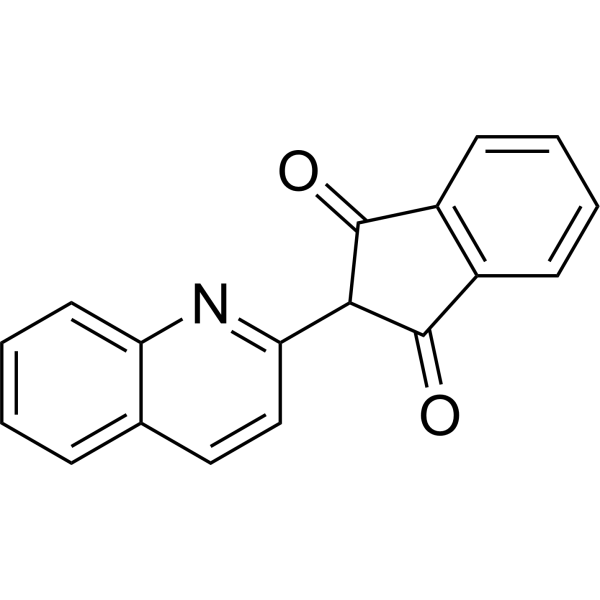
Physicochemical Properties
| Molecular Formula | C18H11NO2 |
| Molecular Weight | 273.29 |
| Exact Mass | 273.079 |
| CAS # | 83-08-9 |
| PubChem CID | 6731 |
| Appearance |
Bright greenish yellow Yellow brown in concentrated H2SO4, yellow flocculent precipitate in dilution Yellow-gold powder |
| Density | 1.345 g/cm3 |
| Boiling Point | 514.5ºC at 760 mmHg |
| Melting Point |
320 °F (Sublimes) (NTP, 1992) 241 °C |
| Flash Point | 260ºC |
| LogP | 3.397 |
| Hydrogen Bond Donor Count | 0 |
| Hydrogen Bond Acceptor Count | 3 |
| Rotatable Bond Count | 1 |
| Heavy Atom Count | 21 |
| Complexity | 423 |
| Defined Atom Stereocenter Count | 0 |
| InChi Key | IZMJMCDDWKSTTK-UHFFFAOYSA-N |
| InChi Code | InChI=1S/C18H11NO2/c20-17-12-6-2-3-7-13(12)18(21)16(17)15-10-9-11-5-1-4-8-14(11)19-15/h1-10,16H |
| Chemical Name | 2-quinolin-2-ylindene-1,3-dione |
| HS Tariff Code | 2934.99.9001 |
| Storage |
Powder-20°C 3 years 4°C 2 years In solvent -80°C 6 months -20°C 1 month |
| Shipping Condition | Room temperature (This product is stable at ambient temperature for a few days during ordinary shipping and time spent in Customs) |
Biological Activity
| ADME/Pharmacokinetics |
Absorption, Distribution and Excretion /Investigators/ observed external color changes in Fischer 344 albino rats administered a single dose of 5,000 mg/kg of Solvent Yellow 33 or Solvent Yellow 33/Solvent Green 3 mixture by gavage. The color changes, which first appeared on day 2 after dosing, were observed throughout a 14-day observation period. The males were light green and the females were yellow. In the absence of vomiting, this observation indicates that the dyes may be excreted through the skin. /Investigators/ exposed male F344/N rats to (14)C-solvent yellow aerosols (160 nmol solvent yellow/liter air) or a mixture of (14)C-solvent yellow and unlabeled solvent green (340 nmol solvent yellow and 370 nmol solvent green/liter air) for 60 min. After either exposure, solvent yellow was rapidly cleared from the respiratory tract, with a t1/2 of 2-3 hr. Solvent green was retained in the lungs with a minimum estimated t1/2 for clearance of 22 days. Solvent green was not detected in other tissues during the 70-hr post-exposure period. After either exposure, high-pressure liquid chromatography analysis of tissues extracts indicated that 40 to 75% of the (14)C in liver and kidney consisted of solvent yellow metabolites. Greater than 90% of the (14)C in the lungs was unmetabolized solvent yellow. The major pathway for excretion of solvent yellow and solvent yellow metabolites was the feces (74% of the initial body burden) ... Urinary (14)C accounted for 14% of the initial body burden ... Over 90% of the (14)C excreted in the urine was solvent yellow metabolites. Very little solvent yellow (2%) was metabolized to (14)CO2. By 72 hr after exposure, only 10% of the initial (14)C deposited remained in the body. The disposition of 2-(2-quinolyl)-1,3-indandione (D. C. yellow #11, DCY) in male Fischer rats dosed intravenously or by feeding was determined. For rats given (14)C-DCY in the feed (0.00044-0.41% of the diet), recovery of radioactivity during the 24-hr dosing period and the 72-hr period thereafter ranged from 89.1 to 93.9% for feces and from 4.98 to 6.25 for urine. Tissues contained only trace amounts. Following intravenous dosing with (14)C-DCY (0.93 mg/kg), radioactivity distributed readily into most tissues; maximum amounts were present at 5 min, the earliest time of assay. Maximum amounts of radioactivity in fat, skin, and gut tissue, however, were present at 30 min after dosing. These three tissues also had relatively long alpha phases for the elimination of radioactivity. In 24 hr after intravenous dosing, rats excreted 81.1% of the dose in the feces and 16.0% of the dose in the urine. For rats fitted with biliary cannulas, 54.5% of the dose, all of which was metabolites of (14)C-DCY, was recovered in the bile in 4 hr. Associated with the rapid and extensive biliary excretion of metabolites of intravenously administered (14)C-DCY was the appearance of large amounts of radioactivity in the feces and also, at intermediate time points, in the liver, gut contents, and gut tissue. In conclusion, rats rapidly distribute, metabolize, and excrete (14)C-DCY. Solvent Yellow 33 is also rapidly absorbed from the lung after repeated exposures; less than 0.2 percent of the quantity deposited after each exposure is retained (i.e., 99.8 percent is absorbed within 16 hr). Metabolism / Metabolites Only 13 and 40 percent of the products excreted in urine and feces, respectively, are umetabolized Solvent Yellow 33. Therefore, a large fraction of the dye is metabolized, probably in the liver and kidney. Biological Half-Life /Investigators/ exposed male F344/N rats to (14)C-solvent yellow aerosols (160 nmol solvent yellow/liter air) or a mixture of (14)C-solvent yellow and unlabeled solvent green (340 nmol solvent yellow and 370 nmol solvent green/liter air) for 60 min. ... The major pathway for excretion of solvent yellow and solvent yellow metabolites was the feces (74% of the initial body burden); the t1/2 for excretion was 14 hr. Urinary (14)C accounted for 14% of the initial body burden and the t1/2 for excretion was 10 hr. ... |
| Toxicity/Toxicokinetics |
Non-Human Toxicity Values LD50 Dog oral >1 g/kg LD50 Rat oral >5 g/kg LD50 Mouse intravenous 36 mg/kg |
| References |
[1]. A review on experimental chemically modified activated carbon to enhance dye and heavy metals adsorption[J]. Cleaner engineering and technology, 2022, 6: 100382. |
| Additional Infomation |
D & c yellow 11 appears as bright greenish yellow solid or canary yellow powder. (NTP, 1992) Quinoline yellow is a quinoline derivative with a 1,3-dioxoindan-2-yl substituent at C-2. It has a role as a dye. It is a member of quinolines, a beta-diketone and an aromatic ketone. See also: D&C Yellow No. 10 (annotation moved to). |
Solubility Data
| Solubility (In Vitro) | May dissolve in DMSO (in most cases), if not, try other solvents such as H2O, Ethanol, or DMF with a minute amount of products to avoid loss of samples |
| Solubility (In Vivo) |
Note: Listed below are some common formulations that may be used to formulate products with low water solubility (e.g. < 1 mg/mL), you may test these formulations using a minute amount of products to avoid loss of samples. Injection Formulations (e.g. IP/IV/IM/SC) Injection Formulation 1: DMSO : Tween 80: Saline = 10 : 5 : 85 (i.e. 100 μL DMSO stock solution → 50 μL Tween 80 → 850 μL Saline) *Preparation of saline: Dissolve 0.9 g of sodium chloride in 100 mL ddH ₂ O to obtain a clear solution. Injection Formulation 2: DMSO : PEG300 :Tween 80 : Saline = 10 : 40 : 5 : 45 (i.e. 100 μL DMSO → 400 μLPEG300 → 50 μL Tween 80 → 450 μL Saline) Injection Formulation 3: DMSO : Corn oil = 10 : 90 (i.e. 100 μL DMSO → 900 μL Corn oil) Example: Take the Injection Formulation 3 (DMSO : Corn oil = 10 : 90) as an example, if 1 mL of 2.5 mg/mL working solution is to be prepared, you can take 100 μL 25 mg/mL DMSO stock solution and add to 900 μL corn oil, mix well to obtain a clear or suspension solution (2.5 mg/mL, ready for use in animals). Injection Formulation 4: DMSO : 20% SBE-β-CD in saline = 10 : 90 [i.e. 100 μL DMSO → 900 μL (20% SBE-β-CD in saline)] *Preparation of 20% SBE-β-CD in Saline (4°C,1 week): Dissolve 2 g SBE-β-CD in 10 mL saline to obtain a clear solution. Injection Formulation 5: 2-Hydroxypropyl-β-cyclodextrin : Saline = 50 : 50 (i.e. 500 μL 2-Hydroxypropyl-β-cyclodextrin → 500 μL Saline) Injection Formulation 6: DMSO : PEG300 : castor oil : Saline = 5 : 10 : 20 : 65 (i.e. 50 μL DMSO → 100 μLPEG300 → 200 μL castor oil → 650 μL Saline) Injection Formulation 7: Ethanol : Cremophor : Saline = 10: 10 : 80 (i.e. 100 μL Ethanol → 100 μL Cremophor → 800 μL Saline) Injection Formulation 8: Dissolve in Cremophor/Ethanol (50 : 50), then diluted by Saline Injection Formulation 9: EtOH : Corn oil = 10 : 90 (i.e. 100 μL EtOH → 900 μL Corn oil) Injection Formulation 10: EtOH : PEG300:Tween 80 : Saline = 10 : 40 : 5 : 45 (i.e. 100 μL EtOH → 400 μLPEG300 → 50 μL Tween 80 → 450 μL Saline) Oral Formulations Oral Formulation 1: Suspend in 0.5% CMC Na (carboxymethylcellulose sodium) Oral Formulation 2: Suspend in 0.5% Carboxymethyl cellulose Example: Take the Oral Formulation 1 (Suspend in 0.5% CMC Na) as an example, if 100 mL of 2.5 mg/mL working solution is to be prepared, you can first prepare 0.5% CMC Na solution by measuring 0.5 g CMC Na and dissolve it in 100 mL ddH2O to obtain a clear solution; then add 250 mg of the product to 100 mL 0.5% CMC Na solution, to make the suspension solution (2.5 mg/mL, ready for use in animals). Oral Formulation 3: Dissolved in PEG400 Oral Formulation 4: Suspend in 0.2% Carboxymethyl cellulose Oral Formulation 5: Dissolve in 0.25% Tween 80 and 0.5% Carboxymethyl cellulose Oral Formulation 6: Mixing with food powders Note: Please be aware that the above formulations are for reference only. InvivoChem strongly recommends customers to read literature methods/protocols carefully before determining which formulation you should use for in vivo studies, as different compounds have different solubility properties and have to be formulated differently. (Please use freshly prepared in vivo formulations for optimal results.) |
| Preparing Stock Solutions | 1 mg | 5 mg | 10 mg | |
| 1 mM | 3.6591 mL | 18.2956 mL | 36.5912 mL | |
| 5 mM | 0.7318 mL | 3.6591 mL | 7.3182 mL | |
| 10 mM | 0.3659 mL | 1.8296 mL | 3.6591 mL |