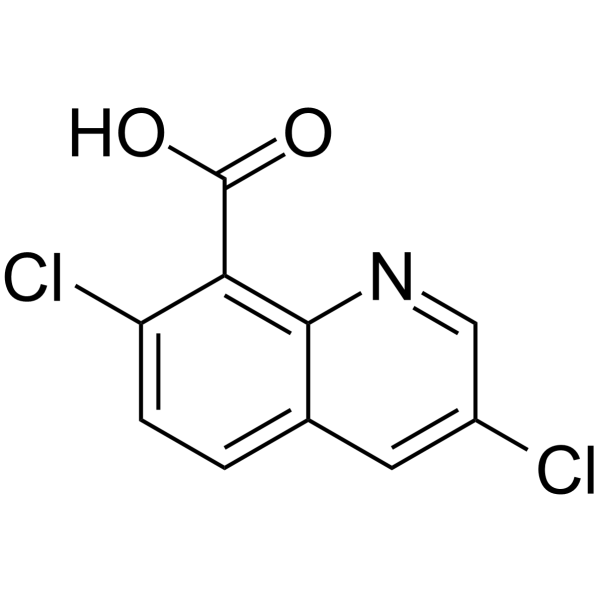
Physicochemical Properties
| Molecular Formula | C10H5CL2NO2 |
| Molecular Weight | 242.06 |
| Exact Mass | 240.969 |
| CAS # | 84087-01-4 |
| PubChem CID | 91739 |
| Appearance |
White/yellow solid Colorless crystalline solid |
| Density | 1.6±0.1 g/cm3 |
| Boiling Point | 405.4±40.0 °C at 760 mmHg |
| Melting Point | 274ºC |
| Flash Point | 199.0±27.3 °C |
| Vapour Pressure | 0.0±1.0 mmHg at 25°C |
| Index of Refraction | 1.695 |
| LogP | 2.11 |
| Hydrogen Bond Donor Count | 1 |
| Hydrogen Bond Acceptor Count | 3 |
| Rotatable Bond Count | 1 |
| Heavy Atom Count | 15 |
| Complexity | 262 |
| Defined Atom Stereocenter Count | 0 |
| SMILES | O=C(C1C2C(=CC(=CN=2)Cl)C=CC=1Cl)O |
| InChi Key | FFSSWMQPCJRCRV-UHFFFAOYSA-N |
| InChi Code | InChI=1S/C10H5Cl2NO2/c11-6-3-5-1-2-7(12)8(10(14)15)9(5)13-4-6/h1-4H,(H,14,15) |
| Chemical Name | 3,7-dichloroquinoline-8-carboxylic acid |
| HS Tariff Code | 2934.99.9001 |
| Storage |
Powder-20°C 3 years 4°C 2 years In solvent -80°C 6 months -20°C 1 month |
| Shipping Condition | Room temperature (This product is stable at ambient temperature for a few days during ordinary shipping and time spent in Customs) |
Biological Activity
| ADME/Pharmacokinetics |
Absorption, Distribution and Excretion The extent of oral absorption was high (> 90%), based on urinary and biliary data, with most of the biliary component reabsorbed and excreted in urine. The biliary component increased disproportionately with increasing dose from 15 to 600 mg/kg bw. Absorption of radiolabel was rapid, with maximal blood concentrations achieved between 0.25 and 1 hour for single doses of 600 mg/kg bw and below. Quinclorac was widely distributed in the body, with highest concentrations present in the blood, plasma and kidneys. Tissue levels were generally higher (< 2-fold) in females than in males. The labelled material was rapidly excreted, primarily via urine (50-90% in 24 hours). Initial plasma half-lives were calculated to be approximately 3-4 hours. Clearance from the blood was slower following repeated dosing with 600 mg/kg bw and with single doses of 1200 mg/kg bw, resulting in non-proportionate increases in the area under the concentration-time curve (AUC). The excretion pattern and tissue distribution of radioactivity were similar across administered dose levels and when the administration of radiolabelled quinclorac was preceded by 7 or 14 days of administration of the labelled or unlabelled material. The metabolism of quinclorac ((2,3,4-(14)C)3,7-dichloro-8-quinolinecarboxylic acid) following oral administration was studied extensively in male and female CD rat. The compound was rapidly absorbed and eliminated in the urine following administration of single oral doses of (14)C quinclorac at 15 or 600 mg/kg and at 15 mg/kg after the animals were dosed with unlabeled quinclorac at 15 mg/kg/day for 14 days. Elimination in the urine 5 days after dosing accounted for 91 to 98% of the dose with only 1 to 4% eliminated in the feces. No radioactivity was detected in expired air. Biliary excretion was significant (11.5 to 14.5% of the dose) in animals receiving 600 mg/kg. However, most of this radioactivity was reabsorbed from the intestines and eliminated in the urine. Most of the radioactivity in the bile is associated with the glucuronide conjugate of quinclorac. The conjugate is apparently hydrolyzed in the intestines and reabsorbed. Almost all the radioactivity in the urine is unchanged quinclorac. Radioactive tissue residue levels 5 days after dosing were dose-dependent. Results from these and other (whole-body autoradiography and time-course) studies indicate that quinclorac may accumulate in the adrenal glands, bone marrow, thyroid, squamous epithelium of the non-fundic stomach, and ovaries. In 7-day time-course studies (oral gavage at 15 mg/kg/day or dietary at about 1,000 mg/kg/day) maximum (14)C residue levels were detected 30 minutes after the final dose; thereafter, residue levels decreased with time. Mean (14)C residues in plasma were also detected at 30 minutes in animals receiving single oral doses of 15, 100, or 600 mg/kg or 15 mg/kg/day for 7 days. Elimination was biphasic with half-lives of 3 to 4 hours for the rapid phase at the low doses and a half-life of about 13 hours at 600 mg/kg. Peak plasma levels of radioactivity in animals receiving higher doses (1200 mg/kg or 600 mg/kg/day for 7 days) were noted for 7 to 48 hours postdosing: saturation kinetics were also noted at these higher doses. Metabolism / Metabolites Samples ... extracted and analyzed for the presence of metabolites using techniques including thin-layer chromatography and mass spectroscopy. Absorbed quinclorac was metabolized to only a limited extent, with unchanged parent compound representing approximately 80% of the excreted radiolabel. The major biotransformation product was quinclorac-glucuronide conjugate, representing approximately 5% of the administered dose. The pattern of metabolism was similar across sexes, dose levels and administration of repeated doses. A number of metabolites each representing less than 5% of the administered dose were not identified. The metabolism of quinclorac is so limited that a metabolic pathway is considered unnecessary. Biological Half-Life In 7-day time-course studies (oral gavage at 15 mg/kg/day or dietary at about 1,000 mg/kg/day) maximum (14)C residue levels were detected 30 minutes after the final dose; thereafter, residue levels decreased with time. ... Elimination was biphasic with half-lives of 3 to 4 hours for the rapid phase at the low doses and a half-life of about 13 hours at 600 mg/kg. ... |
| References | [1]. Cavalheiro de Menezes C, et al. The effects of diphenyl diselenide on oxidative stress biomarkers in Cyprinus carpio exposed to herbicide quinclorac (Facet®). Ecotoxicol Environ Saf. 2012;81:91-97. |
| Additional Infomation |
Quinclorac is a quinolinemonocarboxylic acid that is quinoline-8-carboxylic acid in which the hydrogens at positions 3 and 7 have been replaced by chlorines. It is used (particularly as its dimethylamine salt, known as quinclorac-dimethylammonium) as a (rather persistent) herbicide for the post-emergence control of weeds in rice, grass and turf. It is not approved for use within the European Union. It has a role as a herbicide, an agrochemical and a synthetic auxin. It is a quinolinemonocarboxylic acid, an organochlorine compound and a monocarboxylic acid. It is a conjugate acid of a quinclorac(1-). Quinclorac is a selective herbicide used primarily to control weeds in rice crops, but is also used on other agricultural crops and is found in some household herbicides for lawn use. |
Solubility Data
| Solubility (In Vitro) | DMSO: 125 mg/mL (516.40 mM) |
| Solubility (In Vivo) |
Note: Listed below are some common formulations that may be used to formulate products with low water solubility (e.g. < 1 mg/mL), you may test these formulations using a minute amount of products to avoid loss of samples. Injection Formulations (e.g. IP/IV/IM/SC) Injection Formulation 1: DMSO : Tween 80: Saline = 10 : 5 : 85 (i.e. 100 μL DMSO stock solution → 50 μL Tween 80 → 850 μL Saline) *Preparation of saline: Dissolve 0.9 g of sodium chloride in 100 mL ddH ₂ O to obtain a clear solution. Injection Formulation 2: DMSO : PEG300 :Tween 80 : Saline = 10 : 40 : 5 : 45 (i.e. 100 μL DMSO → 400 μLPEG300 → 50 μL Tween 80 → 450 μL Saline) Injection Formulation 3: DMSO : Corn oil = 10 : 90 (i.e. 100 μL DMSO → 900 μL Corn oil) Example: Take the Injection Formulation 3 (DMSO : Corn oil = 10 : 90) as an example, if 1 mL of 2.5 mg/mL working solution is to be prepared, you can take 100 μL 25 mg/mL DMSO stock solution and add to 900 μL corn oil, mix well to obtain a clear or suspension solution (2.5 mg/mL, ready for use in animals). Injection Formulation 4: DMSO : 20% SBE-β-CD in saline = 10 : 90 [i.e. 100 μL DMSO → 900 μL (20% SBE-β-CD in saline)] *Preparation of 20% SBE-β-CD in Saline (4°C,1 week): Dissolve 2 g SBE-β-CD in 10 mL saline to obtain a clear solution. Injection Formulation 5: 2-Hydroxypropyl-β-cyclodextrin : Saline = 50 : 50 (i.e. 500 μL 2-Hydroxypropyl-β-cyclodextrin → 500 μL Saline) Injection Formulation 6: DMSO : PEG300 : castor oil : Saline = 5 : 10 : 20 : 65 (i.e. 50 μL DMSO → 100 μLPEG300 → 200 μL castor oil → 650 μL Saline) Injection Formulation 7: Ethanol : Cremophor : Saline = 10: 10 : 80 (i.e. 100 μL Ethanol → 100 μL Cremophor → 800 μL Saline) Injection Formulation 8: Dissolve in Cremophor/Ethanol (50 : 50), then diluted by Saline Injection Formulation 9: EtOH : Corn oil = 10 : 90 (i.e. 100 μL EtOH → 900 μL Corn oil) Injection Formulation 10: EtOH : PEG300:Tween 80 : Saline = 10 : 40 : 5 : 45 (i.e. 100 μL EtOH → 400 μLPEG300 → 50 μL Tween 80 → 450 μL Saline) Oral Formulations Oral Formulation 1: Suspend in 0.5% CMC Na (carboxymethylcellulose sodium) Oral Formulation 2: Suspend in 0.5% Carboxymethyl cellulose Example: Take the Oral Formulation 1 (Suspend in 0.5% CMC Na) as an example, if 100 mL of 2.5 mg/mL working solution is to be prepared, you can first prepare 0.5% CMC Na solution by measuring 0.5 g CMC Na and dissolve it in 100 mL ddH2O to obtain a clear solution; then add 250 mg of the product to 100 mL 0.5% CMC Na solution, to make the suspension solution (2.5 mg/mL, ready for use in animals). Oral Formulation 3: Dissolved in PEG400 Oral Formulation 4: Suspend in 0.2% Carboxymethyl cellulose Oral Formulation 5: Dissolve in 0.25% Tween 80 and 0.5% Carboxymethyl cellulose Oral Formulation 6: Mixing with food powders Note: Please be aware that the above formulations are for reference only. InvivoChem strongly recommends customers to read literature methods/protocols carefully before determining which formulation you should use for in vivo studies, as different compounds have different solubility properties and have to be formulated differently. (Please use freshly prepared in vivo formulations for optimal results.) |
| Preparing Stock Solutions | 1 mg | 5 mg | 10 mg | |
| 1 mM | 4.1312 mL | 20.6560 mL | 41.3121 mL | |
| 5 mM | 0.8262 mL | 4.1312 mL | 8.2624 mL | |
| 10 mM | 0.4131 mL | 2.0656 mL | 4.1312 mL |